Archive for the ‘South-east Asia’ Category

Is Indonesia different?

August 2, 2013

Below is a critique of How Asia Works with specific reference to Indonesia. Indeed there is a second part of the critique that you can track down via the Lowy site. I am just posting the first part and, underneath it, rejoinders to the main points it makes.


Indonesia’s development formula

by Stephen Grenville – 25 July 2013 11:10AM

I share Sam Roggeveen’s enthusiasm for the iconoclastic approach of Joe Studwell’s How Asia Works (his previous book on Asian Godfathers was a great read too). I also share Studwell’s scepticism about the ‘magic of the market’, his views on the IMF, and his admiration for the achievements of the South Koreans.

But I’m unconvinced by Studwell’s three-step development prescription, not because it is intrinsically wrong but because it is too hard to implement successfully.

The Koreans might have done so, but the strategy requires a level of sustained administrative competence, single-minded toughness and luck which are rare. Just as important, there are alternative development strategies, less demanding of skilled policy-making and administrative competence. The growth outcome won’t match Korea’s, but will be more feasible for countries like Indonesia (which Studwell sees as a development failure).

Let’s go through the three elements of the Studwell strategy. The first stage requires land reform and a boost to agricultural productivity.

It’s an old and sensible idea that agriculture has to provide the investable surplus which will propel the rest of the economy along the path of development. Fifty years ago, Clifford Geertz (Agricultural Involution) despaired about Indonesia’s failure to follow the example of Japan, which shifted surplus agricultural labour into factory work to create a modern urban/manufacturing sector. This failure would lead the excess population to atrophy, farming progressively more Lilliputian plots.

But things turned out better. With the average size of farms on Java around half a hectare, the opportunity for land reform couldn’t play the key role that Studwell advocates. But Soeharto, with his roots in agriculture, gave rice production high priority (extension services, high-yield seeds, fertilizer, pesticides and attractive terms-of-trade between agriculture and urban consumers via an active price stabilisation authority). Not very free-market, but big yield increases and self-sufficiency were speedily achieved.

What about a vigorous industry policy, the second Studwell requirement? Despite inheriting the usual disaster story of failed prestige projects from Sukarno, Soeharto was ready to have a go at ‘picking winners’.

Cement, fertilizer, textiles, paper production, food processing and petroleum refining all fitted Indonesia’s comparative advantage and made sense. Others were less defensible: Krakatau Steel,Tommy Soeharto’s national car and Ibnu Sutowo’s tankers. Habibie‘s IPTN aeroplane fits the Studwell strategy and might have succeeded if it hadn’t been stopped by the Asian crisis: ex-aeronautical engineer Habibie was well-qualified to lead this project, plane construction is quite labour-intensive (all those rivets) and the Indonesian archipelago needs lots of them (one airline recently ordered several hundred in one hit).

Whether IPTN would have succeeded is not the issue here: the point is that Indonesia, for better or worse, did try the sort of hot-house industrialisation Studwell advocates, and the IMF wasn’t able to stop this, at least until the 1997 crisis. Planning retained a central role, just as Studwell wants, and state-owned enterprises did the government’s bidding. Where Indonesia had comparative advantage, this often worked out well, and where the industry didn’t suit Indonesia’s attributes, generally it was a failure.

Indonesia’s development experience doesn’t fit the Studwell formula. Java’s rice production has done well without relying on his key element of land reform, and industry policy based on domestic entrepreneurship has been tried without much success.

Governments attempting to steer the process of development need effective administrative capacity; in a follow-up post, I’ll expand on the idea that market failure is common enough, but so too is government failure.

Joe Studwell’s response:

1. I doubt, contra Mr Grenville, that there is some arbitrary minimum land holding that makes land reform unworkable. If this were the case, then the micro-plots of a few tens of square metres championed by groups like Landesa would make no sense, when historical evidence around the world shows that privately-held micro-plots produce very high yields.

I am presently up my hill in Italy, and using a very slow Internet connection, and so cannot readily check the average Javan landholding. I assume Mr Grenville means that the average Javan landholding is half a hectare now, and would therefore be less after land reform. (The average land holding in most parts of China, Japan, ROK, and Taiwan after land reform was roughly half a hectare.) If my understanding is correct, my response is that Java has some of the best soil and climate conditions in the whole of east Asia, and so even smaller plots should be more than viable — if indeed size matters at all in a downward direction, a question which I think deserves real scrutiny.

Mr Grenville is correct that yields on Java are high by south-east Asian standards. The rice yield is over five tonnes per hectare. However this is still less than the average in north-east Asia. Given its soil and climate, it would not surprise me if north-east Asian style household farming could produce as much as 9 tonnes per hectare on Java — about as high as has been managed anywhere, because the growing conditions are so favourable.

Mr Grenville is correct that Suharto invested heavily (if patchily) in agricultural extension services and (eventually) used minimum price guarantees to promote higher yields. However he is wrong to say that self-sufficiency was achieved ‘quickly’. Rice self-sufficiency was not achieved until the mid-1980s, 40 years after independence, and wheat self-sufficiency never was. So I maintain my position that Indonesia is a real relative failure in agriculture.

2. On industry, much of my criticism of policy in south-east Asia focuses on politicians’ efforts to ‘pick winners’ rather than run industrial policy that periodically culls losers. I also talk at length about the need for ‘export discipline’ to anchor industrial policy. And I avoid traditional discussions of what is or is not a society’s comparative advantage because, to my mind, development is about changing (within reason) your comparative advantage. Economic development is about investing in a learning process in order to reap higher future returns.

Mr Grenville’s points about industry in Indonesia therefore seem to me to be based on a misreading, or mere scanning, of How Asia Works. He highlights industrial projects that were picked as ‘winners’, were not subjected to sufficient competition or pressure to export, and which consequently produced a poor return on industrial policy investment. His observations are essentially supportive of the policy requisites I highlight.

The one thing I think is truly misplaced in Mr Grenville’s comments is the argument in the third paragraph that, essentially, Indonesians are politically and administratively ‘not up to’ the task of accelerated economic development, particularly compared to people like the Koreans. Is this true? In 1945, South Korea was the rural backwater of a brutally colonised state in which Koreans had been allowed to play perhaps the most restricted administrative and economic role in any east Asian colony. I cannot see that the Koreans had much political, administrative or educational capital. Elite Indonesians, by contrast, held senior civil service positions under the Dutch, could win scholarships to study in Europe, and had much greater (formal) political, administrative and educational resources. The difference was not the endowments, but the change politicians wrought over 60 years of independent government.

Why was the peasant Park Chung Hee able to achieve so much more than the superbly educated Sukarno? Probably, I think, because Park focused on the basics and got them right.
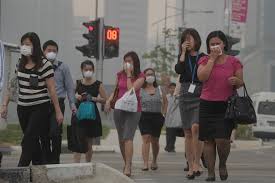
Singapore reaps what it sowed

June 22, 2013

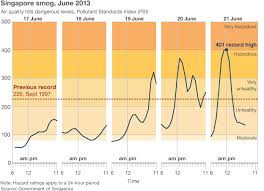
Sing smog 1 Sing smog 2


Sing smog 3


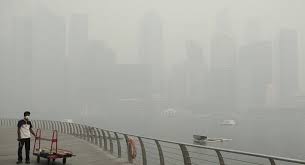
See the 22 April AFP story below about the life-threatening smog enveloping Singapore. It comes (largely) from deliberately set fires on and around oil palm plantations in Sumatra, fires illegally set to facilitate land clearance.

You need additional information to read the story properly. Here it is. The story identifies two firms as largely responsible for the fires:

1. APP (Asia Pulp & Paper). The tale is too long to tell in detail here. Look it up in Asian Godfathers. Controlled by the Widjaya family, who defaulted on US$14 billion of debt (no, that is not a typing error) during the Asian crisis and then set out to buy the debt back at cents on the dollar. They did this by the most extraordinary acts of financial subterfuge, many of which were run through Singapore-based and Singapore-‘regulated’ institutions. A 2002 petition by creditors to the Singapore courts to have APP taken over and run by a local administrator was rejected. The Widjayas are serial law breakers. Where is their business run from? Singapore. Where did they hole up, and who protected them, after the Asian crisis? Singapore.

2. APRIL (Asia Pacific Resources International Holdings Ltd). Controlled by Sukanto Tanoto, who in the wake of the Asian crisis in 2006 was listed by Indonesian state bank Mandiri as one of its six biggest delinquent debtors. He owed Rupiah5.4 trillion. Tanoto was also under investigation for fraud at his own bank, Unibank, which after the Asian crisis was reported by regulators to have extended 51% of its loans to Tanoto firms; the maximum legal limit for loans to related parties was 20%. Tanoto is a serial law breaker. Where is his business run from? Singapore. Where did he hole up, and who protected him, after the Asian crisis? Singapore.

Finally, what is the east Asian market where it has been least possible to distribute Asian Godfathers since its publication in 2007 (way more difficult than in ‘authoritarian’ China). That’s right. Singapore!

Palm oil companies behind Singapore smog: Greenpeace

Fires on Indonesia’s Sumatra, which have cloaked Singapore in record-breaking smog, are raging on palm oil plantations owned by Indonesian, Malaysian and Singaporean companies, environmental activist group Greenpeace International said.

“NASA hotspot data in Sumatra over the past 10 days (11-21 June) has revealed hundreds of fire hotspots in palm oil concessions that are owned by Indonesian, Malaysian and Singaporean companies,” the group said in a statement received by AFP.

Singapore’s smog index hit the critical 400 level on Friday, making it potentially life-threatening to the ill and elderly, a government monitoring site said. On Saturday morning, the reading was at 323, still in the “hazardous” zone.

Parts of Malaysia close to Singapore have also been severely affected by the smog this week.

“Fires across Sumatra are wreaking havoc for millions of people in the region and destroying the climate. Palm oil producers must immediately deploy fire crews to extinguish these fires. But really cleaning up their act starts with adopting a zero deforestation policy,” said Bustar Maitar, head of Greenpeace Indonesia’s forest campaign.

The Indonesian environment minister Balthasar Kambuaya said Friday that a team has investigated eight companies suspected to be behind the fires and promised to reveal the companies’ names after the probe.

A senior presidential aide Kuntoro Mangkusubroto said Friday that the fires happened in concession areas belonging to Asia Pulp & Paper (APP) and Asia Pacific Resources International (APRIL).

“It is very clear that the fires are in APP concessions and APRIL. We need to settle this matter,” he told reporters while showing the distribution of fires from 1 to 18 June in concession areas in Riau.

APP, the world’s third-largest paper producer said in a statement late Friday that “ground verification” detected “only 7 points that are actually forest fire, affecting around 200 hectares of land”.

“They are under and being controlled by approximately a thousand fire fighting crews and their team. Our team’s preliminary investigation found that 5 of the fires were set by the community to clear land for crops and 2 cases are still under investigation”, APP added.

APRIL could not be reached for comment.

Indonesia stepped up its fire-fighting efforts Friday by deploying aircraft to artificially create rain and to water bomb the blaze.

The haze crisis has caused a dramatic escalation in tensions between tiny Singapore and its vast neighbour, with the city-state repeatedly demanding that Jakarta steps up its efforts to put out the fires.


More:

Sunny places for shady people.

On the road

June 17, 2013

The longest trip I ever made away from the family. Three-and-a-half weeks including Astana.

From there I arrived in Beijing. Domingo Cavallo sitting in the seat next door except I didn’t recognise him. We shared a cab into town and had a nice chat.

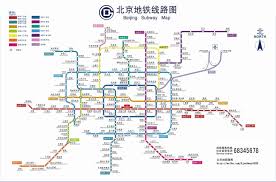
Various talks in Beijing, but also desperately trying not to stop to smell the rose(s) and get on with my research. The revelation of this trip was Line 6, newly opened, of the Beijing Underground. What a line. It connects, on a straight, east-west route, the greedy gweilos of Chaoyang district and the paranoid, pipe-hitting, nationalistic politicians and bureaucrats in the Beihai North and Chegongzhuang areas. Plus it ends up in IT-land Haidian. It’s the golden line of money and power, with the fastest trains to match. Well built.

Beijing subway

Tianjin was easy on the 300kmh train. Back in the day I was pulled over on the expressway doing 160kmh. You are the fastest today, said the policeman. ??, I replied. He popped the fine in a briefcase, heaving with cash. Still took 2 hours door to door. The train is 30 mins. Then an interesting factory manager. Minimum wage in Tianjin this year is Rmb1,800. Ouch.

Then 5 hours on the high-speed to Shanghai. I never liked the place, but this time, for the first time, they charmed me. The urban planning is just better than Beijing. The people are calmer, less bullshitty than they were. Beautiful dinner with friends. Small dogs. I am still obsessed with where all the dog shit goes. They say no owner cleans up after the pooches. It’s the waidi ren, the peasant slave labour, that just picks up the shit early in the morning while Shanghai is dozing.

No high-speed to Guangdong yet, so took the sleeper. Beers in the dining carriage with a businessman who told a story you just could not make up. It’s like they just want to write the next book for you, take the weight… We trade numbers. A Burmese-Chinese returnee who can’t speak Chinese and a Shanghainese too.

In Guangdong I have to go to Zhongshan, near Zhuhai, to see a rather smart company. Seems to me a lovely place, not visited in 15 years. Taxi driver says street crime is on the rise. But I think the people are great, open, smiling at the gweilo.

Then across the border for a weekend on Coloane, at Pousada de Coloane. Sunday lunch at Fernando’s, my favourite anywhere. You never could book. However they have introduced a piece of paper on which you write your name after 12.30, when restaurant already full, and they use this to determine who at the bar is next. Even Portugal is making progress. I lament the changed shape of the Vinho Verde bottle.

Hong Kong is a whirr of money pigs and talks. In the midst I am drinking ??in the FCC when a svelte young colonial strides in. It is Hemlock. I hardly know him. Convex chest, unhunched shoulders, a smile… He tells me, apologetically, that he has ‘a girlfriend, almost half my age…’ Wonders will never frickin’ cease. Of course he still shoves a plate of noodles in his face at 11am. But Thus Spake Zarathustra just came to a movie theatre near you.

All in all, a lovely trip. Problem is that in the whole month only Bowring tries to really nail me, with a question at the FCC. God bless. It is one of the points that Charlie Munger lists in his guide to gentle informational murder. They just don’t challenge you. And yet without the struggle, we cannot progress.

Finally, I get home. And the wife tells me to stop swearing so much. Gravity, at last.


Some media stuff:

Pilling on Indian IT after a chat

Marginal Revolution likes the book. And is probably right that neither beach reader nor academic reader will be happy.

Tom Holland on the book.

Jake Van der Kamp responds to Tom Holland in the SCMP, except without reading the book. This is staggeringly lazy. File under Howard Davies. And I have often quite liked Van der Kamp’s stuff. But this thin, indolent drivel is a pretty good guide to why so many millions remain poor. How can anyone serious pass judgement on something they have not read? It is a book about stages, that takes in your view, Mr Van der Kamp, and the other one. Separately, and somewhat pedantically, ‘fulsome’ does not mean ‘full of’. It means ‘insincere’.

And now Holland responds. His main point is valid. I said at the beginning (and end) of How Asia Works that this is a book about economic development. Real development is also about social and political development. But I was not willing or capable to try to put the other parts of the equation in the same book. It would be too complex. And people would not absorb the basic message about economics. The next book will deal with the institutional stuff.

RTHK on the book. I had to download a plug-in to run this, but assume the average reader is more tech savvy than I. Trick is to do all this and then hit the play button to start the show. But first go to ‘Select segr’ and choose the 11.05 slot. With Phil Whelan. That is where the interview is. Very clunky stuff. But listenable if you get there. ACTUALLY… just did this again a slightly different way. Went here. Then just scrolled down the page and hit the button next to ‘Joe Studwell — How Asia Works’. Took a couple of secs to load up, but then fine.

Podcast interview by the Economist Intelligence Unit in Hong Kong. It was the end of the day. I am more tired than at RTHK, but still a decent chat.

Amcham in Beijing. The podcast should be here.

More to come when I remember what it was.

Malaysian squib

May 6, 2013

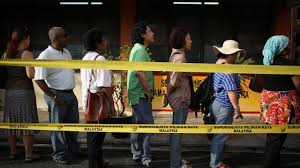
Malaysian election 2013

Results are in and the opposition alliance won only 89 seats in Sunday’s election. The ruling UMNO alliance took 133 seats, down only 5 from the last election.

Still, there were some important shifts in voting patterns.

The main ethnic Chinese opposition group, the Democratic Action Party (DAP) did very well, a reward for years of political hard work and standing up to the bullying and intimidation of UMNO. UMNO’s in-house ethnic Chinese running dog party, the Malaysian Chinese Association (MCA), did very badly and looks like political toast. This is good news.

The opposition Pan-Malaysian Islamic Party (PAS), campaigning for the introduction of sharia, faired poorly. Anwar Ibrahim’s policy to bend with the wind and let PAS have whatever it wanted backfired.  This is also good news.

Malaysia can be added to the list of countries whose electors are now more grown-up than its politicians.

Still, going forward I would expect another period of misery as Najib fails to deliver any significant internal UMNO reform.

The pain will likely be leavened for the middle class by a stock-market bull run, for which all the pieces are now in place.

As the official ad campaign has it, Malaysia Truly (south-east) Asia.


Just in:

GaveKal, the firm that bought my interest in Dragonomics, reports that Sabah and Sarawak are 18% of the population but 36% of BN seats following the election (see Mr. Yap’s comment).

Household debt in Malaysia is now 80% of GDP, with the average family spending 44% of income to service debts. (It’s that old IMF trope — seen throughout south-east Asia — a first world financial structure with a third-world economy).

UMNO/BN got back in with lots of spending promises, but the fiscal deficit is already 5% of GDP.


What’s Good About Malaysia?

May 3, 2013

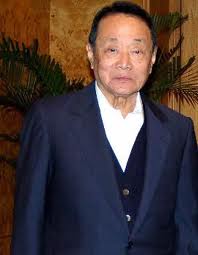
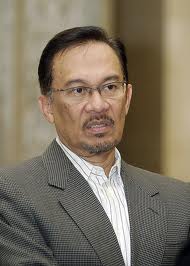
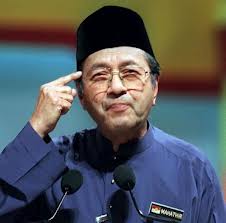
Mal Krishnan Mal KuokMal Hussain Mal Syed M Mal Anwar Mal Jomo Mal Mahathir


Among the major economies of east Asia, Malaysia — which will hold a national election on  Sunday — is the most racially mixed, a melting pot of people of Malay, Chinese, Indian and Sri Lankan ancestry.

All the racial ingredients are present to foment east Asia’s most dynamic and cosmopolitan society — a California, Holland or south-east England of today, or a Tang China or Arab ascendancy of a earlier epoch.

Unfortunately, the ingredients have long been just that — ingredients. In 1965, Malay fear of being outnumbered by ethnic Chinese (and the reverse) was the background to the break-up of a union with Singapore. More recently, the cosmopolitan dream has languished under the affirmative action policies of the ruling United Malays National Organisation (UMNO). Affirmative action has too often meant filling the boots of a small Malay elite, and assorted running dogs, rather than taking the country forward.

Today, many Malaysians of all races reckon themselves less integrated and less happy than ever. And yet despite this, the signs of cosmopolitan promise in this most beautiful and enchanting of Asian nations never disappear.

The richest man in Malaysia is a reclusive Tamil, Ananda Krishan, an extraordinary entrepreneur who has bent every political leader for two generations to his will. Even politicians who hate each other end up agreeing with Krishnan’s agenda, and admiring the Islamic-art inspired Twin Towers he built in Kuala Lumpur. If government had forced him to do something more useful than run monopoly concessions from tv to telephones, and fret about the layout of his luxury yacht, this son of Sri Lankan railway clerks would surely have built one of the greatest branded businesses in the region.

The richest Malaysian long since moved on from Malaysia, in part because of his frustration at the place’s limited ambitions. Robert Kuok, commodities kingpin and Shangri-la hotelier has, in his latter years, put on an ever more Chinese face, but his own family is a wondrous assortment of different races, from West Indian to Welsh and Arab to Malay. His first, late wife was half-British.

The biggest financial services conglomerate put together in Malaysia is the work of a Malay-Arab-Indian, Rashid Hussain, whose inititals gave rise to the ubiquitous RHB logo seen everywhere in the country. One of the fastest growing businesses of late belongs to a Pashtun-Malay entrepreneur, Syed Mokhtar Al-Bukhary, so sharp that a Chinese billionaire once told me he refused to eat chocolates sent to him by Syed Mokhtar until they had been tried on his family pet (the tycoon and the animal survived). The best known Malaysian brand these days is low-cost airline Air Asia, run by an ethnic Indian, Tony Fernandes.

Nor is this cosmopolitan smorgasboard of talent limited to the business sphere. In Jomo Kwame Sundaram (Indian Tamil-Indonesian-Teochew Chinese), currently serving as Assistant Director General of the United Nations’ Food and Agriculture Organisation (FAO), Malaysia produced south-east Asia’s most prolific and respected development economist.

In Mahathir Mohamad — one- or two-quarters Indian, two- or three-quarters Malay, though in power he declined to concede his mixed race ancestry for political reasons — Malaysia produced the south-east Asian politician who came closest to creating a viable industrialisation strategy, one that could have put his country on the track that Japan, South Korea, Taiwan and then China followed.

The mercurial Mahathir, however, studied but failed to digest the real lessons of north-east Asia. Agriculture was left stuck in the colonial mould, while industrial policy never harnessed competition to developmental ends in the manner of more successful east Asian states, as any businessman who works in both Malaysia and China will tell you.

Today, Malaysia’s businessmen goof around buying English soccer clubs (Queen’s Park Rangers, which came bottom of the Premiership this year, Cardiff which is joining it) when they could and should be driving their nation’s economic development.

UMNO’s defensive claim going into this Sunday’s election is that it is a tried and tested ‘product’. But given that Malaysia was much the most profitable British colony, and now has an even more formidable resource base after the discovery of vast natural gas resources, a modest GDP per capita lead over neighbouring Indonesia and Thailand is far from impressive. It is the US$15,000 GDP per capita lag on Taiwan and South Korea — much poorer states at the end of the Second World War — that tells.

Anwar Ibrahim (Malay-Indian), who leads the largest opposition party, Keadilan, has little to recommend him. A former Finance Minister, he has bent with the political winds for decades, only leaving UMNO after Mahathir turned on him. The leaders of allied opposition parties are untested in power beyond the local level — indeed sometimes at any level.

Yet Keadilan and its allies do offer Malaysia the chance of rule by a different party after 56 years of UMNO incumbency. It is a chance worth taking, even if — as appears to be happening to Japan’s LDP after defeat by its opposition — the main benefit would be to shake UMNO out of its corrupt and navel-gazing torpor.

Sunday is also a chance to change the nature of racial politics in Malaysia. Race has become an albatross around the country’s neck. It should be Malaysia’s greatest asset.


Tony down, Vince up

April 29, 2013

Cardiff promotion Tan and Chan Tien Ghee Fernandes QPR sad

The weekend’s English Premier League soccer results confirm that the team controlled by Malaysian billionaire Tony Fernandes will go down, while the team controlled by Malaysian billionaire Vincent Tan (currently in the league below) will go up.

What makes Third World billionaires waste their money on Premier League soccer clubs?

My working theory is that the habit reflects a desperation for recognition among people whose businesses will never buy them respect. (Actually, Tony Fernandes is a poor example because his Air Asia business is a relatively ‘normal’.)

The typical Third World billionaire who buys a Premier League club does not do something at the office that allows them to hold their heads high in the company of those they would like to be seen with. To wit:

‘So, how did you make your money?’

‘My dad fucked my mum.’

or

‘Well, I got my start robbing a train. Then a I cornered a bank. And now I’m in minerals. It’s important to have good bodyguards.’

or

‘In essence, I gave these guys who run my country a huge bung, and they gave me a licence to print money. So I did.’

So you buy a soccer club. Of course it is also useful to be in London on a regular basis to stash and invest some of your cash, while the UK’s tax laws have been redesigned around the needs of footloose billionaires.

But, in the end, no one will respect you even if, like Abramovich, you win the Champions League.

Methinks it a mug’s game.


Premiership clubs controlled by billy-willies:

Abramovich controls Chelsea and, according to Forbes, has spent US$3bn on the club. Meanwhile life expectancy for men in Russia is just 60 years.

Uzbek-Russian billionaire Alisher Usmanov and partner Farhad Moshiri control 30% of Arsenal. Usmanov has long indicated his willingness to increase his stake in Arsenal to full control but has yet to lay his hands on the shares.

Sheik  Mansour bin Zayed Al Nahyan owns  Manchester City.

Mohamed El-Fayed, erstwhile owner of Harrods, still owner of the Paris Ritz, controls Fulham.

Tony Fernandes and Lakshmi Mittal control Queens Park Rangers, who are already relegated. It looked like a good networking opportunity for Tony, founder of Malaysian Ryanair tribute company Air Asia, but will the two still be pals after losing tons of money while achieving nothing?

Vincent Tan, a master of the untendered Malaysian government monopoly concession, controls Cardiff, who are coming up from the division below to replace Tony’s QPR. Other Malaysian billionaires love to hate Vince, but the children of Cardiff momentarily love him. Note that Vince has also signed up to the Gates/Buffett GivingPledge, promising to give away at least half his loot ‘to help address society’s most pressing problems’; (here is his personal pledge). Now that Vince has got his team into the Premiership, he could choose to regard the losses required to stay there as fulfilment of his GivingPledge. What more pressing problem is there than Wales’s lack of a Premiership football team? If other premiership billionaires grasp the angle, Melinda Gates’s phone will be ringing off the hook. Soccer as philanthropy — allowing Third World tycoons to feel better about themselves while watching football. If any of them get the idea from this blog, I would like some tickets please.

There is a Wikipedia table of English football club owners here.

Thoughts beyond the premiership

European businesspeople who constructed more regular businesses invest in clubs some times, but seem to go for smaller clubs. Amancio Ortega, behind Spanish retailer Inditex, put money into Deportivo La Coruna. Francois Pinault, who controls the likes of Gucci and YSL, also controls the football team Rennes. Delia Smith, of English cookbook fame, has a major stake in Norwich. George Soros does have 10% of Manchester United, but that is a big club run for profit.

Oh, the land…

April 15, 2013

Here is a link to a piece I wrote recently for the China Economic Quarterly about the agricultural underpinnings of development. It is something of a taster for a key theme of How Asia Works.

CEQ Q1 2013 Land Policy

How Asia Works

April 5, 2013

I was just sent a link to a first review of my new book, carried in the FT. If you want to see other reviews (assuming there are any), check www.howasiaworks.com. This one I will paste in here since it gives a pretty good synopsis of what the books is about (and, let’s be honest, isn’t entirely negative either).


Reap what you sow

David PillingReview by David Pilling

How Asia Works: Success and Failure in the World’s Most Dynamic Region, by Joe Studwell, Profile, RRP£14.99, 288 pages
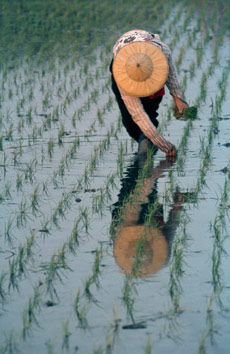
A woman plants rice seedlings in a flooded paddy field, Taiwan©GettyA woman plants rice seedlings in a flooded paddy field, Taiwan

Why are the northeast Asian states of Japan, South Korea and Taiwan rich, while the southeast Asian ones of Thailand, the Philippines and Indonesia are relatively poor? Is the failure of the latter because of their geography or climate, or is it because their leaders chose wrong-headed policies?

One of the many virtues of the pithy, well-written and intellectually vigorous How Asia Works is that Joe Studwell does not equivocate. South-east Asian nations have ended up on what he calls the “rubbish heap of industrialisation” because they failed to learn the lessons of history. Instead of taking what he presents as relatively simple steps to technological advancement, leaders were captured by their ruling elites or took bad advice from international institutions such as the World Bank. The latter pushed neo-liberal policies – including no protection for fledgling industries – that Studwell considers wholly inappropriate for countries trying to get on the first rung of the developmental ladder. His recommendation to poor nations is to emulate Park Chung-hee, the South Korean strongman who oversaw what became known as the miracle on the Han river: “make public pronouncements about the importance of free markets, and then go quietly about your dirigiste business.”

The measures taken by Japan, then South Korea, Taiwan and, after 30 years of Maoist missteps, communist China were, argues Studwell, threefold. They involved land redistribution, the development of an export-oriented manufacturing policy, and the formation of a closely controlled finance system. The three important development insights, he argues, are that “a country’s agricultural potential is most quickly released when its farming is transformed into large-scale gardening supported by agricultural extension services; that the technological upgrading of manufacturing is the natural vehicle for swift economic transformation … and that finance must be harnessed to both these ends”. Only the small city-states of Hong Kong and Singapore have successfully taken a different path.

The most original part of the book deals with farming. Studwell, whose Asian Godfathers (2007) dissected the failures of crony capitalism, argues convincingly that successful Asian nations were built on radical land reform. Japan began parcelling out land after the Meiji Restoration of 1868, a policy continued after the war when the US occupation oversaw a seemingly un-American exercise in land confiscation and redistribution. South Korea and Taiwan followed suit. Large farms are often considered more efficient because they can be highly mechanised to produce higher yields per farmer or per unit of investment. In other words, they are more profitable. But in poor, labour-abundant countries, Studwell contends, that is not the point. The goal should be to use available labour to maximise yield per hectare, something achieved on smaller, intensively farmed plots.

Maximising yields serves several broader development goals: farmers earn money to spend on local manufactures; higher food production means the state doesn’t have to waste precious foreign exchange on imports; and farmers’ savings can be recycled through the banking system into industry. Both the indulgent leaders of the Philippines, who left vast haciendas in the hands of absentee landlords, and Maoist ideologues, who collectivised land into unproductive large-scale co-operatives, ignored the basic insight on what he calls “the triumph of gardening”.

The sections on industrial policy and finance are more familiar, though the ideas remain controversial among free-market economists who argue that governments can’t “pick winners”. Such economists, says Studwell, misunderstand what Japan, and later South Korea, actually did. The key was to force manufacturers, whether of steel or cars, to export and thus compete on international markets. Those that couldn’t hack it were killed off. Korea, for example, had three putative car champions in 1973 at a time when local auto sales were only 30,000 cars a year. In the early years, the market leader was the now-forgotten Shinjin. Only later did Hyundai emerge as the last car company standing. “The economics of development requires nurture, protection and competition,” he writes. The alternative to such hard-headed, nationally driven policies, he says contemptuously of the Philippines, is “an authentic, technology-less Third World state with poverty rates to match”.

Studwell’s thesis is bold, his arguments persuasive, and his style pugnacious. It adds up to a highly readable and important book that should make people rethink the glib equation of free-market policies with economic success. He also writes with disdain for those who would peddle the “fairy tale” that poor countries can become rich by skipping industrialisation. Of India’s attempt to build wealth through IT services, which employ only a few million people, he says: “Punditry that likens India’s economic development to that of the more northerly countries is fatuous.”

The implication of Studwell’s analysis is that talk of globally converging living standards is overdone. Those countries that do not begin with comprehensive land reform or bully their entrepreneurs into nation-building – as opposed to rent-seeking – are bound to fail. Even the relatively successful ones won’t get further than Malaysia, he says, a country whose botched efforts at industrialisation he likens to attending school but not paying much attention.

That leaves China, which in many ways has emulated the successful northeastern model, through post-1978 land reform and the creation of state champions financed through policy banks. China’s biggest companies, he argues, are closing in on international standards in heavy industry. But consumer businesses are not. As demographics worsen and as vested interests worry more about personal gain than national development goals, he wonders whether China will get stuck.

Studwell’s book is a warning to those who believe that developing countries in Asia, Latin America and now Africa have cracked the secret of growth and will inevitably catch up with rich ones. Only those nations with good policies will make it, he argues. And good policies are out of fashion.

David Pilling is the FT’s Asia editor


Nakries, Bothschilds, torpor

February 22, 2013

Rothschild 1

Bakrie

Inbred Etonian titty Nat Rothschild takes on legendarily dodgy pribumi carpet baggers, the Bakrie brothers (led by Rothschild lookalike Aburizal). I guess the takeaway is that there is little to choose between the British aristocracy and a bunch of Third World wideboys when it comes to moral conduct. The Bakries have been coining in money in Indonesia ever since the Benteng programme of the 1950s was set up by Sukarno to support ‘downtrodden’ indigenous traders. They weren’t downtrodden then, and they aren’t now. The Bakries made a killing out of exclusive trading licences that did nothing to support Indonesian development. Nat ‘Mr Offshore’ Rothschild, meanwhile, showed how naturally at home he is in a south-east Asian, Latin American or Russian business environment by cutting a deal with the Bakries to ‘reverse list’ their coal assets in London. This is a favourite Third World tycoon game whereby you find a failed listed business and have it take over your real business, thereby avoiding the intrusive due diligence and transparency that can go with an Initial Public Offering. Nat then got in a terrible bait that having gone into business with some of the dodgiest characters in Indonesia they turned out to be dodgy. (His own efforts to ‘tool up’ by bringing in the likes of Hashim Djojohadikusumo, a B-grade tycoon and elder brother of former Indonesian special forces commander Prabowo Subianto, were a flop.) Meanwhile, despite the recent global financial crisis, British regulators let the entire sordid affair carry on, presumably on the assumption that British aristocrats who live in Switzerland can be trusted to keep their own moral counsel. What happened afterwards with the London-listed business is precisely the sort of shenanigans and fleecing of minority shareholders that happens in places like Indonesia. Quelle surprise!

The Guardian explains some of the background.

Here is the Bloomberg coverage.

Here is the FT coverage (subscription needed).

(Almost) nowhere to run to

February 22, 2011


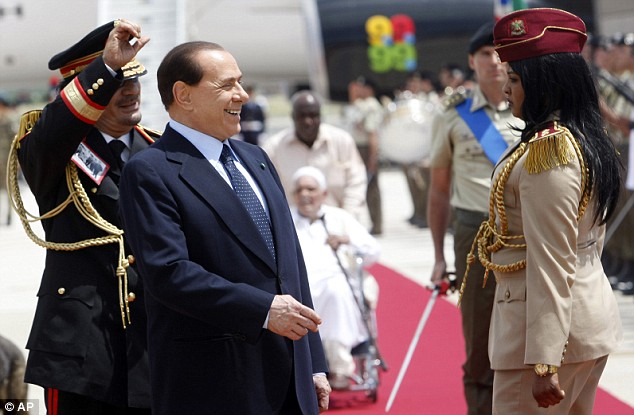
Tunisia, Egypt, Libya… the list of north African countries to which Italian politicians may no longer be able to flee in exile gets longer every day. Bettino Craxi, the politician who ‘made’ Sivio Berlusconi, fled of course to Tunisia (here he is, all remorseful, on the beach). Italian spooks assisted the coup which brought the lately chased out Mr. Ben Ali to power.

Silvio himself might have been expected to skip off to his friend Muammar Gaddafi in Libya if things had gotten really nasty at home. But the way it is looking in Tripoli just now (here is some text from the first US tv crew in), there may be no north African option left. One feels for Silvio after all the effort expended smoothing the path of Gaddafi’s third son Saadi into Italian Serie A football, where he ‘played’ for four seasons and managed a cumulative half an hour on a first-team pitch. It is a wonder that Perugia, Udine and Sampdoria dared to leave him on the bench after his bodyguards in Libya had in 1996 killed eight opposing fans and wounded 39 for mocking this (please note) much underrated footballing prodigy.

Berlusconi has made multiple trips to Libya, including to Benghazi (search ‘Cooperation with Italy’) where the current rebellion started, but he likely won’t be going back soon. Gaddafi came to see Silvio in Italy several times, including just last August when he paid a modelling agency to supply him 200 nubile young women he could give a lecture to on the merits of (his version of) Islam. Muammar and Silvio were such a great team, but the former’s (liberal, London-educated) second son Saif going on telly and promising to keep shooting until the last bullet has put the relationship in a rather poor light.

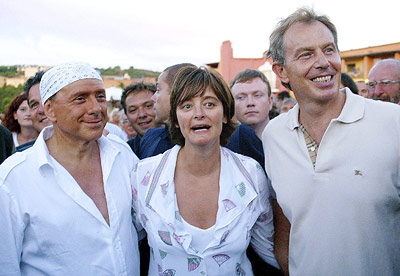
I guess that in a worst case scenario Silvio can always go to Russia and see his best mate Vlad. But how would he keep his suntan up in Moscow? He could call in some of those unpaid holiday letting favours from Tony and Cherie (‘Flowers for me, Silvio?’) Blair, but he won’t get any more bronzed in north London. Surely there must be somewhere hot and dodgy left in the world where a man on the run can put his feet up? I know. Singapore!

Meanwhile: Stanley Ho, if you are watching, check this out. Perhaps you and Muammar should swap family management tips. Well, you both like ballroom dancing…