Archive for the ‘Asia’ Category

Hong Kong and the Emperor… and Tohti

September 25, 2014

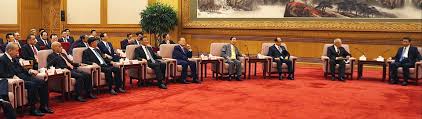
A pleasant, somewhat lazy, couple of weeks <working> in Hong Kong and Shenzhen. Sitting on a surprisingly pleasant Shenzhen beach this week I watched the Hong Kong tycoon fraternity make its school trip to Beijing. Led by Head Boy Li Ka-shing, it was a full court press. Senior prefects Lee Shau-kee and Robert Kuok kept good order, while the dim but dependable Tung Chee-hwa explained his love of games and recited a short Ode to the Celestial Throne before the assembled Chinese leadership. A tremendous time was had by all, with the boys remarking that carpet and decor quality in the Great Hall is now almost as good as at home.

On the street of course, things are not quite so happy.

While the sixth form of St. Swag’s was up in Beijing learning how all is well in Hong Kong as is, school kids in the Special Administrative Region are boycotting classes this week to protest China’s gerrymandering of the 2017 election arrangements. If you haven’t followed it, the game is that everyone in Hong Kong will get a vote (as promised in the Basic Law), but Beijing will choose the candidates (<two or three>). It is actually a step back from the current arrangements which at least allowed the election of Henry Tang to Chief Executive to be blocked, replaced instead by the ineffectual but more brain-functional CY Leung.

Hong Kong, though it is rarely stated, is now just like Taiwan. The Taiwanese call it <Three Thirds>. In Taiwan, one third is Deep Blue (older, KMT, pro mainland integration). One third is Deep Green (younger, Democratic Progressive Party, pro independence). One third is in the middle.

So too, with only modest variation, in Hong Kong. There is no explicit pro independence camp but the generational gap is just the same. Hong Kong, like Taiwan, has entered its 1960s. And in the 1960s students on campus get beaten, and even shot if you remember, in their fight for what is right.

If you care at all, it is time to do whatever you can to prevent violence from arriving. You might write to the Chinese. But if you are a gweilo, that is likely counter-productive. Better to write to the American and British consuls in Hong Kong (emails below), and to the British and American governments, urging them to stand up for the spirit as well as the letter of the Basic Law, and to be ready to grant visas to Hong Kong students who will get arrest records, even criminal convictions, for peacefully protesting Beijing’s behaviour. It does make a difference if you have a moment.

Meanwhile, the Emperor. At the same time it is gently screwing Hong Kong, the Xi Jinping government’s decision to give a life sentence to, and seize all the assets of, the leading, non-separatist voice of Uighur nationalism, Ilham Tohti, is surely the most horrible, colonial, racist act we have seen from China for a very long time. Obama may have a lot on the Middle East, but he needs to draw some lines in the sand in East Asia. There are still plenty of rational voices in China, like there were in 1920s Japan. But the longer this stuff goes on, the harder, I think, the negotiating process becomes. I do not want to read this blog entry in 10 years time and find that some very unpleasant historical analogies going through my head were justified.

Well, enough of the misery. Tomorrow I return to Hong Kong for dinner with dear Hemlock. Back when CY Leung was elected, Hemlock had a hard-on for him, said he was going to change stuff. Not so much on the democratisation front, which would have to occur through a degree of managed confrontation, but in terms of the godfather economy and all those stitch-up oligopolies in real estate and retail and the securities markets. You gotta love Hemlock, even if he’s not as funny as he used to be. It is so heartening that after all these decades, the old boy could still be an ingenue (accent missing). It is so strange that it should turn out that I am the cynical one.
tycoons in beijing 0914

Above: Can’t get a bigger photo. Running anti-clockwise from Xi Jin-ping on the right, looks to me like Tung, K.S., Lee Shau-kee, Robert Kuok, Henry Cheng (son of Cheng Yu-tung, now decrepit), Lui, possibly Michael Kadoorie, and finally David Li of Bank of East Asia.

Saint Swag’s. September 2014 School trip to Beijing. 6th Form boys attending.

(Parents please note: the wearing of non-school uniform items such flat caps is strictly against school policy, including on school trips. Lui Senior (Cuthberts), who has already been in trouble this term for playing cards in dorm, has been fined a week’s tuck and given leaf sweeping for his transgression. This sort of thing will not be tolerated at St. Swag’s.)

Cheung Kong (Holdings) chairman Li Ka-shing

Chairman of Kerry Group, Robert Kuok

Chief executive officer of Shangri-La Asia, Kuok Khoon Chen

PCCW chairman and younger son of Li Ka-shing, Richard Li Tzar-kai

K Wah Group chairman and Galaxy Entertainment Group founder Lui Che-woo

Henderson Land Development chairman Lee Shau-kee and his elder son Peter Lee Ka-kit

Sun Hung Kai Properties Alternate Director Adam Kwok Kai-fai

Bank of East Asia chairman David Li Kwok-po

New World Development chairman Henry Cheng Kar-shun

CLP Holdings chairman Michael Kadoorie

Sino Land chairman Robert Ng Chee Siong

Harilela Group vice-chairman Gary Harilela

Hang Lung Properties chairman Ronnie Chan Chichung

Shui On Land chairman Vincent Lo Hong-sui

MGM China’s co-chairman and daughter of casino mogul Stanley Ho Hung-sun, Pansy Ho Chiu-king

Ian Fok Chun-wan, son of the late Henry Fok Ying-tung

Wharf (Holdings) chairman Peter Woo Kwong-ching

Asia Financial Holdings chairman Robin Chan Yau-hing

Li & Fung honorary chairman Victor Fung Kwok-king

Lai Sun Development chairman Peter Lam Kin-ngok,

Oriental Press Group former chairman Ma Ching-kwan

Glorious Sun Enterprises chairman Yeung Chun-kam

Phoenix Satellite Television chairman Liu Changle

Swire Pacific director Ian Shiu Sai-cheung

Shimao Property Holdings founder and chairman Hui Wing-mau

China Grand Forestry Resources Group founder Ng Leung-ho

Goldlion Holdings deputy chairman Ricky Tsang Chi-ming

Novel Enterprises vice-chairman Ronald Chao Kee-young

HKR International managing director Victor Cha Mou-zing

Hongkong and Shanghai Banking Corporation chief executive officer Peter Wong Tung-shun

Prof Anna Pao Sohmen, daughter of late tycoon Pao Yue-kong

Far East Consortium International chairman David Chiu Tat-cheong

Shun Hing Group vice-chairman David Mong Tak-yeung

Galaxy Entertainment Group deputy chairman Francis Lui Yiu-tung

Dah Sing Life Assurance Company chairman David Wong Shou-yeh

Far East Holdings International chairman Deacon Chiu’s son, Duncan Chiu

Bank of China International Holdings deputy chief executive officer Tse Yung-hoi

Sing Tao News Corporation chairman Charles Ho Tsu-kwok

More:

UK Consul General to write to about standing up for the Basic Law, granting visas, etc is Caroline Wilson. [email protected]

US Consul General to write to about standing up for the Basic Law (an agreement lodged with the United Nations), granting visas, etc is Clifford Hart. [email protected]

Why foreigners do have a dog in any Hong Kong fight. Re-posted NYT oped.

Op-ed about the Hong Kong situation by former Chinese political prisoners in the Wall Street Journal.

Video stream of Hong Kong student protests this week.

On why allowing everyone to vote but restricting the candidates isn’t democracy, Georgetown professor Don Clarke offers this nicely phrased US 3rd Circuit decision in a corporate voting case from 1985. Here’s the actual law library link (Durkin v National Bank of Olyphant). Of course what the Chinese are doing is just what British colonial governments did, but let’s not go there.

<We rest our holding as well on the common sense notion that the unadorned right to cast a ballot in a contest for office, a vehicle for participatory decisionmaking and the exercise of choice, is meaningless without the right to participate in selecting the contestants. As the nominating process circumscribes the range of the choice to be made, it is a fundamental and outcome-determinative step in the election of officeholders. To allow for voting while maintaining a closed candidate selection process thus renders the former an empty exercise. This is as true in the corporate suffrage contest as it is in civic elections, where federal law recognizes that access to the candidate selection process is a component of constitutionally-mandated voting rights.>

On Tohti:

Teng Biao writes in The Guardian that the guy sent down for life actually deserves the Nobel. Here is the background.

Nicholas Bequelin writes in the NYT that the treatment of Tohti will radicalise more Uighurs. This is your key piece of analysis.

English translation of Chang Ping article trying to find logic in the treatment of Ilham Tohti. See also the translated extracts from Tohti’s statement after sentencing, below.

Ilham Tohti’s statement after sentencing in Chinese. Here are some heart-rending extracts in English:

<My outcries are for our people and, even more, for the future of China.

Before entering prison, I kept worrying I wouldn’t be able to deal with the harshness inside. I worried I would betray my conscience, career, friends and family. I made it!

The upcoming life in prison is not something I’ve experienced, but it will nonetheless become our life and my experience. I don’t know how long my life can go on. I have courage; I will not be as fragile as that. If you hear news that I mutilated or killed myself, you can be certain it is made-up.

After seeing the judgment against me, contrary to what people may think, I now think I have a more important duty to bear.

Even though I have departed, I still live in anticipation of the sun and the future. I am convinced that China will become better, and that the constitutional rights of the Uighur people will, one day, be honored.

Peace is a heavenly gift to the Uighur and Han people. Only peace and good will can create a common interest.

I wear my shackles twenty-four hours a day, and was only allowed physical exercise for three hours out of eight months. My cell mates are eight sentenced Han prisoners. These are fairly harsh conditions. However, I count myself fortunate when I look at what has happened to my students and other Uighurs accused of separatist crimes. I had my own Han lawyer whom I appointed to defend me, and my family was allowed to attend my trial. I was able to say what I wanted to say. I hope that, through my case, rule of law in Xinjiang can improve, even if it is only a baby step.

After yesterday’s sentencing, I slept better than I ever did in the eight months (of my detention.) I never realized I had this in me. The only thing is don’t tell my old mother what happened. Tell my family to tell her that it’s only a five-year sentence. Last night, in the cell next door Parhat [student of Tohti’s] slammed himself against the door and cried out loud. I heard the sound of shackles, nonstop, as they were taken to interrogations. Maybe my students have been sentenced too.

(To his wife): My love, for the sake of our children, please be strong and don’t cry! In a future not too far away, we will be in each other’s arms once more. Take care of yourself! Love, Ilham.>

Only in Chinese on Hong Kong:

Wen Wei Po, Beijing mouthpiece in Hong Kong, says that Hong Kong student organiser Joshua Wong has received training from <black hands> in the US navy. I understand there is lots of this stuff doing the rounds in the official press.

Update, 29 September:

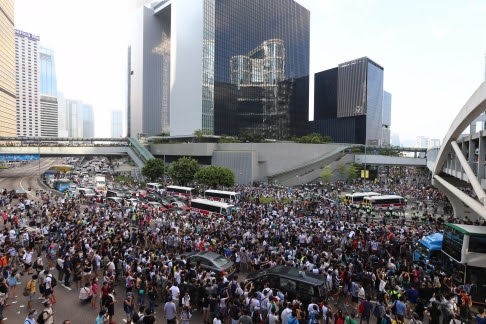
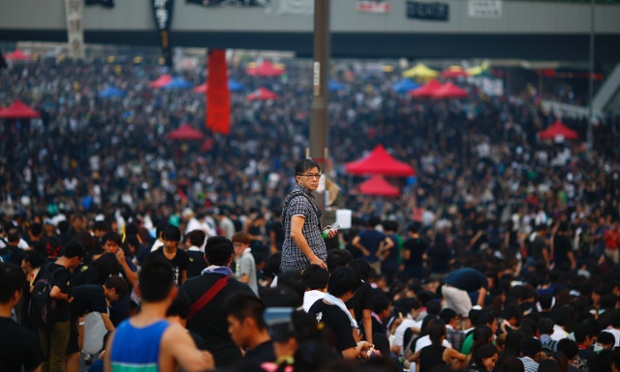
Well, it’s game on after a weekend of student-led confrontations with the police. Parts of HK island (Admiralty, Causeway Bay) are at a standstill, but Central still functioning. Speculation that Xi Jinping is going to can CY Leung, try to buy off the student leaders with small gestures. A talk-first strategy worked well with both Tiananmen in 1989 and more recently with the Falunggong protests in Beijing. But once you have lulled protesters into a false sense of security in HK, it is not so easy to send in secret police to round up the organisers, let alone send in troops. This is a whole new ball game for the CPC…

Here are the early instructions from the Propaganda Dept to mainland media outlets about handling information on the Hong Kong protests, courtesy of China Digital Times:

<All websites must immediately clear away information about Hong Kong students violently assaulting the government and about “Occupy Central”. Promptly report any issues. Strictly manage interactive channels, and resolutely delete harmful information. This [directive] must be followed precisely. (September 28, 2014)

???????????????“??”????????????????????????????????????????????[Original text]>

At the end of this SCMP story on the protests is a 9-minute embedded video interview with student leader Joshua Wong (you will have to do some kind of registration to access this). It is well worth watching. Not only Beijing, but the HK tycoons, have a very serious young man on their hands.
28 September 2014
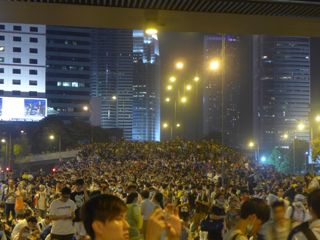
28 September 2014
HK 280914b

28 September 2014

28 September 2014

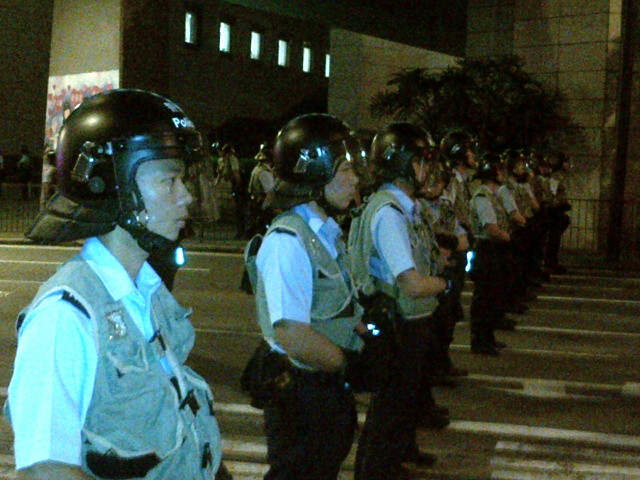
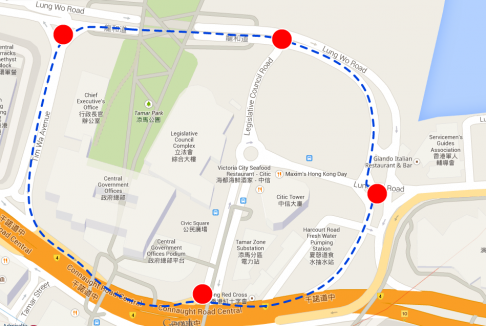
Cordon created by police around Tamar/Admiralty, keeping protests out of central for now. 28 September


Cordon created by police around Tamar/Admiralty, keeping protests out of central for now. 28 September
 

Socialist rule of law

August 18, 2014

At one level I feel sorry for the Chinese Communist Party when people complain about its horrific record on the rule of law. The CCP has never promised what we understand by rule of law. It is only committed to ‘socialist rule of law’, which is why the Party calls it that. Socialist rule of law means that the interests of the Party — or what it thinks are its interests from day to day — come before everything else, including stuff like evidence and what the written law says.

If you followed the recent trial and conviction of private investigator Peter Humphrey in Shanghai, then Georgetown University law professor Don Clarke’s analysis of the court transcripts is well worth a read. Humphrey’s case was high-profile but essentially low level. It gives a good idea of what to expect if you are a gweilo who gets ensnared in China’s ongoing campaign to give multi-national companies (and anyone connected with them like Humphrey) a periodic kicking.

The standard features exhibited by the court proceedings are:

1. Expend most court time ‘proving’ facts that are not in dispute by either side. This makes the proceeding look like a legal case. (Even then, the case only took one day.)

2. Bend the law under which the case is being prosecuted into whatever shape you fancy. Here, Humphrey was prosecuted under a law designed to punish government and public sector workers for selling private information to which they have access. Humphrey was the recipient of such information. He has been prosecuted. The providers have not.

3. When passing sentence, don’t worry about sentencing precedents if you have a point to prove. Humphrey got 2.5 years for a relatively small number of transactions. As Clarke shows, in other recent cases in Shanghai other defendants got only suspended prison terms for massively greater infringements.

As typically happens in these cases, Humphrey made a grovelling public admission of ‘general’ guilt before the trial, almost certainly on the advice of his lawyer. The idea is that you will get leniency. I am not sure about this argument. The maximum term prescribed by law is 3 years. I would have preferred not to do the ‘confession’, stand up in court and point out the hypocrisy of the proceedings (in the politest possible terms) and take the extra 6 months.

Meanwhile, lest you feel sorry for gweilos, spare a thought for recently released human rights lawyer Gao Zhisheng. According to his wife, after his 3 years inside, he can’t even speak intelligibly any longer. Now that is your old-school socialist rule of law…


Gao Zhisheng’s wife wants him to seek treatment in US after ‘horrific torture’ in Chinese jail

Wife pleads with China to let her ‘underfed and psychologically abused’ husband travel to America to seek medical help and be with his family

PUBLISHED : Thursday, 14 August, 2014, 12:34pm
UPDATED : Thursday, 14 August, 2014, 12:40pm
Agence France-Presse in Washington

Chinese rights lawyer Gao Zhisheng suffered malnutrition and psychological abuse in prison, his wife said as she called for Beijing to let him seek treatment in the United States.

Gao, who has defended some of China’s most vulnerable people such as underground Christians, aggrieved miners and members of the banned Falungong spiritual movement, was released last week after serving a three-year prison sentence.

His wife, who fled with their two children to the US in 2009, said on Wednesday that she learned Gao had lost 22.5kg in weight after being fed only a slice of bread and cabbage each day.

Gao can no longer speak intelligibly after being deprived of any interaction with people and kept in a small cell with little light and no reading material or television, she said.

“I am completely devastated by what the Chinese government has done to my husband. The only thing I feared more than him being killed was his suffering relentless and horrific torture and being kept alive,” the wife, Geng He, said in a statement.

Gao remains under round-the-clock surveillance of Chinese authorities at his sister-in-law’s home in the western Xinjiang region, where he was imprisoned, according to Freedom Now, a rights group that is offering him free legal representation.

Saying that Gao has been prevented from seeing a doctor since his release, Geng urged the United States to press China to allow him to come to travel.

“If President Xi Jinping has any sense of decency or humanity, after crushing my husband both physically and psychologically, the least he could do is allow me as a devoted wife to care for him,” Geng said.

Despite Gao’s release, China still imprisons a number of high-profile critics including Liu Xiaobo, the writer and democracy advocate who won the Nobel Peace Prize.

5,000 years…

August 10, 2014


image

image

image

image

After three weeks here, I stand by the assertion that Taipei is the world’s most interesting and liveable Chinese city. However it would be wrong to suggest that Taipei’s free society, strong sense of community, respect for other people, good manners and superb food are not undergirded by the fundamental and immutable laws of a deeper Chinese culture, the one with 5,000 years of continuous history.

The quotidian evidence of this is surely the piety shown for small dogs, as demanded by the Analects of Confucius  (‘Exemplary persons would feel shame if their small dogs were not well-dressed, or their perambulators not in working order.’) The mainland has begun to rediscover its ancient respect for small pooches in recent years, but Taipei reveals how far there is still to go. Here, pooches are properly dressed in dresses, vests and nappies, and wheeled around in high-end canine perambulators purchased from designer doggy shops that can be found on almost every street.

image

image


image


I have been told that the real reason why the tomb of Qinshihuangdi at Xi’an — close by the terracotta warriors — has never been opened is that this would disturb the souls of 8888 Celestial Poodles who were buried with the first emperor. All the stuff about mercury poisoning is a red herring.


Tribute in the bag

August 8, 2014

image

Thailand’s latest junta, the National Council for Peace and Order (aka National Council for Underdevelopment as Usual), has confirmed it is committing to a US$23 billion high-speed rail investment. Beyond this I can find very few concrete details. But the expectation is that much of the construction work, as well as the rolling stock, signalling equipment, and even quite basic industrial inputs will be supplied by China. Late last year, before the junta got rid of Thaksin’s little sister, Chinese premier  Li Keqiang was down in Bangkok doing the hard sell. When the junta boys grabbed the reins of power they made a show of putting the deal that was then shaping up on hold. But a few months later it is back in play, albeit possibly with some cuts to the project specification suggested by this Bangkok Post article (see the references to lower speed services).

Although we know nothing of the Chinese financing terms, it looks like the Celestial Empire has done an effective number on its traditional south-east Asian tribute states. First they leaned on the Laotians, the poorest and most biddable group, to agree to the first leg from Kunming through their territory. Now they have the Thais in the bag. Officially, the Malaysians say high speed rail is too expensive for them. But my guess is that the Malaysian government will fold once construction starts on the Kunming to Bangkok legs and sign a deal. The Chinese an easily twist their arms by threatening to buy their palm oil and gas somewhere else. (When I saw Mahathir late last year in KL he told me that he personally he is already in favour of a Chinese high-speed deal, so Beijing has one still-loud voice singing its song already.)

Who is all this investment good news for? It is good news for China’s rail equipment and rail construction firms, into which Beijing has sunk vast sums in order to master high-speed rail technology. And it is good news for bourgeois types like myself, who want fast, clean travel between their preferred Nanyang beaches and mountain retreats and the panda lairs of south-west China.

But we shouldn’t pretend it is good news for south-east Asian economic development. By the time there is a high-speed link all the way from Kunming to Singapore — which could now easily be completed within 10 years — the projects will have cost at least US$60 billion in today’s money. That expenditure will have done almost nothing to increase south-east Asia’s grasp of manufacturing technology, or even its project management capacity, because all the value-added goes to China. At a time when south-east Asia desperately needs to increase manufacturing employment to provide jobs for countries’ young populations, the China high-speed rail deals instead reveal the developmental bankruptcy of regional politicians. Their only strategy in addition to being a proto-colonial resource base for China, is to become a tourist destination for a new Chinese middle class.


More

This from Geoff Wade at the Australian Strategic Policy Institute, though I am not convinced all the numbers quoted are accurate.

What is not to like?

July 31, 2014

Summer in Taiwan. I came out two weeks ago with two kids and flew on to Penghu — the ‘Pescadore’ islands between Taiwan and China. Fortunately not on the flight that crashed that week. Clean air, clean beaches, and a diet of oysters and the odd beer.imageimageimage

Then we moved back to Taipei. Fantastic public transport, reasonably priced Chinese language summer camp, sitting in the hot springs at Beitou with a bunch of old boys and girls with flannels on their heads, wandering through night markets and shooting balloons with air pistols, chewing the fat with thoughtful, relaxed, helpful people. Chinese people at ease with themselves. Imagine that!

They tell me they lost the development race with Korea. Not really, I say. You lost the economic development race. But you won the overall development race. In Seoul they are all pissed out of their heads from Monday till Sunday, working 50 hours a week. Here, people are drinking fresh fruit juice and iced tea, eating the best food in east Asia, going to the temple or church, planning a holiday in Laos or Myanmar (it is striking how many people are wholly uninterested in visiting the mainland), reading a good book.

To be sure, I exaggerate for effect. But I honestly suspect that Taiwan is presently the most liveable place in east Asia. The parks, the public pools, the transport system, the schools all work in the general interest. Taipei retains the architectural charm of Tokyo because there are narrow streets but little high-rise construction, but it is more interesting because the Chinese are always up to something. It’s individuality with social responsibility. The losers are males of working age who are compelled to go to the mainland for work. But everyone else is here having a nice time. And there are pleasantly few gweilos of the irritating sort, because they have moved to China, or else stayed in Hong Kong or Singapore in order to better pool their wisdom and thereby earn their clients less money than the market index pays.

image image

Thinking back to Indonesia and Jokowi, if he wants to see what a manufacturing-plus-infrastructure strategy could do for his country, he should pop up here before he assumes the presidency. This is south-east Asia with dignity, built by small-time manufacturers like Jokowi. The Vietnamese, who are the only south-east Asian state on track to replicate this model, might also come over to remind themselves of the future. It ain’t too shabby.

Jokowi, thankfully

July 27, 2014

This week’s confirmation that Jokowi won the Indonesian presidential election is a relief. The alternative was an administration under Prabowo and his band of western-educated, elitist carpet-baggers.

Indonesia avoided the negative outcome. But it cannot be said that Jokowi guarantees a fundamental change of direction, as many foreign journalists would like to believe. Jokowi is beholden to the PDI-Struggle party of Sukarno’s daughter Megawati, and to the network of Vice President Jusuf Kalla, themselves different stripes of the Indonesian establishment.

Nor does Jokowi have a policy agenda. He stood as an ordinary person who is not corrupt. But a government that rules relatively cleanly and a little more efficiently will be nothing more than a reprise of SBY’s first term, before the ex-general’s team was consumed by corruption-as-usual.

The real game changer in Indonesia would be a manufacturing strategy that creates more semi-skilled employment opportunities and develops indigenous technological skills. An infrastructure build-out would complement this by creating demand for domestically-manufactured inputs. But such a policy shift is probably too much to expect. Since the Asian crisis and IMF intervention Indonesia has settled on a consumer-focused banking system and a proto-colonial raw material export economy. There are lots of vested interests that surround this arrangement. It would be a very big surprise if Jokowi were to upset the IMF’s apple cart.

Sounds like my book

October 31, 2013

A long trip through Malaysia, Indonesia and China leaves me more convinced than ever that east Asia has two distinct destinies in economic development terms, and that the south-east Asian states are on the wrong side of the tracks.

I start off in Malaysia, where the United Malays National Organisation (UMNO) holds power despite winning a slightly smaller vote share than the opposition in May’s elections. The effect has been a skittish, neurotic administration confronted with deep-seated developmental problems it has no desire or capacity to address. The government commissions reports from the likes of McKinsey as if believing foreign management consultants are likely to come up with some brilliant idea to solve the nation’s problems. In reality, locals know all too well what the issues are — a coddled plantation sector and ignored smallholders in agriculture, low levels of indigenous industrial competitiveness, an untamed army of oligarchs that does almost nothing to promote national economic development and recycles its cash flows offshore, a financial system that pushes out consumer debt rather than supporting industrial development, and resurgent speculation in high-end real estate. Despite oil and gas revenues that cover around two-fifths of the national budget, the government still runs a budget deficit of 5 percent of GDP as it strives to buy off discontent.

In Malaysia today, there is a general sense of malaise, compounded by a recently much increased crime rate — particularly theft, burglary and violent crime. This was never a country that you associated with crime (other than expropriation by godfathers), but that seems to have changed.

On 9 October, a nearly 90-year-old Mahathir was kind enough to grant me a meeting. After corresponding with him during the writing of How Asia Works, I was looking forward to sitting down with him. However the experience did nothing to change the conclusions I had already reached.

Here are the highlights: On agriculture, Mahathir insisted that plantations always produce better yields than smallholders. On Malaysia’s tycoons staying out of manufacturing and not contributing to industrialisation, he commented: ‘They do what they think they can do best. We don’t direct them.’ On the future of economic development, he said he never did, and does not now, see ASEAN as a vehicle for economic policy cooperation and joint development. ‘Economic cooperation is secondary in ASEAN,’ he said. Instead Mahathir talked of the tourism potential of millions of Chinese visitors and of China as a source of cheap manufactured products for Malaysia; he favours buying a Chinese high-speed rail line to run the length of the country.

For me, the takeaway was that Mahathir doesn’t think a country like Malaysia ‘ought’ to be able to compete with a country like China. His parting shot was to say that it was unfair of me to compare the manufacturing development of Malaysia and Korea in How Asia Works: ‘We are not a single ethnic country. We are a multi-ethnic country. That makes it more difficult. They [Malaysia’s ethnic groups] are not at the same level.’ It was the race-based outlook that I describe in How Asia Works as having been so devisive and detrimental to effective policy in every south-east Asian country.

Would Indonesia be any different? I spoke at an event generously hosted by Trade Minister Gita Wirjawan, who read How Asia Works soon after it was published and announced himself ‘a fan’. However, while he might agree with the analysis of south-east Asia’s problems, at the event he offered no clear statements as to policy changes he believes are required if Indonesia is to improve its development prospects. All I picked up in Jakarta was the same, general sense of discontent after 15 post-Asian crisis years of partial economic recovery based on commodity trade (principally with China) and zero industrial progress.

On this topic, I spent the day before the Trade Ministry event at what used to be called IPTN in Bandung, now known as Indonesian Aerospace. People I asked in Jakarta assumed that the aircraft-building industrial policy adventure sponsored by BJ Habibie — which the IMF insisted be cut off from further state funding as a condition of providing credit to Indonesia in 1998 — is long dead.

But not so. IPTN/IAe lends a little support to my assertion in the book that even failed industrial policy will produce some tangible benefits (just very expensive ones compared with well organised industrial policy). Up in Bandung, IPTN had 15,600 employees, including 3,500 engineers, before the Asian crisis hit. The firm was receiving monthly government remittances to cover development costs for Indonesia’s indigenous N-250, 50-seat turbo-prop aircraft. With almost no cash reserves, when the cash was cut off the firm went into freefall. Management did not stabilise the business until the headcount had been cut by more than 12,000, to just 3,000. They did so by turning what had been an aircraft building business into a low-cost parts supplier, particularly to Airbus.

Today, the two N-250 prototypes sit disconsolate in a parking area of the 80 hectare site (the one at the bottom is three metres longer and can seat 70, so was really the N-270, as in two engines, 70 seats). Suharto himself launched the first prototype in 1995, naming it Gatotkoco after a character in Hindu-Javanese legend. Something of the order of US$1 billion had been pumped into the N-250 programme by 1998. The renamed Indonesian Aerospace kept flying its prototypes — racking up 1,200 test hours — until 2007 in the vain hope of finding cash to finish the project. The outside technical reviews were generally positive, but the will and capacity of the government to back the project were gone.

IPTN N250 GatotkocoIPTN N250IPTN N270

After the state cash flow was cut, Indonesian Aerospace first obtained work making wing ribs for the Airbus A380. Then it obtained contracts for the A320, and for Boeing and other aircraft. There was no way for the firm itself to invest in development projects because residual government debt made it unbankable. Only in 2011 did the government agree to a debt write-off (technically a debt-equity swap). This was followed in 2012 by a Rupiah1.2 trillion (circa US$100m) ‘goodbye’ capital injection from the state.

Indonesian Aerospace continued to assemble small aircraft after the crisis that it had assembled before 1998 in a joint venture with a Spanish firm — now owned by Airbus Military. Gradually it has managed improve the terms of its cooperation with Airbus, moving, for instance, to profit sharing on the most popular model it builds. Critically, the post-crisis era focused Indonesian Aerospace on selling aircraft as well as making them. It currently exports around one-fifth of the small aircraft it assembles — to Thailand for rain-seeding, to South Korea for coastal surveillance, to Malaysia, Pakistan and Turkey. Exports, however, are still nowhere near as strong as they were in Embraer’s formative stages in Brazil, before that firm went on to be truly globally competitive. Indonesian non-weaponized defence procurement is the current backbone of Indonesian Aerospace’s order backlog, which stands at US$1 billion.

Perhaps most interesting is that the firm, after conducting five years of market studies (what would have been an unthinkably long period of analysis in the pre-crisis era when it was rushing straight from the N250 to the N2130, a 130-seat jet aircraft), has committed to develop a new civilian aircraft of its own. Indonesian Aerospace managers say they have 150 non-binding commitments for a very small, 19-seat passenger aircraft designed for low-cost travel between second-tier cities in the provinces. Indonesia, like the rest of south-east Asia, already has a booming low-cost sector between key cities based on Boeing and Airbus aircraft. This is an attempt to grab a bit of market share below the radar of the big boys. The aircraft will work off short landing strips, be able to carry substantial amounts of freight relative to passengers, and is designed for use with minimal air traffic control; a prototype will fly in 2015.

Indonesia’s industrial policy was badly conceived, with too little competition, no involvement of leading entrepreneurs, and almost zero export orientation. Even today Indonesian Aerospace has failed to build a supplier cluster around Bandung. But it looks like the firm may in the end produce a marketable aircraft worthy of the name of indigenous technological capacity.

The big point of contemporary comparison, of course, is China. Earlier in 2013 there was a mild panic among foreign observers that that country’s accumulation of bad debt — largely a result of the aggressive industrial policy orientation of its financial sector — could lead to imminent financial melt-down. But not so. Unlike Indonesia, which had no capital controls in 1997, China is protected from changes of sentiment about its banks by capital controls that trap money in the country and keep the system liquid. China’s capacity to grow away from debt is declining as its growth rate gradually falls, but the basic fact of capital controls still meant that this year’s panic was a storm in a teacup. There is always a lot of waste involved in industrial policy, but control of the domestic financial system allows a government to socialise the cost.

Riding the high-speed rail system (HSR) from Shanghai to Suzhou to Xuzhou to Beijing, visiting firms, I also reflected how massively greater is China’s technological capacity today than was Indonesia’s when that country hit the skids in 1997-8. The entire Chinese economy makes stuff that the world economy is willing to pay for. Manufacturing activity is not confined to one or two bellwether projects like IPTN or Malaysia’s Proton. If crisis struck China today, the country would be way more competitive, in more value-added activities, once the crisis abated than was Indonesia after 1998. And China doesn’t face a crisis today because it has not been dumb enough to abandon capital controls. I suspect the country only has one more economic cycle to go before its control over capital is insufficient to escape crisis — the irony of its present stage of development is that China must begin to deregulate finance in order to waste less capital in an era of slowing growth. But by the time crisis does strike, China’s technological competitiveness and its roster of globally competitive large firms will be substantially higher again that it is today.

So what I came back to England thinking is that there is just a lack of political will and political self-belief in south-east Asia to do things differently. I am not sure it was ever really any different. Even Mahathir, who talked the best game in the region in terms of promising a shift to a Japanese-Korean model when he was premier, says that Malaysians cannot really follow the model because they are not racially up to it. On that view, you have lost before you start.

Weekend reading: abuse of state power special

August 25, 2013

It has been a bumper week for abuse of state power. Here are some of the highlights:

Bradley Manning goes down for 35 years. On the watch of the ‘liberal’ president, Barack Obama. The FT (sub needed) argues that Manning got off lightly and may get parole in 10 years. The Guardian takes a different view on the proportionality of Manning’s sentence, a position closer to mine.

While the reaction pieces are being penned, Manning expresses a desire for hormone treatment to assist in a desired gender reassignment. Federal prisons offer this, military ones do not. Manning has asked that she [sic] be referred to henceforth as Chelsea, with the former name Bradley reserved only for letters to the the confinement facility at Fort Leavenworth, Kansas. There are worse ways to spend half an hour than writing him/her a letter of support, so why not do so?.

From, for me, the damaged but well-meaning Manning to the thoughtful, lucid and brave Edward Snowden. In the UK, Alan Rusbridger, Guardian editor, reveals threats from the British government, securocrats, and indirectly from David Cameron himself, to pre-emptively shut down further reporting of the Snowden cache using British legal powers of pre-emption.

It is depressing to read how the poodles in the UK government told their bosses in Washington that Guardian journalist Glen Greenwald’s partner David  Miranda would be detained at Heathrow, how Met police say they checked they were using anti-terrorism legislation correctly and how the police reckon they were procedurally perfect. Having taken the call from the lickspittle Brits, Washington then moved to distance itself from the Miranda detention and the seizure of his possessions, saying it wouldn’t happen in the US. As the Economist points out (sub needed), the anti-terrorism legislation under which Miranda was detained was established for the police to ascertain if a person “is or has been concerned in the commission, preparation or instigation of acts of terrorism”. To use such legislation against journalists is grotesque.

Over to China, where 70 policemen take the unusual risk of appending their thumbprints to a denunciation of the acting president of the Shanghai High Court who, they say, has been engaged in massive long-term corruption including stealing several tons of alcohol from the police booze budget each year. Court president Cui Yadong was already feeling the heat after senior Shanghai judges were recently captured on video cavorting with prostitutes. The video of the judges has had over 4 million hits.

Separately in China, the New York Times discusses ‘Document number 9’ and the alleged ‘seven subversive currents’ at large in the Chinese nation. Per my recent blog about Xi Jinping, we are starting to get more visibility on the new Chinese president and what we are seeing is not pretty. Xi’s evolving proto-Maoist approach to politics provides the background to the trial on corruption and abuse of power charges of fellow princeling Bo Xilai, which started this week. Bo was the person who invented the ‘New Red’ school of modified Maoist populism when he was running Chongqing. As Xi and pals move to crush him, the irony and hypocrisy are not lost on John Garnaut in Foreign Policy.

Here in Italy, meanwhile, we are enjoying a peculiarly Italian twist on the abuse of state power. Silvio Berlusconi, having been definitively condemned for a felony for the first time, has opted for an attack on state power that recalls, for me, Italy’s fascist past (much more so than the claims, which I previously dismissed on this site, that Beppe Grillo is proto fascist). Over the Ferragosto holiday Sil promised a programme of direct action on Italy’s beaches, with his supporters leafleting holiday makers who would otherwise be trying to catch a rest. The focus of Sil’s campaign is not so much a proposal for structural reform of the judiciary, or indeed enforcement of existing norms (which would be half the job done already), but instead a direct attack on magistrates and judges as a species. The strategy has more than a whiff of hoped-for intimidation.

Here is a lead story (in Italian) from Berlusconi’s Il Giornale during the holiday. Although the article was on the front page, it has no news content, and comprises a simple frontal assault on the judiciary, likening its perceived efforts to ‘attain political power’ over the nation to Mao Zedong’s Long March. The connection with Maoism/communism is established in the first sentence. Italy, we learn, does not have a mundanely inefficient legal system to be improved by systemic change, but an extremist, personal, visceral political conspiracy against the Italian people (to wit, Sil and his businesses).

Here are some current icons from Berlusconi’s PDL/FI site:

banner-forzasilvio pdl-logo 20ANNI-DI-CACCIA-UOMO 995980_621688441198598_1936708951_n 998453_620420304658745_378895156_n 998913_622166501150792_278588033_n 1097945_620420421325400_707118344_n slide-1-638

The manner in which Berlusconi’s personal interests, those of the Mediaset group he controls, and national politics are conflated is bewildering for anyone from the First World. But of course this is not the First World. Next month Sil will relaunch Forza Italia (FT, sub needed), his original political movement named for a football chant (in the country that now boasts the worst record of football violence and racism in western Europe). ‘Ancora in campo’ / Back on the Field is the new tag line.

To me the strategy looks more than a little fascistic, involving as it does an attack on the institutions of the state and promises of more direct action. However, as the holidays wind down I suspect that we won’t see a proto-fascist movement take hold in Italy. Instead we will see business as usual.  The main evidence of Sil’s promised campaign of direct action so far (the plan on the beaches described here in the FT, sub needed) is a few Forza Italia militants in Rome (here telling journalists they have not been paid to march, that they are ‘spontaneous volunteers’ and that they have ‘just come for Him [Sil]’) and a pisspoor little plane dragging a bit of superannuated toilet paper above a few holidaymakers. ‘Forza Italia, Forza Sil’, I think it says.

I don’t want to do you down Sil, but I’m not sure you’ve really got the fascist cojones for this thing….

Forza Italia sul ferragosto 2013

Meanwhile, my own experience with abuse of state power occurs when I stop at Sasso, the bar on the river on the way to Citta di Castelllo. Despite the fact that there were few people around when I stopped, and lots of safe parking available, a carabinieri police car was parked across the zebra crossing that leads to the children’s playground, with two wheels outside the white parking line and hence well into the road. Thinking this a bit slack, even by Italian police standards, I took a photo on my phone. Walking into the bar, I found two carabinieri eating cream buns. I bought a small bottle of cold water and went outside to drink it in the sun.

While I was doing this, it seems one of regular clients at the bar told the carabinieri I had taken a photo. One of the carabinieri came over and demanded ‘a document’. Of course, I said, handing him my EU photo driving licence. He took it away and wrote down all the details, resting on the boot of his car. Then he came back and said: ‘I have taken down all your details because you took a photo.’ I replied: ‘Yes I did take a photo because of the way you parked.’ The policeman responded: ‘You have no idea what business we are engaged on here.’ I resisted the urge to reply: ‘It looked like you were engaged in eating cream buns.’ Both policemen were standing over me, not completely in my face, but close enough to make me feel uncomfortable.

The officers then made a series of threats:

1. ‘We have your details. If that photo is published on the Internet [he only seemed concerned about the Internet] we know who you are.’ I replied that I have no problem with them knowing who I am.

2. [from the second carabinieri, thinner and younger]: ‘That is a MILITARY vehicle. Do you understand?’ I replied that I am fully aware that the carabinieri is a para-military force.

3. The first officer mentioned seizing my phone (the verb he employed was ‘sequestrare’). I remained impassive, just looked him in the eye. There were a few people around the bar (maybe 8), plus the female boss, whom I have known for years. He didn’t take the phone in the end, just saying: ‘Get rid of that photo or I will seize your phone.’ I said nothing.

2013-08-16 11.56.41

At this point the policemen appeared to run out of threats. They went back to their car, got in it, turned around, and followed me to Citta di Castello, before turning off in the direction of the police station. Should I complain to the justice system or should I launch a proto-fascist programme of direct action? Thankfully this dilemma no longer presents itself. I now live in Cambridge. I think I’ll just go home.

More:

If you would like to harass people on street corners until Silvio is let off his felony, you should be able to sign up at the site below. (Latest talk is of a general amnesty for convicted felons facing up to as much as four years’ jail time. This would be a triple triumph — saving money spent on prisons, reducing Italy’s huge trial waiting lists, and getting Sil off his fraud sentence (plus other sentences that may soon follow). The only downside would be to put a few thousand crooks, some of them violent, back on the streets. What is not to like?)

ForzaSilvio.it

Is Indonesia different?

August 2, 2013

Below is a critique of How Asia Works with specific reference to Indonesia. Indeed there is a second part of the critique that you can track down via the Lowy site. I am just posting the first part and, underneath it, rejoinders to the main points it makes.


Indonesia’s development formula

by Stephen Grenville – 25 July 2013 11:10AM

I share Sam Roggeveen’s enthusiasm for the iconoclastic approach of Joe Studwell’s How Asia Works (his previous book on Asian Godfathers was a great read too). I also share Studwell’s scepticism about the ‘magic of the market’, his views on the IMF, and his admiration for the achievements of the South Koreans.

But I’m unconvinced by Studwell’s three-step development prescription, not because it is intrinsically wrong but because it is too hard to implement successfully.

The Koreans might have done so, but the strategy requires a level of sustained administrative competence, single-minded toughness and luck which are rare. Just as important, there are alternative development strategies, less demanding of skilled policy-making and administrative competence. The growth outcome won’t match Korea’s, but will be more feasible for countries like Indonesia (which Studwell sees as a development failure).

Let’s go through the three elements of the Studwell strategy. The first stage requires land reform and a boost to agricultural productivity.

It’s an old and sensible idea that agriculture has to provide the investable surplus which will propel the rest of the economy along the path of development. Fifty years ago, Clifford Geertz (Agricultural Involution) despaired about Indonesia’s failure to follow the example of Japan, which shifted surplus agricultural labour into factory work to create a modern urban/manufacturing sector. This failure would lead the excess population to atrophy, farming progressively more Lilliputian plots.

But things turned out better. With the average size of farms on Java around half a hectare, the opportunity for land reform couldn’t play the key role that Studwell advocates. But Soeharto, with his roots in agriculture, gave rice production high priority (extension services, high-yield seeds, fertilizer, pesticides and attractive terms-of-trade between agriculture and urban consumers via an active price stabilisation authority). Not very free-market, but big yield increases and self-sufficiency were speedily achieved.

What about a vigorous industry policy, the second Studwell requirement? Despite inheriting the usual disaster story of failed prestige projects from Sukarno, Soeharto was ready to have a go at ‘picking winners’.

Cement, fertilizer, textiles, paper production, food processing and petroleum refining all fitted Indonesia’s comparative advantage and made sense. Others were less defensible: Krakatau Steel,Tommy Soeharto’s national car and Ibnu Sutowo’s tankers. Habibie‘s IPTN aeroplane fits the Studwell strategy and might have succeeded if it hadn’t been stopped by the Asian crisis: ex-aeronautical engineer Habibie was well-qualified to lead this project, plane construction is quite labour-intensive (all those rivets) and the Indonesian archipelago needs lots of them (one airline recently ordered several hundred in one hit).

Whether IPTN would have succeeded is not the issue here: the point is that Indonesia, for better or worse, did try the sort of hot-house industrialisation Studwell advocates, and the IMF wasn’t able to stop this, at least until the 1997 crisis. Planning retained a central role, just as Studwell wants, and state-owned enterprises did the government’s bidding. Where Indonesia had comparative advantage, this often worked out well, and where the industry didn’t suit Indonesia’s attributes, generally it was a failure.

Indonesia’s development experience doesn’t fit the Studwell formula. Java’s rice production has done well without relying on his key element of land reform, and industry policy based on domestic entrepreneurship has been tried without much success.

Governments attempting to steer the process of development need effective administrative capacity; in a follow-up post, I’ll expand on the idea that market failure is common enough, but so too is government failure.

Joe Studwell’s response:

1. I doubt, contra Mr Grenville, that there is some arbitrary minimum land holding that makes land reform unworkable. If this were the case, then the micro-plots of a few tens of square metres championed by groups like Landesa would make no sense, when historical evidence around the world shows that privately-held micro-plots produce very high yields.

I am presently up my hill in Italy, and using a very slow Internet connection, and so cannot readily check the average Javan landholding. I assume Mr Grenville means that the average Javan landholding is half a hectare now, and would therefore be less after land reform. (The average land holding in most parts of China, Japan, ROK, and Taiwan after land reform was roughly half a hectare.) If my understanding is correct, my response is that Java has some of the best soil and climate conditions in the whole of east Asia, and so even smaller plots should be more than viable — if indeed size matters at all in a downward direction, a question which I think deserves real scrutiny.

Mr Grenville is correct that yields on Java are high by south-east Asian standards. The rice yield is over five tonnes per hectare. However this is still less than the average in north-east Asia. Given its soil and climate, it would not surprise me if north-east Asian style household farming could produce as much as 9 tonnes per hectare on Java — about as high as has been managed anywhere, because the growing conditions are so favourable.

Mr Grenville is correct that Suharto invested heavily (if patchily) in agricultural extension services and (eventually) used minimum price guarantees to promote higher yields. However he is wrong to say that self-sufficiency was achieved ‘quickly’. Rice self-sufficiency was not achieved until the mid-1980s, 40 years after independence, and wheat self-sufficiency never was. So I maintain my position that Indonesia is a real relative failure in agriculture.

2. On industry, much of my criticism of policy in south-east Asia focuses on politicians’ efforts to ‘pick winners’ rather than run industrial policy that periodically culls losers. I also talk at length about the need for ‘export discipline’ to anchor industrial policy. And I avoid traditional discussions of what is or is not a society’s comparative advantage because, to my mind, development is about changing (within reason) your comparative advantage. Economic development is about investing in a learning process in order to reap higher future returns.

Mr Grenville’s points about industry in Indonesia therefore seem to me to be based on a misreading, or mere scanning, of How Asia Works. He highlights industrial projects that were picked as ‘winners’, were not subjected to sufficient competition or pressure to export, and which consequently produced a poor return on industrial policy investment. His observations are essentially supportive of the policy requisites I highlight.

The one thing I think is truly misplaced in Mr Grenville’s comments is the argument in the third paragraph that, essentially, Indonesians are politically and administratively ‘not up to’ the task of accelerated economic development, particularly compared to people like the Koreans. Is this true? In 1945, South Korea was the rural backwater of a brutally colonised state in which Koreans had been allowed to play perhaps the most restricted administrative and economic role in any east Asian colony. I cannot see that the Koreans had much political, administrative or educational capital. Elite Indonesians, by contrast, held senior civil service positions under the Dutch, could win scholarships to study in Europe, and had much greater (formal) political, administrative and educational resources. The difference was not the endowments, but the change politicians wrought over 60 years of independent government.

Why was the peasant Park Chung Hee able to achieve so much more than the superbly educated Sukarno? Probably, I think, because Park focused on the basics and got them right.

Holiday reading and viewing: booze, race, nationalism

July 23, 2013

English beach


Since I am sort of on holiday this week, I have decided that everybody else should be too. So here is weekend reading re-dressed as holiday reading.


1. First up, to get us started, a great discussion of the role of alcohol, and of alcohol addiction, in writing.

Next, the serious stuff.

Here are three articles on questions of race and nationalism.

2a. Orville Schell and John Delury offer a thoughtful piece about China’s need to move on from the narrative of national humiliation that the country’s schools and politicians have fed the population ever since 1949 (and indeed longer in the case of early converts to the communist party’s cause).

2b. In the United States, Barak Obama can no longer avoid speaking out about the Trayvon Martin case.

2c. Philip Stephens in the FT (sub needed) reflects on the mindless racism of Italian politics, but ends with his ideas that just maybe Gianni Letta represents change. Would that it were so!

3. Third, a near miss. Gideon Rachman in the FT (sub needed) has a thoughtful piece on Putin’s Russia but fails to nuance it with what Putin’s government is doing to put Russia back on an economic development path — in essence, reining in the oligarchs and bringing cash flows from national mineral assets back under public control. Putin may be a revolting man, and yet may also be a revolting man whose time has come.

4. Finally, a heartening curiosity. Teach First seems to be working. It is now Britain’s single biggest recruiter. So it turns out that smart people often do care, and don’t reflexively sell their souls to a law firm or investment bank.