Tony down, Vince up

April 29, 2013

Cardiff promotion Tan and Chan Tien Ghee Fernandes QPR sad

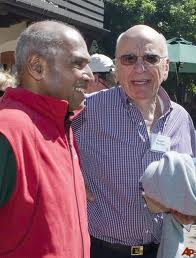
The weekend’s English Premier League soccer results confirm that the team controlled by Malaysian billionaire Tony Fernandes will go down, while the team controlled by Malaysian billionaire Vincent Tan (currently in the league below) will go up.

What makes Third World billionaires waste their money on Premier League soccer clubs?

My working theory is that the habit reflects a desperation for recognition among people whose businesses will never buy them respect. (Actually, Tony Fernandes is a poor example because his Air Asia business is a relatively ‘normal’.)

The typical Third World billionaire who buys a Premier League club does not do something at the office that allows them to hold their heads high in the company of those they would like to be seen with. To wit:

‘So, how did you make your money?’

‘My dad fucked my mum.’

or

‘Well, I got my start robbing a train. Then a I cornered a bank. And now I’m in minerals. It’s important to have good bodyguards.’

or

‘In essence, I gave these guys who run my country a huge bung, and they gave me a licence to print money. So I did.’

So you buy a soccer club. Of course it is also useful to be in London on a regular basis to stash and invest some of your cash, while the UK’s tax laws have been redesigned around the needs of footloose billionaires.

But, in the end, no one will respect you even if, like Abramovich, you win the Champions League.

Methinks it a mug’s game.


Premiership clubs controlled by billy-willies:

Abramovich controls Chelsea and, according to Forbes, has spent US$3bn on the club. Meanwhile life expectancy for men in Russia is just 60 years.

Uzbek-Russian billionaire Alisher Usmanov and partner Farhad Moshiri control 30% of Arsenal. Usmanov has long indicated his willingness to increase his stake in Arsenal to full control but has yet to lay his hands on the shares.

Sheik  Mansour bin Zayed Al Nahyan owns  Manchester City.

Mohamed El-Fayed, erstwhile owner of Harrods, still owner of the Paris Ritz, controls Fulham.

Tony Fernandes and Lakshmi Mittal control Queens Park Rangers, who are already relegated. It looked like a good networking opportunity for Tony, founder of Malaysian Ryanair tribute company Air Asia, but will the two still be pals after losing tons of money while achieving nothing?

Vincent Tan, a master of the untendered Malaysian government monopoly concession, controls Cardiff, who are coming up from the division below to replace Tony’s QPR. Other Malaysian billionaires love to hate Vince, but the children of Cardiff momentarily love him. Note that Vince has also signed up to the Gates/Buffett GivingPledge, promising to give away at least half his loot ‘to help address society’s most pressing problems’; (here is his personal pledge). Now that Vince has got his team into the Premiership, he could choose to regard the losses required to stay there as fulfilment of his GivingPledge. What more pressing problem is there than Wales’s lack of a Premiership football team? If other premiership billionaires grasp the angle, Melinda Gates’s phone will be ringing off the hook. Soccer as philanthropy — allowing Third World tycoons to feel better about themselves while watching football. If any of them get the idea from this blog, I would like some tickets please.

There is a Wikipedia table of English football club owners here.

Thoughts beyond the premiership

European businesspeople who constructed more regular businesses invest in clubs some times, but seem to go for smaller clubs. Amancio Ortega, behind Spanish retailer Inditex, put money into Deportivo La Coruna. Francois Pinault, who controls the likes of Gucci and YSL, also controls the football team Rennes. Delia Smith, of English cookbook fame, has a major stake in Norwich. George Soros does have 10% of Manchester United, but that is a big club run for profit.

Weekend reading: Italy and Spain and more

April 28, 2013

Italy gets a government that surely cannot last, led by a ‘left-wing’ politician whose uncle is the chief of staff to Silvio Berlusconi. Front up  a younger guy and put more women in the cabinet so the Germans think we’ve grown up, seems to be the plan. FT (sub needed) has a sensible leader about how political reform may be the only way to unlock the door to economic reform.

Meanwhile, in The Guardian Simon Hattenstone writes about his long correspondence with Amanda Knox, who faces a retrial for failing to be guilty of murder when everybody in Perugia knows she’s a witch.

In Spain, Almodovar has a new movie out about his country’s economic crisis. It sounds dark, funny and uplifting — whereas Italy has become shallow, unfunny and boring.

I quite like Krugman’s habit of leavening his blog with some decent music. And he has this very funny take-down of the Reinhart-Rogoff controversy over the relationship between debt and GDP from Colbert (you may need a VPN set to the US to view this). The theme of picking your data points to fit the hypothesis you already decided on is entirely consistent with what How Asia Works describes happening in World Bank reports about east Asian development in the 80s and 90s. Harvard, eh? Martin Wolf (sub needed) has a nice reminder of British industrial revolution history when debt was twice GDP. The best thing in How Asia Works on the non-linear relationship between debt and GDP growth is the financial history of South Korea, set out in Part 3. South Korea was more indebted than any Latin American state in the 1970s and 1980s but, unlike them, didn’t go bust because of what the debt was spent on.

If you are in London, this is superb. And very much on the theme of development.

Need more mirth?

Have a look at the curious tale of the Management Today review of How Asia Works…

Infrastructure to-do list No.1

April 25, 2013

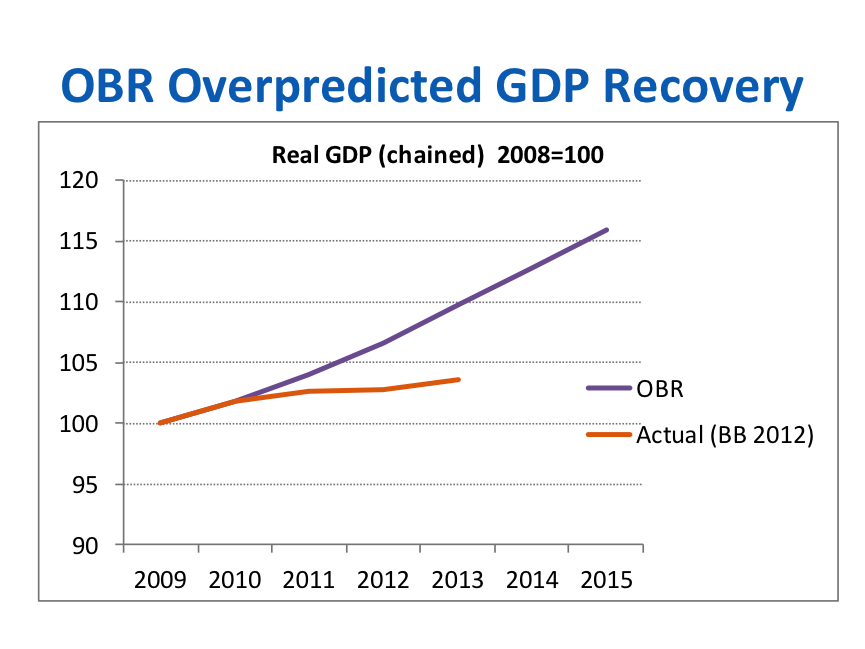
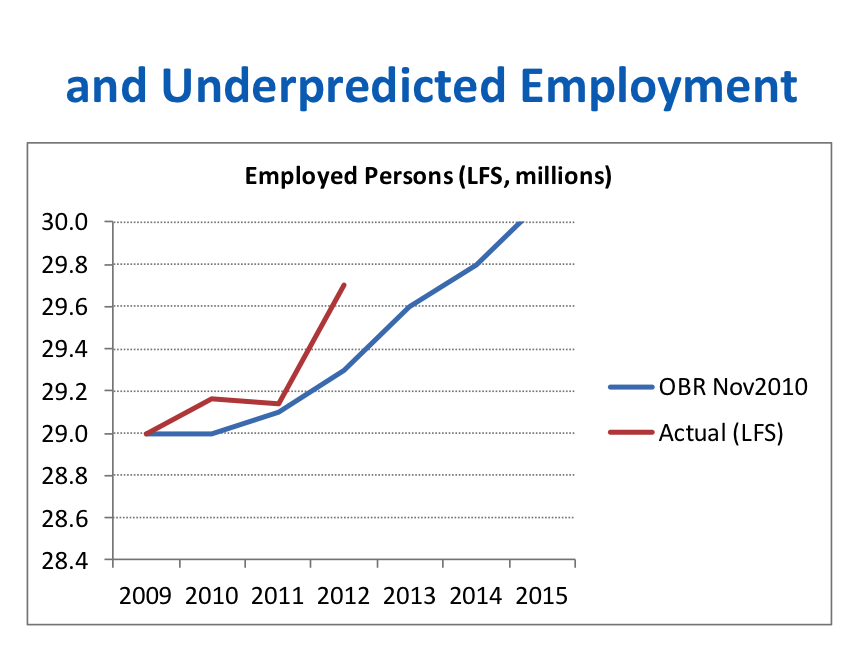
The UK has, for now, avoided a third recession. According to data released today, the economy grew 0.3% in Q1. However, as the Labour Party was quick to point out, cumulative growth since George Osborne’s epochal 2010 Spending Review has been 1.1%, when he promised it would amount to 6% over the period. And the construction sector shrank 2.5% in Q1, offset only by strong growth in services (related, one wonders, to booming stock markets and The City?). In reality, the British economy remains weak.

When aggregate demand in an economy falls because private sector investment has collapsed, government is the only spender that can step in to make up the difference until confidence returns.

When governments decide whether to spend money in these circumstances, the critical issue is whether they can find capital expenditures which will contribute to long-run productivity gains. In other words, can you spend to create demand today by buying something that will have ongoing value in the future. The most obvious target investments are in infrastructure, because construction creates lots of jobs and has big economic ‘multipliers’ by creating demand for all sorts of goods and service inputs into construction.

So let’s start making a list.

On Monday I have to go from Cambridge, the fastest-growing urban centre in the UK, to Warwick University, near Coventry, to give a talk. The distance is just 80 miles. But if I go by train, I have to go via London and it will take over 2.5 hours to get to Coventry, and nearly 3 hours to get back.

Write that down on a piece of paper, George.


Data behind How Asia Works / Getting signed copies in restricted markets

April 24, 2013

Here are two pages that exist on the www.howasiaworks.com site under separate menu buttons. I am replicating them on this site as a posting and filing it under Uploads / Downloads

One page provides a Paypal link for people who want to obtain the first chunk of data behind How Asia Works.

The second page is for anyone attending one of my talks in China or another country that makes it hard to import books who wants to be sure of obtaining a signed copy.

Any event I speak at which is open to the public will continue to be listed on the Events calendar in the right-hand bar.

…………


Get the data behind How Asia Works

During the research for How Asia Works I accumulated large amounts of data to support the arguments I make. The first batch of data, concerning agriculture, have been put together (by an impecunious graduate student) into Excel and Numbers spreadsheets and around 30 useful charts and graphs.If you would like these data, you are invited to support the continued organisation of the rest of the data by paying a minimum of British Pounds6 (more if you are able and think my research worthwhile) via the link below. The money will only be used to pay poor graduate students.

Click on the tiger’s head to pay via a Paypal account or a credit or debit card. If you are generously paying more than Pounds6, please use multiples of 6 to avoid confusion with payments for signed books.

You will then be sent the files. Please do not undermine our work by giving the files to other people. Many thanks.

How Asia Works tigers head

Pay for a signed copy before an event

When I speak at events, copies of How Asia Works are usually available for purchase at the event and I will sign them.

It is difficult, however, to get books to some events, particularly in China. If you want to be certain of receiving a signed book at an event in China — or in any other state that heavily restricts freedom of information — you can pay British Pounds15 via Paypal and one way or another we will get you the book.

Click on the tiger’s head to pay via a Paypal account or a credit or debit card. Pay multiples of Pounds15 depending on how many books you want (don’t worry that the quantity button is fixed at 1). In the course of paying, you will see a link labelled ‘Add special instructions to the seller’. Use this to indicate which event you will be attending.

You need to pay at least one week before an event to be sure of getting a book. Any problems, use the Comments function to send me a message (it will not be posted; I have to hit a button for that to happen).

How Asia Works tigers head

When Britain was like Italy

April 21, 2013

A day in London allows for a few minutes talking about How Asia Works on CNBC here, and a longer discussion on the UK’s Monocle Radio ‘Globalist’ programme, (beginning at the 16 minute mark).

In between I decide to spend a couple of hours wandering the corridors of the Royal Courts of Justice, as the large building that contains the High Court of Justice and the Court of Appeal on The Strand is confusingly called. The place is of interest to anyone who wants to understand the need to constantly reform institutions. In particular, Italians should visit this building. It was constructed in the late 19th century to stop the British justice system being what Italy’s is today.

Law Royal Courts panorama

Before anyone enters, the essential book to read is Charles Dickens’ Bleak House, probably his greatest, which centres on a legal case that has multiplied and gone on for so long that no one can really remember exactly what the case is about, or quite why it started. People just attend hearings because the case(s) has(ve) taken on life(ves) of its(their) own. All that is clearly remembered is that the whole, huge, expensive, draining, painful affair concerns the Jarndyce family, which is enshrined in the case name, Jarndyce v Jarndyce. The different sides of the Jarndyce family just do what the lawyers tell them, and the case does not end until it has consumed all the family’s money, and caused the death of a sympathetic character, because the system makes it possible for cases never to end.

Things were so bad in the British legal system by the 1860s — students of development should note that this had not stopped the British economy growing and becoming the world’s most powerful — that there was eventually a cross-party consensus that radical reform was necessary. A royal commission (essentially an independent review) was set up to consolidate a morass of different legal institutions under one roof, streamline procedures and simplify judicial processes so that the system worked. The Royal Courts of Justice, which opened with their 18 (now 88) courts in 1882, shunted Britain on from the world of Bleak House. Opening the court, Queen Victoria’s speech stated the aim was to ‘conduce to the more speedy and efficient administration of justice’.

Almost always, you can just wander in to a court here and sit down and listen to what is going on. I spent half an hour observing the goings on in each of two randomly selected courtrooms. In Italy, I haven’t seen courtrooms beyond the provincial level (except on television). But some very loose points of comparison can be offered. Here in London there is no chatting during court proceedings, no playing around with mobile phones, no lawyers saying hello to their friends and colleagues in court while ignoring their clients, no male lawyers dedicating their working day to trying to flirt with any woman in sight. And everything is taped. When I once asked to tape record proceedings in an Italian court the judge grudgingly acceded, but with a look that suggested I was proposing a coup d’etat.

Unlike Italian courts, the Royal Courts give a sense of being places where stuff gets done. This is not to say that there isn’t plenty wrong with the justice system in the UK. However, compared with Italy, this is the modern world. The Royal Courts are a living museum of institutional development that is well worth a visit. For the kids, there is a room displaying all the silly outfits that judges and lawyers have worn over the years — and thankfully wear less of these days. The grown-up exhibit is the institutional progress captured in quite a beautiful building with its varied, interesting and business-like courtrooms.

Could Italy have the same thing in the foreseeable future? One way to consider this is to remember that the leaders who made the British reforms of the 1870s possible were Gladstone and Disraeli, working in concert. Would you consider that any of the putative ‘reformers’ of contemporary Italian politics — Monti,Berlusconi, Bersani, or Grillo — is in their league?

More

Imagine this in Italy: Edwin Wilkins Field, one of the key reformers and the Secretary to the royal commission of 1865 on the Royal Courts of Justice, declined remuneration!

Evolution continues: didn’t have time to go see it, but the latest addition to the Royal Courts is the Rolls Building, opened in 2011.

Italy grotesque

April 18, 2013

Franco Marini

Silvio Berlusconi

Bersani old


Today’s papers report that an 80 year-old former Christian Democrat is to be chosen as Italy’s new president.

It is like the declining days of the Soviet empire, starring gerontocrats whose names no one could even bother to remember any longer.

Berlusconi, it is said, wants Franco Marini because, in part, he thinks he will shield him from prosecution.

Bersani, we can only presume, wants Franco Marini because he is even less capable of looking beyond the old Italian politics than Berlusconi is.

What this really shows is that Grillo was correct with his Dead Man Talking rejection of any alliance with Bersani. On the other hand, Grillo’s own suggestion for president is another 80 year-old, Stefano Rodota, and like Marini, another lawyer. (Note that every president of the Philippines from Manuel Quezon to Cory Aquino — 10 in a row — was a lawyer. The Philippines is the east Asian country that has gone backwards fastest in the past 50 years. Can the Italians beat that record? I wouldn’t bet against them.)

The upshot of all this must be that Italy returns to the polls in July. Bersani will go. The left will come up with a new leader, most likely Matteo Renzi, and then we will see if he has any policies.

The Unspeakable Truth, however, is that only Thatcherite shock that breaks up an ocean of vested interests can work for Italy at this point. But who dare say this, let alone do what is necessary? My guess is no one, which pushes me to the conclusion that the likelihood of Italy leaving the Euro is now 50:50. Italy can leave, devalue, and squeeze a few more years out of its existing economic model. Growing up is a choice, not a compulsion.

More

Corriere della Sera (in Italian) reports that Marini did not get a quorum of votes in the first round, but there will be another vote today. Word is that Bersani’s party is splintering as the votes go forward.

FT (sub needed) on Marini.

AFP backgrounder on Marini. Heartwarming tales of childhood poverty, though apparently he ‘kills with a silencer’.

Wikepedia’s entry on Marini.

Grillo rails against Marini in one of his piazza screaming events.

STOP PRESS: Later on the 18th

It looks like Bersani’s PD is imploding as Marini fails again in the second vote. Corriere della Sera reports the latest here in Italian. PD will ask that further votes on the presidency are postponed and meet internally on Friday. At this point, Bersani isn’t just dead, he’s entered full rigor mortis. Will he have the cojones to refuse to resign this week? I reckon that in the ugliest traditions of Italian politics that will be the case. Never, ever, ever put your country before yourself… (Isn’t that a quote from Silvio?)

Guy Dinmore in Rome has filed an excellent, long article about the state of Italy for the FT (sub needed).

REPRINT PRESS FROM MAY 2006:

A brilliant Italian solution. Unable to agree on a new president, the politicians re-elect the previous one — spritely 87 year-old Giorgio Napolitano. The first rule of Italian politics is observed: if in any doubt whatsoever, do nothing. Having failed to broker a deal to form a government in his first presidency, Napolitano now has seven more years to create one. Moreover, if he gets a third term in 2020, he’ll be 101 when he retires. Really super.

Oh, the land…

April 15, 2013

Here is a link to a piece I wrote recently for the China Economic Quarterly about the agricultural underpinnings of development. It is something of a taster for a key theme of How Asia Works.

CEQ Q1 2013 Land Policy

Goodbye Margaret

April 8, 2013

thatcher 20s thatcher 50s

As a kid, I did impersonations of her, sitting in the back of my mother’s VW Beetle, leaning in between the seats. I lived in the increasingly post-industrial north of England and her voice was so ‘other’ that I couldn’t give a jot what she actually stood for. Of course I was too young to understand either the politics of Margaret Thatcher or the quintessentially British neurosis behind her forced upper class accent.

With the benefit of 30 years of hindsight, I have no great issue with the economics of Thatcher. The reason that so many people on all sides of the political divide find it hard to criticise her is that, more than anything, she delivered a mortal blow to many vested interest groups. In the Britain of the late 1970s, her time had come.

In the end, however, Margaret Thatcher’s legacy is a shallow one.  She did very little to challenge the dreary class basis of British society (far less, indeed, than her grotesque parody and successor, Tony Blair). She understood nothing about Europe and fingered liberal post-war Germany as a proto-fascist state. As a result, while she arrested the immediate economic decline of Britain, she presided over its continued intellectual demise, a trajectory that finds Britain today to be a very marginal society — far, far less than the sum of its individuals.

The United States had its Thatcher in Reagan. But since then it has produced Obama. We, meanwhile, gaze upon Cameron and Osborne, waiting forlornly for the thinking man’s Margaret to appear.

More:

Martin Wolf quick-ish wrap on her economics (FT sub needed)

Confirm the shallowness of Ken Baker by reading this (FT sub needed)

Ditto Niall “Harvard” Ferguson here (FT sub needed)

Guardian doesn’t seem to have anything interesting at a quick glance.

Across the pond, similar drivel from the NYT.

Bloomberg gets the point by focusing more acutely and has a good headline. But it ain’t philosophy.

As good as it gets, and nowhere near as good as his biography of her, by Hugo Young, from 2003 before he died.

Next day:

Perhaps time is improving the copy. Ian McEwan captures Thatcher quite well.

And AC Grayling does at least as well in the New York Times.

How Asia Works

April 5, 2013

I was just sent a link to a first review of my new book, carried in the FT. If you want to see other reviews (assuming there are any), check www.howasiaworks.com. This one I will paste in here since it gives a pretty good synopsis of what the books is about (and, let’s be honest, isn’t entirely negative either).


Reap what you sow

David PillingReview by David Pilling

How Asia Works: Success and Failure in the World’s Most Dynamic Region, by Joe Studwell, Profile, RRP£14.99, 288 pages
A woman plants rice seedlings in a flooded paddy field, Taiwan©GettyA woman plants rice seedlings in a flooded paddy field, Taiwan

Why are the northeast Asian states of Japan, South Korea and Taiwan rich, while the southeast Asian ones of Thailand, the Philippines and Indonesia are relatively poor? Is the failure of the latter because of their geography or climate, or is it because their leaders chose wrong-headed policies?

One of the many virtues of the pithy, well-written and intellectually vigorous How Asia Works is that Joe Studwell does not equivocate. South-east Asian nations have ended up on what he calls the “rubbish heap of industrialisation” because they failed to learn the lessons of history. Instead of taking what he presents as relatively simple steps to technological advancement, leaders were captured by their ruling elites or took bad advice from international institutions such as the World Bank. The latter pushed neo-liberal policies – including no protection for fledgling industries – that Studwell considers wholly inappropriate for countries trying to get on the first rung of the developmental ladder. His recommendation to poor nations is to emulate Park Chung-hee, the South Korean strongman who oversaw what became known as the miracle on the Han river: “make public pronouncements about the importance of free markets, and then go quietly about your dirigiste business.”

The measures taken by Japan, then South Korea, Taiwan and, after 30 years of Maoist missteps, communist China were, argues Studwell, threefold. They involved land redistribution, the development of an export-oriented manufacturing policy, and the formation of a closely controlled finance system. The three important development insights, he argues, are that “a country’s agricultural potential is most quickly released when its farming is transformed into large-scale gardening supported by agricultural extension services; that the technological upgrading of manufacturing is the natural vehicle for swift economic transformation … and that finance must be harnessed to both these ends”. Only the small city-states of Hong Kong and Singapore have successfully taken a different path.

The most original part of the book deals with farming. Studwell, whose Asian Godfathers (2007) dissected the failures of crony capitalism, argues convincingly that successful Asian nations were built on radical land reform. Japan began parcelling out land after the Meiji Restoration of 1868, a policy continued after the war when the US occupation oversaw a seemingly un-American exercise in land confiscation and redistribution. South Korea and Taiwan followed suit. Large farms are often considered more efficient because they can be highly mechanised to produce higher yields per farmer or per unit of investment. In other words, they are more profitable. But in poor, labour-abundant countries, Studwell contends, that is not the point. The goal should be to use available labour to maximise yield per hectare, something achieved on smaller, intensively farmed plots.

Maximising yields serves several broader development goals: farmers earn money to spend on local manufactures; higher food production means the state doesn’t have to waste precious foreign exchange on imports; and farmers’ savings can be recycled through the banking system into industry. Both the indulgent leaders of the Philippines, who left vast haciendas in the hands of absentee landlords, and Maoist ideologues, who collectivised land into unproductive large-scale co-operatives, ignored the basic insight on what he calls “the triumph of gardening”.

The sections on industrial policy and finance are more familiar, though the ideas remain controversial among free-market economists who argue that governments can’t “pick winners”. Such economists, says Studwell, misunderstand what Japan, and later South Korea, actually did. The key was to force manufacturers, whether of steel or cars, to export and thus compete on international markets. Those that couldn’t hack it were killed off. Korea, for example, had three putative car champions in 1973 at a time when local auto sales were only 30,000 cars a year. In the early years, the market leader was the now-forgotten Shinjin. Only later did Hyundai emerge as the last car company standing. “The economics of development requires nurture, protection and competition,” he writes. The alternative to such hard-headed, nationally driven policies, he says contemptuously of the Philippines, is “an authentic, technology-less Third World state with poverty rates to match”.

Studwell’s thesis is bold, his arguments persuasive, and his style pugnacious. It adds up to a highly readable and important book that should make people rethink the glib equation of free-market policies with economic success. He also writes with disdain for those who would peddle the “fairy tale” that poor countries can become rich by skipping industrialisation. Of India’s attempt to build wealth through IT services, which employ only a few million people, he says: “Punditry that likens India’s economic development to that of the more northerly countries is fatuous.”

The implication of Studwell’s analysis is that talk of globally converging living standards is overdone. Those countries that do not begin with comprehensive land reform or bully their entrepreneurs into nation-building – as opposed to rent-seeking – are bound to fail. Even the relatively successful ones won’t get further than Malaysia, he says, a country whose botched efforts at industrialisation he likens to attending school but not paying much attention.

That leaves China, which in many ways has emulated the successful northeastern model, through post-1978 land reform and the creation of state champions financed through policy banks. China’s biggest companies, he argues, are closing in on international standards in heavy industry. But consumer businesses are not. As demographics worsen and as vested interests worry more about personal gain than national development goals, he wonders whether China will get stuck.

Studwell’s book is a warning to those who believe that developing countries in Asia, Latin America and now Africa have cracked the secret of growth and will inevitably catch up with rich ones. Only those nations with good policies will make it, he argues. And good policies are out of fashion.

David Pilling is the FT’s Asia editor


The Disneyland within Disneyland

March 26, 2013

Ital election Mickey face

Italian laywer toga

Upset, perhaps, that Italian politics is grabbing all the attention in the wake of recent elections, Italy’s judges are making a bold move to have the spotlight of international incredulity shine once more on their egomaniacal antics.

The national appeals court, the Court of Cassation, has sent the Meredith Kercher murder case back for a third trial, this time in Florence.

The headline reason (we won’t get the detailed ‘reasoning’ for up to 90 days) is that elements of the second trial were not conducted according to proper procedure.

To which the only response is: perhaps, but this is Italy, the Land of Unprofessionalism, where nothing is done entirely according to the rules.

On the other hand, the evidence that Sollecito and Knox were not responsible for the murder, that Rudy Guede was, and that police and magistrates broke countless laws in the course of the investigation and trial, is incontrovertible.

Nothing can now change the fact that the investigation of Meredith Kercher’s murder was staggeringly unprofessional, and that the handling of the physical evidence was disastrous.

These facts should have pointed Italy’s judiciary and its politicians to the need for urgent, radical reforms to the judicial and police systems (as recommended by the EU Commission, see below). Instead they are creating additional unnecessary pain for a large group of people, most obviously the victim’s family. And as ever in Italy, it is all done behind a gossamer veil of ‘propriety’.

More:

Guardian on the Court of Cassation decision.

In a report by the EU Commission last year, the human rights commissioner condemned the length of proceedings and the inefficiency of the Italian legal system, noting: ‘The complexity and magnitude of the problem is such that Italy needs nothing short of a holistic rethinking of its judicial and procedural system, as well as a shift in judicial culture, with a concerted effort from the Ministry of Justice and the High Council of the Judiciary, as well as judges, prosecutors and lawyers.’ Moreover, he said the problems are as much the fault of a self-serving judiciary as of politicians who fail to make judicial reforms: ‘While legislative action is necessary, it is not sufficient and should be complemented with organisational and management aspects for courts and judges, in line with the relevant guidelines of the European Commission for the Efficiency of Justice. Existing examples, such as the experience of the First Instance Court of Turin, prove that good results can thus be obtained even within the current framework and without additional financial or human resources.’

In just over a month, Amanda Knox’s book about her experiences in Perugia will be out. One assumes that Giuliano Mignini will fire her off one of his suits for criminal defamation, as he did when Sollecito’s book was published.