I have written nothing on this blog for over a month while I try to think through the logic of financial sector reform in the wake of the global financial crisis. Frankly, I haven’t got very far. I am not sufficiently knowledgeable about the detailed systemic workings of contemporary banks and ‘shadow banks’ (the bits, like brokers and pension funds, that cause bank-like problems without being banks) to be able to offer a clear blueprint.
Today, however, I was reading some of the now declassified material surrounding a policy choice by the United States government that was clear, decisive and hugely beneficial to tens of millions of people. This was the decision at the end of the Second World War to confiscate all rented farmland in defeated Japan, and to redistribute it to actual cultivators. Reading the original memorandum that led to the policy, one is struck by the extraordinary simplicity and clarity of the thinking: here are the lesser interventions we could attempt – most obviously tenancy reform – and here is why, though such interventions seem superficially tempting and easier, they will either change nothing or make the situation worse. Here is the case for a radical intervention (expropriation). Here is how it can be achieved and the valuation mechanism that will make the process affordable to the Japanese government (offering some small compensation to landlords). And that, of course, is what the US and the new post-war Japanese government did. They changed the institutional terms under which Japanese agriculture, and half the country’s population, operated, setting the stage for the most remarkable developmental story the world has seen (more remarkable than anything we have yet observed in China).
I mention this because reading a memorandum about an effective policy intervention reminds me that I can state a case about financial reform without spelling out every detail. The logic is the same as with the Japanese example for no other reason than that the case for radical change in finance is now just as compelling, and the likelihood that lesser interventions will achieve nothing or worse is just as great. In essence, financial reform requires its own act of expropriation: we have to take away from bankers, shadow bankers, and other speculators all money which they can play with in the current financial system but do not stand to lose because of explicit and implicit government guarantees.
Martin Wolf in The Financial Times (here and here and here, though possibly not if you do not have a subscription) thinks this is impossible because the financial system is too complex. His colleague at The FT, John Kay, thinks that it is possible if you hive off the most core ‘core’ of finance – the so-called ‘payments system’ – and restrict that bit of banking to buying only government securities with the retail deposits it takes in. This of course leaves huge chunks of finance – including things like mortgages – outside of what Kay and others call ‘narrow banking’, the little bit that under Kay’s proposals government would explicitly guarantee.
Japanese land reform makes me think that one should be able to do something more practical and far-reaching than what Kay proposes, given the political will. The counter to Wolf’s arguments is simply that finance is whatever politicians make it; they can rewrite the rules as they like. This, though we have forgotten it, is why we have politicians. And this means that the objective of separating speculative from non-speculative money is feasible.
In the UK, where the government already owns most of the retail banking sector, I would force all core banks to become mutuals (building societies), owned by their members. This is the appropriate form of ownership for the core, boring, low-cost bank activities, which should serve the needs of customers rather than third-party investors. These mutuals would take in government-guaranteed deposits which they would use as the float we employ to make regular payments, to finance mortgages on first homes, to provide working capital to business, and to purchase government securities — all within bands set by the Bank of England. The central bank would hence have a somewhat expanded mandate, giving core banks modestly changing limits for the amount of treasuries they could hold, the minimum business lending they had to do, and their mortgage lending range. This would not be finance by bureaucratic dictat because the Bank of England would be acting within its own limits and because the core mutuals would not provide all mortgages, all business finance, or buy all government debt. But people would use the mutuals because their deposits were guaranteed and credit would tend to be cheaper because the assets and guarantees behind it would tend to be better than outside the mutuals.
In effect, individual citizens would have a certain amount of core mutual ‘entitlement’ and would be encouraged, through voting, to set the agenda and objectives of their mutual. One role of the mutual part of the financial system would be to address the welfare needs which private bankers claim have been supported by private sector bank deregulation – they mean by this access to more mortgage lending for poorer people. Government would probably mandate the Bank of England to force the mutuals to lend a certain amount of their money to poorer people who maintain long-term exclusive accounts and (in a financial sense) behave themselves, such that they could borrow in excess of normal loan multiples to buy first properties. Separately, the mutuals would probably also offer some forms of ‘plain vanilla’, low(er) yield pension products that might be given capital guarantees – contraversial – or some other advantage, say preference in the allocation of government debt or legally-mandated first dibs on private sector initial public offerings (IPOs).
None of this would reduce risk outside the core banking field, indeed it might well increase it. Not to worry: more frequent, more limited collapses among non-guaranteed financial institutions would almost certainly be a good thing. When a crisis occurred, it would – unlike today – be possible to bankrupt the institution in question and send a clear message to people about the risk associated with investing in ‘the real world’. This would be possible, of course, because there finally would be a real world, instead of the unified Never-Never Land that global finance has become since the demise of clear regulation, beginning in the early 1970s. We would all have our building society account, and our other uninsured investments, and no one could be in any doubt about which was which. The system, I suspect, would also be fantastic for competition because it would allow lighter-touch regulation of uninsured financial institutions. My feeling is that politicians are far too keen at present to put the boot into hedge fund managers, who are a real font of new ideas (compared with bankers), because it is so much easier than changing an economy’s overarching ‘financial architecture’.
None of the above will happen, because it would need another World War with 50 million dead to make it happen (which brings us back to Japanese land reform). But it would still, I think, be the right thing to do and hence is worth discussing. Of course there are lots of problems with what I have outlined, not least finding a new, workable balance between the mutual and uninsured financial sectors. Any thoughts on how to address such issues would be gratefully received.
Related items of note:
Paul Krugman suggests that the financial reform package in the US is likely to be so lame that it is best to boycott it.
http://www.nytimes.com/2010/03/01/opinion/01krugman.html
Roger Alcaly, in the NYRB, reminds us that a lot of hedge fund managers (like him) are much nicer and more intelligent than a lot of bankers, with the best review of the mechanics of the crisis I have seen.
http://www.nybooks.com/articles/archives/2010/mar/25/how-they-killed-the-economy/
The manifesto of the British Conservative party for the 6 May 2010 election is full of bluster about mutual-style organisations, as are other party proposals. But no one I am aware of is proposing that a core banking system be restricted to mutuals, which would be a significant policy.
http://www.guardian.co.uk/politics/2010/apr/12/conservative-manifesto-cameron-power-people
We should not forget the fiscal travesty in our financial system – the fact that interest on debt is tax deductible for business where dividends on equity are not. In essence, this provides a fiscal/legal guarantee of acute over-indebtedness at some point in every economic cycle. Various people have mentioned the fiscal issue in the past year (Martin Wolf, Clive Crook, someone at The Economist, me on this blog, me in a Mr. Angry letter to The FT). Unfortunately the tendency among the journalists is to drop the point down to the eighth paragraph (hard to avoid when no politician will even speak about the question). Still, the fiscal thing ought to be written about in its own right.
 Bettino Craxi, the politician who ‘made’ Sivio Berlusconi, fled of course to Tunisia (here he is, all remorseful, on the beach). Italian spooks assisted the coup which brought the lately chased out Mr. Ben Ali to power.
 One feels for Silvio after all the effort expended smoothing the path of Gaddafi’s third son Saadi into Italian Serie A football, where he ‘played’ for four seasons and managed a cumulative half an hour on a first-team pitch. It is a wonder that Perugia, Udine and Sampdoria dared to leave him on the bench after his bodyguards in Libya had in 1996 killed eight opposing fans and wounded 39 for mocking this (please note) much underrated footballing prodigy.
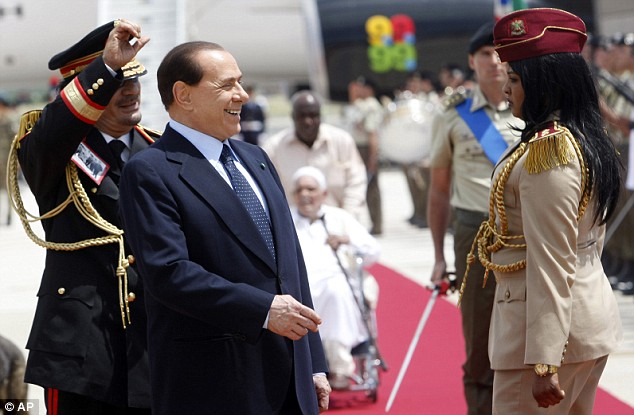 Berlusconi has made multiple trips to Libya, including to Benghazi (search ‘Cooperation with Italy’) where the current rebellion started, but he likely won’t be going back soon.
  Gaddafi came to see Silvio in Italy several times, including just last August when he paid a modelling agency to supply him 200 nubile young women he could give a lecture to on the merits of (his version of) Islam. Muammar and Silvio were such a great team, but the former’s (liberal, London-educated) second son Saif going on telly and promising to keep shooting until the last bullet has put the relationship in a rather poor light.
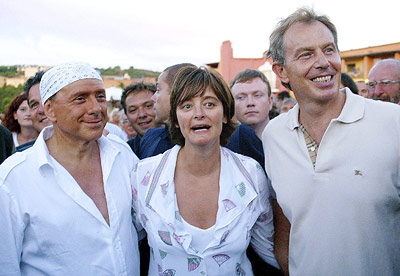 He could call in some of those unpaid holiday letting favours from Tony and Cherie (‘Flowers for me, Silvio?’) Blair, but he won’t get any more bronzed in north London. Surely there must be somewhere hot and dodgy left in the world where a man on the run can put his feet up? I know. Singapore!