A series of notes from the world’s developmental frontier…
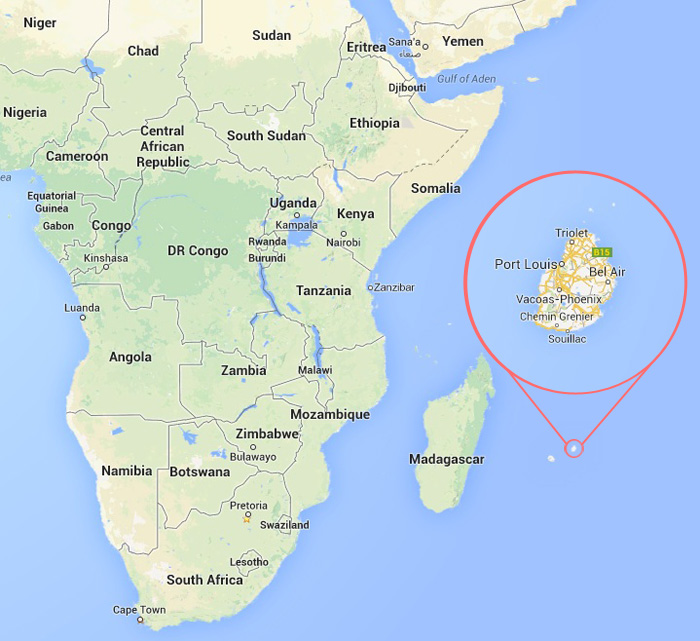
Mauritius is an island roughly 60 kilometres long and averaging just over 30 kilometres wide, located 850 kilometres east of Madagascar in the Indian Ocean. It is also the most complete and equitable economic development success story in Africa.
Mauritius was uninhabited prior to the arrival of Europeans. Its original connection to the African continent was the importation by the French in the 18th century of slaves from Madagascar and Mozambique to work sugar plantations that dominated the colonial economy. In 1810, the British took Mauritius to prevent it being used as a base for attacks on British shipping. French sugar growers were left to carry on, except that from 1835 slavery was prohibited; over the next 70 years, 450,000 Indian labourers were imported to replace the African slaves, on harsh contracts termed indentures. By the time of independence in 1968, this meant that half the population was Hindu Indian, one sixth was Muslim Indian, 30 percent was Creole (as the descendants of the slave population are known), and small fractions were French and Chinese.
Political tensions were high around independence. Franco-Mauritian sugar barons believed they would be subjected to Hindu political hegemony after the British left and their capital was moved off the island; the Creole population also feared Hindu political dominance. It was in these circumstances that Mauritius’ first premier, Seewoosagur Ramgoolam, set out to forge a developmental coalition.
Senior political figures representing Franco-Mauritian and Creole interests were invited to join the post-independence cabinet. Ramgoolam, an avowed socialist, embraced several institutions that linked government to the private sector dominated by the Franco-Mauritian elite. The most important was the Joint Economic Council (JEC), a forum in which key political and business leaders met on a regular basis, usually at the prime minister’s office. The tone was set for a developmental state in which government and private sector were partners, albeit with the government as the dominant partner.
A compromise with sugar
The biggest issue between Ramgoolam’s Labour Party and the Franco-Mauritian elite was how the post-independence government would deal with the sugar estates that dominated Mauritius’ economy, exported their profits and did little to address the island’s chronic unemployment. In the 1950s, many in the Labour Party favoured nationalisation of the farms of the so-called ‘sugar barons’. However, in the context of the coalition Ramgoolam found a more subtle but developmentally effective approach. His government created a Mauritius Sugar Syndicate as the sole sugar exporter, repatriating all proceeds which were not permitted to be invested offshore. And a tax on gross sugar receipts was introduced, initially at 5 percent.
Concurrently, incentives were established to encourage the sugar barons to invest in labour-intensive manufacturing. An Export Processing Zone (EPZ) – one without geographic limits – was created. Any approved factory enjoyed duty-free import of equipment and components and extremely generous income tax concessions for 20 years. The right to unionise was denied, unlike in all other parts of the economy, and the minimum wage was set lower than outside the EPZ. The prospect of tax-free earnings from manufacturing was combined with steady increases in the tax on sugar receipts, which rose from the initial 5 percent to a peak of 23.6 percent in the 1980s.
The fiscal environment meant there was no sense in new investment in sugar (except for smallholders who were exempt from the tax). Sugar barons had already dabbled in local non-sugar businesses prior to independence under a tariff protection scheme designed to reduce imports and foster local industry. They therefore confronted the export-oriented manufacturing promoted by the EPZ with a modicum of experience outside the sugar business. The key to the EPZ was Mauritius’ quota-free and duty-free access to European Economic Community (EEC) markets, which the island was granted from June 1973 under the EEC’s Yaoundé (later Lomé) convention for former African colonies.
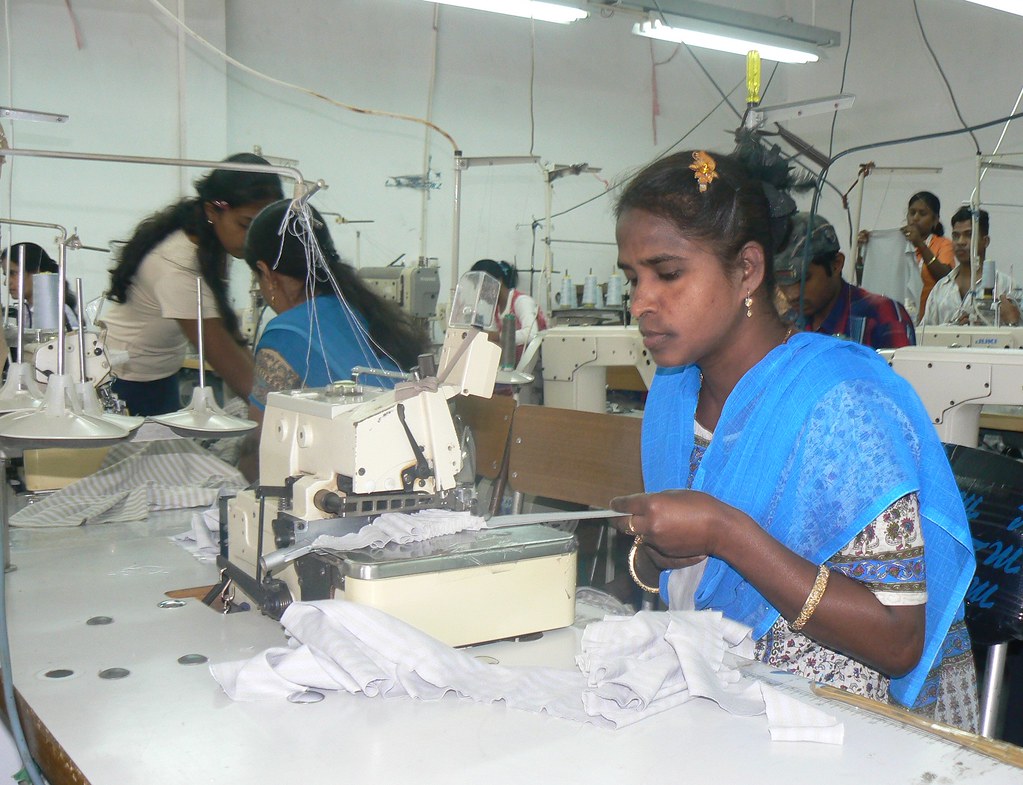
The Mauritian government’s promotion activities drew a small number of mostly Hong Kong and French garment firms to invest in early EPZ factories. The sugar barons offered themselves as local partners with cash to invest. After the first year of the zone, six factories were operating, with 640 workers. By the end of 1976, there were 85 EPZ factories with 16,404 workers, representing the beginnings of a revolution in employment fortunes in Mauritius, which experienced unemployment rates in excess of 20 percent. Knitwear was the dominant product.
The dawn of full employment
The Mauritian economy experienced a crisis brought on by excessive government spending and the second global oil shock at the end of the 1970s and start of the 1980s. However, the attraction of the local garment sector to international investors seeking diversification of production operations, plus a local economic elite pushed by government and fiscal incentives to invest in garment factories, kept the manufacturing sector growing. Indeed, the 1980s turned out to be its boom decade.
During the 1980s, the original woollen knitwear business expanded to a point where Mauritius became the third-biggest exporter in the world. Meanwhile, clothing companies responded to rising costs by becoming more capital-intensive and integrating vertically – larger firms began to make and dye their own fabric in Mauritius. The product range expanded to include everything from shirts to fine-knit items like jogging pants.
By the end of 1990, when the population was one million, there were 89,906 workers employed in 568 EPZ firms — nine out of ten of them in apparel and textile factories. Across its economy, Mauritius had the highest share of EPZ employment of any country in the world. One third of Mauritian workers were employed in EPZ businesses, compared with 10 percent in Singapore, 4 percent in South Korea or 2 percent in Malaysia. The EPZ alone accounted for 12 percent of GDP while sugar-dominated agriculture was 10 percent, down from one quarter in 1970. Unemployment was less than 3 percent.
Across the period from the inception of the EPZ in 1970 through 2000, Mauritian GDP rose by an average 5.8 percent a year, increasing from less than US$300 to US$4,000 per capita. Meanwhile, the rise of manufacturing helped Mauritius become a far more equal society than fellow fast-growth story Botswana because it offered opportunities to almost all Mauritians of working age, not least women. The Gini coefficient of income inequality, where one represents perfect inequality and zero perfect equality, decreased from 0.5 in 1962 to 0.42 in 1975 and 0.37 in 2000 — the latter on par with Taiwan, the economy whose development produced the lowest income inequality in East Asia. By 2000, Mauritius had almost no poverty by World Bank measures.
Manufacturing is special
The impulse to greater income equality delivered by the rise of manufacturing was complemented by policies in agriculture to support smallholder famers. In addition to the exemption from the sugar tax for producers of less than one thousand tonnes per year, government required sugar mills to give smallholders an improved share of sugar extracted from canes and sugar estates to provide parcels of land, as well as cash payments, to any workers laid off. The policies contributed to a degree of social mobility among smallholder farmers and estate workers that did not previously exist.
Subsequent to the garment and textile boom, what were once pure sugar businesses expanded into diversified conglomerates, the largest with turnovers of hundreds of millions of dollars a year. Mauritius, although still an island of only 1.3 million persons, offered or created opportunities in hotels, luxury real estate for wealthy foreigners, offshore financial and information and communications technology (ICT) services, and more. Government continued to support diversification efforts. Mauritian GDP per capita maintained its ascent, from less than US$300 in 1970 to US$11,000 in 2019.
The island’s annual GDP growth from 1970 to 2019 averaged 5.2 percent, or 4.4 percent per capita — compared with 1.3 percent per capita across sub-Saharan Africa. Growth with social equity saw Mauritius rise to ‘high-level’ status on the United Nation’s Human Development Index (HDI) as early as 1996. HDI combines GDP growth with progress in education and life expectancy to give a broader measure of human welfare. Today, Mauritius is the only country in Africa – including north Africa – to be ranked at the topmost ‘very high-level’ by HDI score.
Although the share of manufacturing in Mauritian GDP declined rapidly in recent years, falling from a peak of more than 20 percent in the 1980s to just 11 percent in 2020, its role in the rise of Mauritius cannot be overestimated. As the economist Dani Rodrik showed*, manufacturing is the only sector of an economy that provides an automatic ‘escalator’ for increasing productivity levels. Consequently, only those developing economies which built substantial manufacturing sectors exhibited the unconditional convergence with productivity levels of rich countries that orthodox economics assumes will happen in any poor country with access to global technologies.
Mauritius is unique in Africa for having used a manufacturing strategy to lift itself from poverty to rich-world living standards in just two generations. An agricultural policy that supported smallholders while redirecting capital from large sugar estates to garment manufacturing was the necessary precondition. The lesson about the special role of manufacturing in developing countries ought to be clear to every African state. And yet the continent has almost no other examples of governments developing and deploying coherent manufacturing strategies.
*Rodrik, D., 2013, ‘Unconditional convergence in manufacturing’, The Quarterly Journal of Economics, 128(1).
A series of notes from the world’s developmental frontier…
Botswana is one of only two exceptional African developmental success stories, in the sense of a state that transformed itself from poverty to upper middle income status – meaning from the fourth to the second of the World Bank’s income tiers — in only a generation following independence. (The other genuine success story is the tiny island nation of Mauritius.)
Botswana, in turn, offers two significant lessons for other developing countries, particularly African ones. The first is how Botswana was able to transform a traditional, localised, aristocratic ruling structure, led by tribal chiefs, into a modern, national, democratic political structure in which elite interests were sufficiently accommodated for them to accept the transformative process. The second is the results, positive and negative, that occurred when a poor but well-managed, resource-rich state followed strictly orthodox economic advice about how to employ its natural endowments to develop its economy.
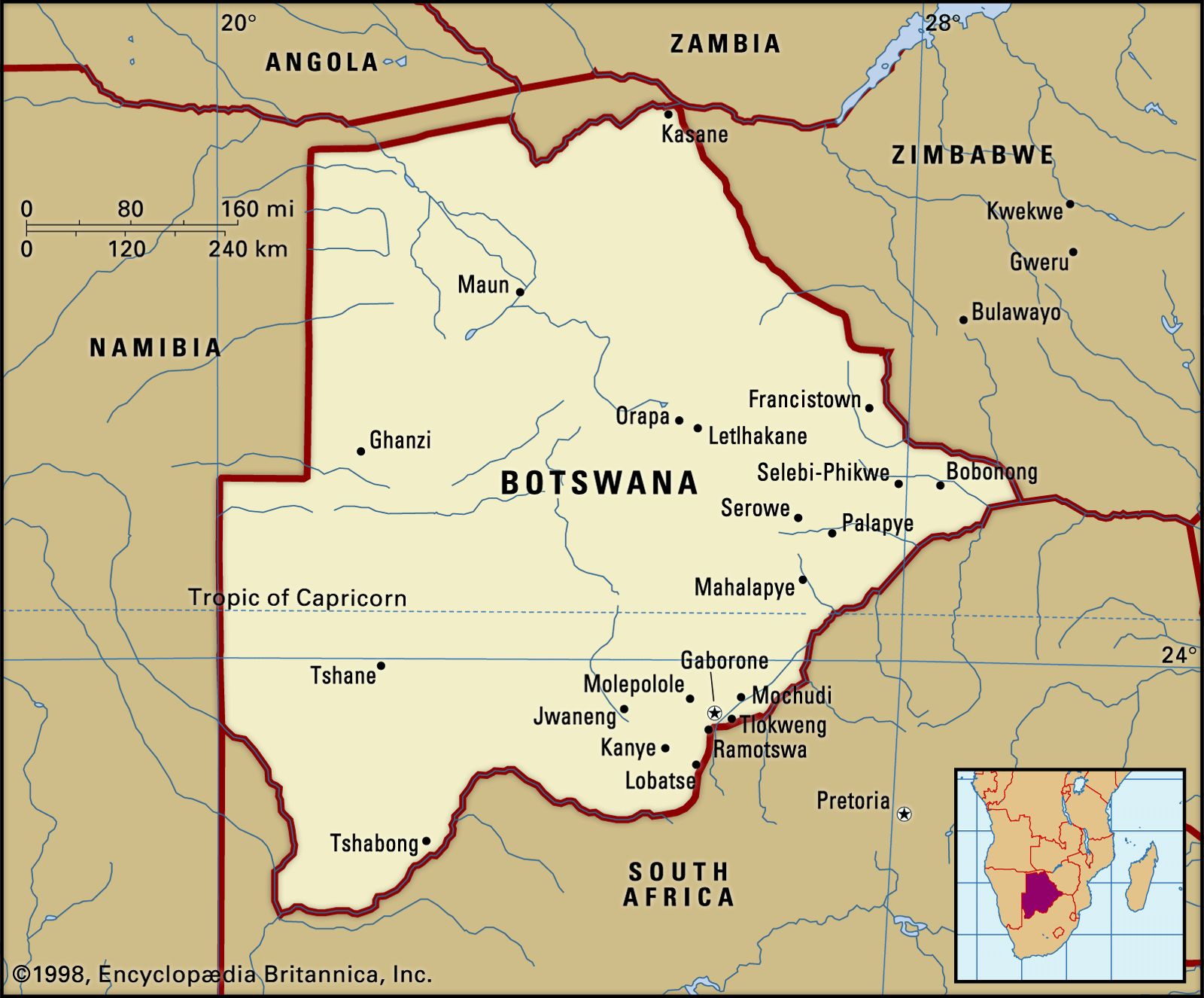
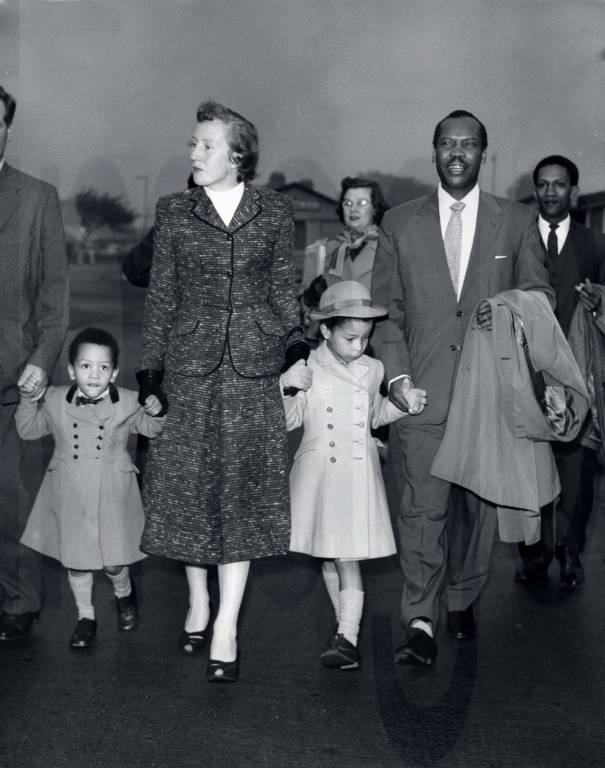
Botswana was defined in the colonial era by being a large, and largely desert-, territory surrounded by white minority-ruled settler states – South Africa, Southern Rhodesia (Zimbabwe) and Namibia. As in Namibia, the main viable economic activity was cattle herding on semi-arid land. The heir to the throne of the largest ‘tribal’ grouping (the term the British used although majorities of each of eight designated ‘tribes’ were assimilated rather than descended from common ancestors) was Seretse Khama, who was exiled for more than five years because his marriage to a white British woman was deemed unbearably provocative to the apartheid South African government. Nonetheless, on his return in 1956 Khama worked closely with the last British Commissioner to begin to develop national institutions of government.
Seretse, Ruth Khama and two of their children
A Legislative Council was initially split half and half between African and European members, with Africans elected by a show of hands which ensured that cattle-owning aristocrats dominated the returns. When politicised Batswana – as the people of Botswana are known – miners working in South Africa formed a radical political party, Khama responded by forming an establishment party led by the African membership of the Legislative Council. The Botswana Democratic Party (BDP) went on to dominate Botswana’s politics until the present day.
Khama formed alliances with anyone committed to a national, if conservative, political programme. The most important was with Quett Masire, the son of a headman on the Bangwaketse Reserve, home to the second most populous group, who had been elected to the Legislative Council and went on to be Botswana’s Vice President, and later its second President. Masire was a highly successful agricultural entrepreneur. The British backed and trained Khama’s team, allowing it in the last years of colonial rule to operate like a full cabinet, to undertake policy formulation and to make grant pitches to the British Colonial Office.
Although Khama was a conservative aristocrat, he stood up firmly for the principle of racial equality. In 1962 he moved a motion in the Legislative Council to establish a select committee on racial discrimination. The report the committee published was the basis for ending the racial segregation that was unofficial but ubiquitous. Similarly, Khama saw off efforts by the tiny white minority in Botswana to retain the same political representation – meaning the same number of members of parliament — as the African majority.
Khama forced the political leaders of the white minority to come to terms with the reality of African majority rule and also convinced the chiefs of the eight ‘tribal’ groups to surrender key powers to a new national government. Under the terms of the post-independence constitution, the chiefs could not run for seats in the legislature but instead held unelected posts in an advisory House of Chiefs. ‘Advisory’ meant powerless. In addition, the constitution created District Councils, which took over the staff, offices, vehicles and most of the local government functions of the chiefs and former Tribal Councils. The chiefs were compensated with stipends and ex-officio seats on District Councils. By the time they understood the full extent of their loss of power, it was too late.
Khama, his government and the BDP were also careful to shore up their constituency of economic support. In 1963, a National Development Bank was established to provide credit to well-to-do cattle owners to sink boreholes in the western reaches of the Tribal Reserves, extending on to the sand veld of the Kalahari. In conjunction with big increases in state veterinary services and fencing construction from 1964-5 – the latter to limit the spread of outbreaks of foot and mouth disease – this built on a colonial strategy of subsidising large-scale cattle farmers. The BDP added the nationalisation of Botswana’s abattoir on the South African border, allowing for profit from meat sales to be returned to the big cattle owners who provided the abattoir with the vast majority of its animals. After independence, what became the Botswana Meat Commission (BMC) would also absorb losses onto the government’s account during downturns in the beef market, further subsidising big cattle interests.
The lower rungs of aspirational aristocrats and other entrepreneurs who sought bigger herds, credit and cattle-farming subsidies became the group which dominated among the BDP’s legislators and key supporters. When elections under the new constitution took place in March 1965, the BDP campaigned aggressively in rural areas – usually with the support of the local chief and dominant cattle interests — and won 28 of 31 seats in a new Legislative Assembly. Seretse Khama became Prime Minister and Botswana became independent in September 1966.
A reputation for reliability
Seretse Khama’s approach to politics was pragmatic and conservative, and his approach to economic development was very similar. Unlike the leaders of other newly independent states such as Zambia and Tanzania, Khama did not rush to localise the civil service, instead waiting until adequately-trained and experienced Batswana were available. By the mid-1970s, the number of Batswana civil servants tripled as part of a national training drive. However, the replacement of expatriates in the most senior civil service positions was only just beginning.
When the government lacked sufficient local teachers for its education programme, affordable imports were found in Ghana and India. Large numbers of American Peace Corps volunteers were recruited and given roles, in everything from teaching to the central government bureaucracy. A South African socialist and anti-apartheid campaigner, Patrick van Rensburg, was welcomed to open vocational training ‘brigades’ that enrolled thousands of young people. The approach to state capacity building was to pursue anything that worked.
The BDP leadership also made a point of leading by example. The key examples set were racial integration and frugality. Ministers made a point of joining new, racially-integrated sports and social clubs that were established in the capital, Gaborone. With respect to frugality, Seretse Khama was the only government minister to fly first class. Vice President Masire and other ministers travelled in economy.
Quett Masire
The best resources in government were invested in a planning unit that was combined with the finance ministry to be a Ministry of Finance and Development Planning (MFDP). It was led by Quett Masire and set out economic development objectives in rolling five-year plans which were passed into law and could not therefore be changed without parliamentary approval. Under Masire, expatriate economists led by Oxford- and Harvard-trained South African Quill Hermans, and Cambridge-trained Briton Peter Landell-Mills, developed one of the best reputuations in Africa for reliable aid planning and for spending grant funds as promised. Already in the early 1970s, only Congo and Gabon received more aid per capita in Africa.
Botswana in 1966 had the commitment to collective action for national development, the pragmatic, ‘whatever works’ approach, and the nascent planning bureaucracy that characterised the most successful East Asian developmental states. When mineral discoveries were made by foreign companies in Botswana, the government was therefore equipped to manage their exploitation. The first deposits to interest multinational miners were copper-nickel ore around two remote settlements, Selebi and Phikwe, in the east. The second was a diamond-bearing kimberlite pipe at Orapa, in a more central part of Botswana, found by South Africa’s de Beers.
The copper-nickel project’s three linked mines, smelter, dam, rail spur, power station and town required investment equivalent to one-and-a-half times Botswana’s 1968-9 Gross Domestic Product (GDP). Masire and Hermans ensured that all investment risk, including debt guarantees, was held by the miners and financing agencies that supported them. Botswana secured a free 15 percent equity interest as the price of the mining licence, with royalties to be paid on operating profits in addition to corporate tax on profits and withholding tax on dividends. The Botswanan approach was vindicated when copper and nickel prices fell and the mine never made money. However, the mine did fund the build-out of Botswana’s power and water utilities, and road infrastructure.
It was the Orapa diamond mine, which opened in 1971, that changed Botswana’s future. In its first full year, 1972, Orapa produced 2.5m carats and accounted, via the government’s 15 percent share of profits, and taxes, for 10 percent of government revenues. De Beers requested to double its agreed rate of production and asked to commence mining two more diamond-bearing pipes at Letlhakane, 40 kilometres away.
The Botswanan planning team had followed the advice of independent consultants to stipulate that the original contract would be renegotiated in the event of ‘extraordinary’ developments. This clause was invoked and the government demanded the venture become a 50:50 joint venture, with De Beers still shouldering all investment costs. It took three years of negotiations, however the South African company eventually conceded even though, when taxes were considered, the new deal gave Botswana 65-70 percent of profits.
In 1976, the year after the new joint venture agreement was signed, De Beers announced the discovery of a kimberlite pipe in the south of Botswana at Jwaneng. Where Orapa yielded 80 carats per hundred tonnes of extracted material, and Letlhakane 30 carats, Jwaneng would yield 140 carats, leading it to become the most profitable diamond mine in the world. Once the three major sites were all functioning, from 1982, Botswana accounted for around a quarter of global diamond output and this share would rise further.
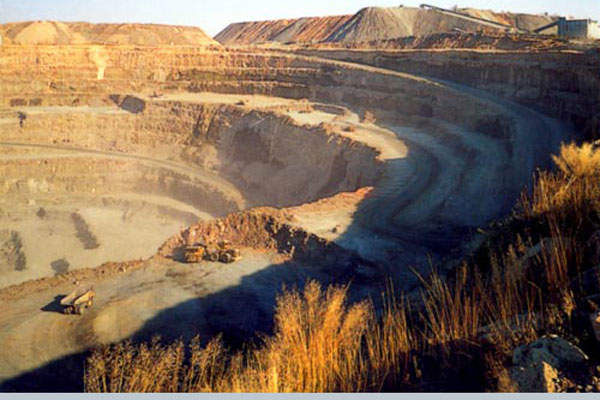
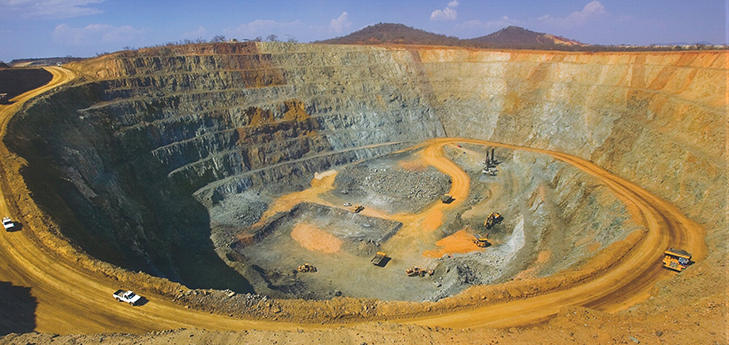
Orapa diamond mine Jwaneng diamond mine
Botswana’s planning unit produced other important results with respect to the country’s foreign trade regime. Following independence, Peter Landell-Mills set out to renegotiate the terms of Botswana’s membership of the Southern Africa Customs Union (SACU), which had not been reviewed since 1910. The planning unit secured a deal for Botswana based on current customs receipts plus a multiplier of 1.42 to compensate for having a tariff regime set by South Africa. The effect was to immediately increase customs revenues from Rand1.4m in 1968, the last year of the old formula, to Rand5.14m in 1969. When mine development began in the 1970s, requiring imports of large amounts of dutiable equipment and accelerating economic growth that in turn encouraged further imports – customs receipts rose much further, helping Botswana to balance its current budget from 1972.
In 1976, Quill Hermans led the launch of a domestic Botswanan currency, the Pula. Previously, Botswana used the South African Rand, however the MFDP wanted a domestic currency so that foreign exchange reserves generated by mining exports were managed by a new central Bank of Botswana. A national currency, with locally-managed controls on movements of capital, also allowed Botswana to limit the appreciation of the Pula during the mining boom and thereby protect the interests of cattle exporters.
In the first two decades after independence, Botswana’s economy grew at more than 13 percent a year as mining came to account for half of GDP. The share of mining receipts in government income rose even faster, to a quarter of revenues in the mid-1970s, and more than half in the mid-1980s. At the same time, Botswana’s reputation for planning and project delivery maintained high levels of foreign aid. In the second half of the 1970s, aid still constituted one quarter of Botswana’s total government expenditures. From being one of the poorest countries in the world, the question for Botswana became how to employ surpluses.
Absence of policy vision
In deploying surpluses, however, what Botswana lacked was any vision for structural change that would better fit its economy to the needs of its people. There was no vision for the large numbers of small-scale farmers and cattle herders in rural areas and no vision for manufacturing and industrial development to provide jobs for semi-skilled city dwellers. Like the national leader, Seretse Khama, the administration was fundamentally reactive, dealing with opportunities and challenges effectively, but with no overarching, proactive strategy beyond the long-established support for big cattle. The role of orthodox economists – who were not a feature of the early developmental states of East Asia – encouraged this; they looked to make the current state of affairs as efficient as possible, not to structurally re-shape the economy. With the benefit of hindsight, Festus Mogae, Botswana’s third President, concludes: ‘We reacted to situations as they arose but failed to imagine our future.’
MFDP economists concentrated investment in education, healthcare and basic infrastructure. Secondary school enrolment, for instance, increased from 1,531 pupils in 1966 to almost 10,000 a decade later. Hospitals increased from seven in the early 1970s to 30 in the 1990s and life expectancy rose from 48 years in 1966 to 65 in 1990. Paved roads increased from 12 kilometres in 1966 to more than 8,000 kilometres by the end of the century.
These investments, however, were not enough to prevent large swathes of the rural population living in poverty. There was a continuation of the private borehole drilling that effectively privatised communal land to large herd owners who could afford the wells. In Botswana’s Central District – what had been the Bamangwato Reserve and the biggest concentration of cattle grazing – fewer than 500 individuals gained de facto private grazing rights over a quarter of the area.
An inclusive agriculture policy would have prioritised small-scale cattle farming and involved local communities in managing communal land. However, such a strategy was never considered. In the 1990s, an estimated five percent of the population owned half the national herd. It was a large-scale but low-efficiency cattle economy and was accompanied by a steady increase in the proportion of rural families reporting they owned no cattle — from 28 percent in 1980 to 46 percent in 1999.
Such families formed the core of the rural poor – a large block making up about one quarter of Botswana’s working population. From the 1970s, as diamond revenues increased, the government’s policy to address rural poverty was to increase subsidies to arable agriculture. However, rainfed arable agriculture in almost all parts of Botswana is so precarious that it only works as a counterpart to less rain-dependent cattle ownership. The subsidies are in effect disguised welfare transfers.
Apart from small-scale farming, the other sector in which the Botswanan government could help to create employment opportunities for a population with limited education was manufacturing. The mines which produced so much profit employed only ten thousand people and new entrants to the labour force in the 1970s were twenty thousand a year. However, manufacturing policy was incoherent. This reflected the dominance of orthodox economists in government who knew that a mineral-driven economy needed to diversify but who were ideologically sceptical of the use of subsidies to induce manufacturing expansion. A lack of conviction led to dabbling in state-led import substitution projects on the one hand, and an unwillingness to aggressively subsidise private sector exporters on the other.
The Botswana Development Corporation (BDC) was created in 1970 as the country’s vehicle to invest in industrial projects. However, it limited its activities to the most basic, low value-added import substitution, including a brewery, a soap factory and a flour mill. There were no investments in more complex industrial plants, such as cement or large-scale metal working. Over time the BDC put more and more of its investment into real estate projects. The government was unwilling to subsidise credit and electricity prices for export-oriented manufacturers – the types of intervention that underwrote export manufacturing expansion in east Asia.
Instead of subsidising manufacturing at scale with firms’ competitiveness tested by their capacity to export – the crux of the East Asian model — from 1982 Botswana implemented a programme to provide subsidies to enterprises based on their employment generation. The Financial Assistance Policy (FAP) provided up to 90 percent of the capital cost of starting a business, and 80 percent of wages, declining to 20 percent, over five years. The programme ballooned, and was characterised by increasing abuse, over 20 years. The manufacturing share of the economy remained stuck at 4-5 percent as FAP projects closed down when grants ended.
The one area in which government did eventually deliver a little manufacturing success was the cutting and polishing of diamonds, which it was able to orchestrate as part of its periodic renegotiations with De Beers. In a deal signed in 2011, De Beers was compelled to relocate its global wholesale diamond aggregation and trading operation, which sells to its approved ‘sightholders’, or wholesale buyers, from London to Gaborone. As of 2018, eight sightholder cutting and polishing operations were running and total downstream diamond employment was around 3,000 people.
Overall, however, the orthodox economic prescription in Botswana left elevated levels of poverty and inequality despite rapid and sustained economic growth. The sectoral economic focuses of East Asian developmental states such as Japan, China or Vietnam on smallholder agriculture and manufacturing, which brought very broad-based development, were absent. Instead, in a Botswana whose population today is 2.3 million, there are only 340,000 formal jobs. Of these, the private sector accounts for 190,000, of which manufacturing is less than 40,000. The other 150,000 public sector jobs are in central and local government. Four times as many people work for the government as in manufacturing.
The failure to create more private sector jobs leaves large numbers of Batswana dependent on welfare of one form or another — 60,000 employed on a work-for-welfare scheme, 70,000 destitutes and orphan carers who exist on welfare, and 150,000 subsistence farmers who survive through subsidy programmes. Ellen Hillbom, a Swedish academic specialised in Botswana’s development, emphasises the contrast between Botswana and the developmental states of East Asia by describing the former as a ‘gatekeeping state’. The BDP gatekeeper, she argues, delivered a stable coalition based around a cattle-owning elite that managed mineral wealth in a disciplined fashion. However, Hillbom says: ‘Stability has lacked original thinking about how to change society.’
A series of notes from the world’s developmental frontier…
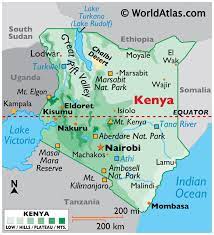
In logistical terms, Kenya is the most important country in East Africa. British colonial investment in the port of Mombasa and the rail line – dubbed the ‘lunatic line’ because of its cost and ambition — from Mombasa to Kisumu on Lake Victoria, and later to Kampala, means Kenya has long dominated trade access to Uganda, Rwanda, Burundi and the eastern portion of the Democratic Republic of Congo (DRC). Mombasa also handles a portion of Tanzania’s international trade. This logistical significance, the possibility that Kenya could become a manufacturing centre for the region, and the existence of fertile land along the coast, in the Western Highlands to the north-west of Nairobi, and around Lake Victoria, have long engendered optimism about development prospects.
From independence in 1963 to 1980, Kenyan growth averaged an impressive 7.1 percent. However, the start of a series of fiscal crises and World Bank and International Monetary Fund structural adjustment programmes in 1980 saw average growth fall to 2.9 percent from 1980 to 2003. Since 2004, growth rebounded to an annual average 5.4 percent. In each of these periods, Kenya was comfortably ahead of the overall sub-Saharan growth rate. With nominal GDP per capita of US$2,075 in 2020, Kenyans are the most prosperous citizens among major East African economies. The poverty rate, on the World Bank’s US1.90-per-day measure, fell from 44 percent in 2005 to 37 percent in 2016. Ostensibly the most impressive feat in the long run has been educational gains. In 1967, Kenyans had an average of just 1.7 years of education; today the figure is 10.7 years. Unfortunately, testing suggests that much of the education is of low quality; according to the World Bank, 60 per cent of 19-20 year olds who have been through secondary education still fail to meet basic literacy standards.
Déjà vu colonialism all over again
What stands out most in Kenya is how little government imposed itself on the economic structure inherited from the colonial era. In agriculture, there was a significant redistribution of white settler-owned land. However, this was a response to the insurgency by landless black farmers that started in 1952 – known popularly as the Mau Mau rebellion – which drew a policy response during the colonial era. From 1954, the Swynnerton Plan supported ‘loyalist’ and generally well-to-do indigenous farmers to move into cash crops like coffee, from which they were previously barred, on consolidated and privately-owned landholdings. From 1962, on the eve of independence, the British government funded the Million Acre Settlement Scheme which purchased white settler farms and again generally favoured better-off black farmers, with typically less fertile areas allocated for ‘high-density’ settlement by poorer and landless farmers. The post-independence government of Jomo Kenyatta went along with this approach, with Kenyatta famously dismissing landless Mau Mau rebels as ‘hooligans’. This was despite strong research evidence in the late 1960s that the poorer farmers with smaller holdings, who were also given much less agricultural extension support than better-off farmers, performed better.[i]
After Kenyatta defeated and ousted a minority of progressive politicians in the late 1960s, Kenyan agricultural policy showed striking continuity with the colonial era. The major difference was that the elite of large-scale landowners was now black. The Kenyatta family itself became, and remains, one of the biggest landowners, including a vast tract of thousands of hectares that extends north-east of Nairobi towards Thika and other large farms in what were known as the White Highlands – the region scheduled by the British as a white-only farming area. The redistribution of land to a black elite, limited redistribution to ordinary Kenyans, and the growth of black cash-crop farming was enough to stabilise the rural situation after independence. Tea did particularly well and continues to account for one quarter of Kenya’s export earnings. However, government agricultural policy has been remarkably passive. The great bulk of agricultural exports, including tea, continue to be unprocessed in the absence of investment to add value locally. Only 13 percent of land with the potential for irrigation has been developed and farming remains 98 percent rain fed. And where members of the African Union have been committed for almost 20 years to spending one-tenth of their budgets on agriculture, Kenya’s leading rural research institute, Tegemeo, puts the Kenyan share – including national and local funds – at around five percent. In the past two decades, the estimated contribution of agriculture to overall growth has been higher in Ethiopia, Rwanda and Tanzania than in Kenya.
When significant developments do occur in agricultural markets, they tend – as with so much in Kenya – to be driven by elite political interests or those of particular ethnic voting blocks. Jomo Kenyatta’s successor, Daniel arap Moi, built up the National Cereals and Produce Board, which bought up surplus maize, often at above-market prices. The vast majority of the maize surplus in Kenya comes from Moi’s ethnic Kalenjin base area in the Rift Valley.[ii] Under current president Uhuru Kenyatta, a son of Jomo, the Kenyatta family business Brookside Dairy became Kenya’s dominant milk processor, buying up competitors and acquiring a market share around 45 percent. In 2020, the Kenyan government banned the importation of cheap Ugandan milk, apparently in breach of East African Community (EAC) trade agreements. According to Kenyan economist David Ndii, under the Kenyatta government since 2013, milk processing margins quadrupled, the cost of processed milk to the consumer doubled and the price paid to farmers, at its nadir, halved, although it since increased following protests.
Plans that were not. And now China
Policy plans are sometimes announced in Kenya, but they have never proven to have implemented substance. After the fall of the Moi regime, a much-heralded Strategy for Revitalising Agriculture was announced in 2004. It delivered little before being abandoned in 2010. A grand plan of the current president promised to increase the share of manufacturing in gross domestic product (GDP) to 15 or 20 percent by 2022, with 500,000 or one million new manufacturing jobs created. Different targets appear on different pages of the presidential web site, perhaps an indication of the lack of seriousness the promise.[iii] In the event, according to World Bank data, the manufacturing share of Kenya’s GDP fell from 10.7 percent in 2013, Uhuru Kenyatta’s first year of office, to 7.5 percent in 2019, a record low in the independence era. One, real-world indicator of the state of industrial policy in Kenya is a sprawling, 2,000 hectare dustbowl with a few small buildings 60 kilometres south of Nairobi. This is ‘Konza Technopolis’, a high-tech production centre and suburb announced in 2008, with a master plan approved in 2013. Today, the only real evidence of progress at Konza is a web site with various digital images of what was hoped for.[iv]
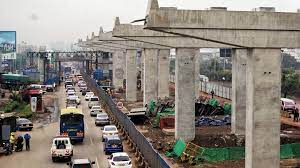
The Kenyan government’s inability to deliver on its economic policy agendas may have contributed to its interest in infrastructure projects outsourced to Chinese firms. A journey along the country’s logistical spine, from Mombasa via Nairobi to Eldoret, reveals a large number of Chinese road projects currently under way. Around Mombasa, there are several operational sites including the Dongo Kundu southern bypass with four bridges that will connect the route south to Tanzania to the main Nairobi road. On the south side of Nairobi, the first phase of a planned expressway to Mombasa, currently contracted as far as Machakos 40 km from Nairobi, is under construction. Within the city, there are several other projects. In the north-west of the capital, along Waiyaki Way, the 27km Nairobi Expressway, some of which is elevated, will connect the north-west of the city to the international airport in the east; construction is at full throttle. A second route north-west out of Nairobi via Ruaka and Ndenderu has a Chinese financed and constructed road in progress. Around Nairobi, there are several more ongoing Chinese road construction projects.
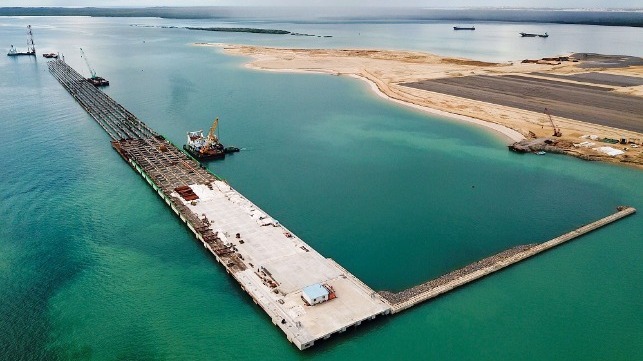
Three hundred kilometres north of Mombasa, at Manda Bay near Lamu, the Kenyan government engaged China Communication Construction Company (CCCC) in a US$480m contract to build the first three of 32 planned berths at a new port it claims opened a first berth in May. The facility, in a remote part of the country, is part of the grandiose Lamu Port-South Sudan-Ethiopia Transport Corridor (LAPSSET), designed to link the economies of three countries to Lamu, which requires large additional investments in road networks. In April 2021, the government in Nairobi announced it has signed with CCCC for 453km of highway construction, including a 257km link north-west from Lamu to Garissa, at a cost of US$166m.
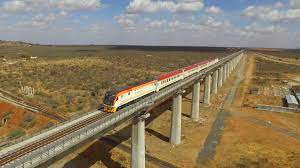
Much the biggest, and most controversial, Chinese project is Kenya’s new Standard Gauge Railway (SGR). The link from Mombasa to Nairobi cost a reported US$3.6bn and an extension to Naivasha, 110km north-west of Nairobi, a further US$1.5bn. The logic of the investment was to reduce freight costs, and accelerate freight times, all along the key logistical route through Kenya to Uganda and the rest of central Africa. However, this does not seem, so far, to have happened. While shipping costs per container on the Mombasa to Nairobi section, which opened to freight in 2018, are similar to road haulage, the addition of depot charges and the cost of moving containers from the railway to final destinations increased costs by up to 50 percent. China’s Exim Bank terms for the loans for the line required guarantees of minimum container volumes which in turn led the Kenyan government to compel all inbound containers destined for the Nairobi region to use the rail service. Despite this, the line has posted substantial losses – US$200m (KSh21.7bn) from inception to May 2020 according to the Ministry of Transport. In 2019, China decided not to provide the further US$4.9bn loans required to complete the connection to Uganda.
It remains unclear what the outcome of the rail project will be. At Naivasha, an Inland Container Depot has been constructed for container transfer to trucks, but is not yet operational. At the same time, a 24km link line is being built by Chinese contractors to connect the SGR to the old, colonial metre-gauge railway (MGR), which Chinese firms have been contracted, along with the Kenyan military, to refurbish. At one site in Eldoret in March, a small team of Chinese was overseeing the reshaping of colonial-era railway sleepers with an imported stamping machine. The Ugandan government announced in 2021 that it will also refurbish its stretch of the historic MGR. What this means for freight costs, however, is impossible to say. Containers will have to be moved between rail bogies on different gauge tracks. The temptation for the Kenyan government to force containers to use the two-gauge route in order to recoup its vast investment may be difficult to resist, leading to monopoly pricing. But if freight costs do not fall across Kenya and into central Africa, the economic logic of the rail project is defeated. Kenya already runs a trade deficit of around six percent of GDP, and higher freight costs will only increase the export shortfall. The World Bank’s 2013 report that said the SGR did not make economic sense appears to be vindicated.[v]
Debts up, revenues down
According to the China Africa Research Initiative (CARI) of Johns Hopkins university, Kenya is one of the top five African countries contributing to revenues of Chinese engineering and construction companies, along with Algeria, Nigeria, Egypt and Angola. CARI identified 43 Chinese loans to Kenya, totalling US$9.2bn, by the end of 2020; at US$6.1bn, loans for transportation projects are second only to Angola. From the Kenyan perspective, the Chinese projects saw public debt as a share of GDP rise from 39 percent in 2013 to 66 percent in 2020, with an increasing share from more expensive commercial sources. According to David Ndii, half of debt is now domestic, at rates of interest over 10 percent, accounting for three-quarters of interest payments. Meanwhile, government revenue as a portion of GDP fell from 18.1 percent in 2013-14 to 16.1 percent in 2018-19. The IMF this year described Kenya as ‘at high risk of debt distress’.[vi]
The situation places great weight on Kenya’s vaunted private sector to carry the economy forward. Entrepreneurial innovation in Kenya is certainly impressive. M-Pesa (meaning ‘mobile money’), the mobile phone-based payments and lending service developed by Kenya’s Safaricom, has come to be used by more than 70 percent of the population, and expanded regionally. Kenya produces significant numbers of agile, private-sector start-ups every year. Peter Njonjo, a former Africa executive with Coca Cola, started Twiga Foods in 2014, which provides the logistics to link farmers with small-scale retailers. Unable to overcome the product quality problems of smallholder farmers in an environment of weak government support, Twiga is integrating larger-scale commercial farms in the region into its city-focused distribution network. It is a typical case of the Kenyan private sector adjusting to what is possible and Twiga has won investment from the World Bank’s private sector lending arm and Goldman Sachs. ‘The lack of government involvement has led the ecosystem to evolve in a very informal way,’ says Njonjo. The private sector’s job, he says, is to find a way through this.
Kenya should be a processing hub for farm products. Led by private sector firms, regional trade in foodstuffs is already much expanded. In March, for instance, potatoes on sale in Kenya are likely to be from Tanzania, plantains from Uganda, reflecting relatively stronger growth of regional trade in East Africa compared with West Africa. Nonetheless, the space available to the private sector in Kenya is less than the government’s rhetoric suggests. There are still more than 300 state sector firms operating in the country despite decades of World Bank and IMF-led ‘reform’ programmes — in retail, manufacturing and agri-processing sectors among others. At the same time, as a recent World Bank report observes: ‘Prominent government officials often have large private sector interests and influence public procurement and government priorities through the use of proxy companies.’[vii]
As noted, Kenya has run ahead of the average sub-Saharan growth rate for several decades. To recognise more of its potential, however, the country needs more competition and more export-focused private sector activity. However, it is difficult in the current political climate — dominated by a small number of what Kenyans term ‘royal families’ that consistently failed to frame an economic development agenda — to see this happening. Kenya, for instance, opened Export Processing Zones in the 1990s at the same time as Bangladesh; but policy implementation failings mean that today Kenyan EPZs employ around 50,000 workers versus four million in Bangladesh. The more likely trajectory for Kenya is towards another debt crisis and a new round of World Bank and IMF interventions. Before that, there will be the next Kenyan election, in 2022, and the possibility of renewed ethnic violence on which Kenyan politics all too often feeds.
[i] Leo, C. (1978). The Failure of the ‘Progressive Farmer’ in Kenya’s Million-Acre Settlement Scheme. The Journal of Modern African Studies,16(4), 619-638.
[ii] Poulton, C. and Kanyinga, K., 2014. The politics of revitalising agriculture in Kenya. Development Policy Review, 32(s2), pp.s151-s172.
Bill Overholt has written a valuable piece in the Harvard University journal Prism putting US-China rivalry into historical context. It is a reminder of how important an understanding of historical context is enabling individuals and governments to make good decisions.
Below is a really great deconstruction, by the estimable Robbie Barnett, of the differences in Chinese policy towards Xinjiang versus Tibet. Sadly, the piece also reminds us just how much under-resourced, bad journalism exists in developed countries. And it highlights how Islamophobia is at the heart of what the Chinese state is doing to Xinjiang.
Tibetan Buddhists walk past a poster showing Chinese President Xi Jinping and former Chinese leaders Jiang Zemin, Mao Zedong, Deng Xiaoping, and Hu Jintao during a government-organized tour of Tibet on October 15, 2020. Thomas Peter/Reuters
…
China’s Policies in Its Far West: The Claim of Tibet-Xinjiang Equivalence
Robert Barnettis a Professorial Research Associate at the School of Oriental and African Studies, University of London; an Affiliate Researcher at King’s College, London; and former Director of Modern Tibetan Studies at Columbia University. Recent edited volumes include Conflicting Memories with Benno Weiner and Françoise Robin, and Forbidden Memory by Tsering Woeser. This piece was produced in collaboration with an ongoing group research project into policy developments on Tibet.
Since the wave of mass detentions in Xinjiang became known internationally, a secondary proposition has begun to circulate in the media and among a number of politicians: the claim that Tibetans are experiencing similar abuses to those faced by Uyghurs and other minorities in Xinjiang, the other vast, colonized area in what China sees as its far western territory. That claim is incorrect. Although Chinese policies in Tibet are exceptionally restrictive and repressive, as far as is known they do not include the extreme abuses found in Xinjiang. Of course, we should encourage such questions to be raised and assessed, but scholars, the media, and opinion leaders need to discriminate more carefully between speculation and knowledge, and between advocacy and scholarly findings. The lines between these categories have been blurred increasingly, perhaps deliberately, and can damage everyone if not restored.
The central premise of the Tibet-Xinjiang equivalence claim is that China’s Tibet and Xinjiang programs are similar in terms of mass abuses. Proponents note correctly that mechanisms, terminology, aims, and underlying theories used by the Chinese Communist Party (CCP) in Tibet and Xinjiang are similar, and that the current Party Secretary of Xinjiang formerly served in Tibet. These continuities reflect the shared repertoire of Communist jargon and history from which all CCP officials draw, as well as their adherence to the CCP’s overall policy regarding nationalities, which has shown an increasingly assimilationist approach since 2014. However, despite their constant declarations of unity with the Party Center, regional officials are not expected to implement the Center’s policies in identical ways in each region.
In fact, Chinese policies in Tibet and Xinjiang have often differed widely in implementation. This divergence reflects topography, history, and logistics, but also continues the deep-seated debates among revolutionaries since at least the time of the Jacobins and Girondins about how rapid or gradual revolutionary reforms should be. Much the same debate took place within the CCP from even before the founding of the People’s Republic of China. It focused particularly on areas inhabited by peoples such as the Tibetans, Mongolians, or Uyghurs. In such areas, radicals in the CCP—notably leaders of the Northwest Military Region—insisted on rapid, often violent social transformation. Gradualists, such as those in the Southwest Military Region in the first half of the 1950s, argued that Tibetans, being more backward in their view, should be won over by allowing feudal practices to continue while slowly building initial alliances with local elites. The details of this debate have been carefully documented by Benno Weiner in his recent book on the factions that respectively opposed or promoted the gradualist strategy known as the United Front in Tibetan areas of Qinghai in the 1950s. Weiner shows that the gradualist approach lasted in those areas until 1958, when policy switched to immediate reforms of society, land ownership, and religious practice, which usually meant the use of force and culminated with the Cultural Revolution. The gradualist approach was reintroduced throughout China in 1979, when Deng Xiaoping came to power. Not coincidentally, Deng had been the Political Commissar of the Southwest Military Region in 1950; arguing that China was still in the “primary stage of socialism” and thus not yet ready for full communism was a return to the praxis advocated by his faction forty years before.
There was nothing new or specifically communist about this debate over how to manage minorities. In the late Qing empire, Chinese reformers had argued over the same question: whether to incorporate non-Han Chinese peoples within the empire rapidly by force or gradually through education, industrialization, acculturation, or some longer process. In Xinjiang, the Qing had resorted to direct control by invading the region in 1877 and turning it into a Chinese province; Tibet had negligible Han Chinese or Manchu presence at that time. By 1910, the proponents of rapid, forced reform had persuaded the Qing court to allow a policy of direct rule and rapid assimilation of Tibetans, which the Qing representative in Sichuan, Zhao Erfeng, carried out until the fall of the dynasty a year later. Some scholars trace the differential ways of managing minorities in China to much earlier perceptions in Chinese political thought as to which minorities were more “raw” or “untamed” relative to those considered somewhat “civilized” and thus amenable to softer tactics. Today, arguments of this kind are diplomatically concealed behind milder-sounding arguments, such as the current view among CCP policymakers that there are two kinds of religion in China—so-called “non-indigenous religions,” which include Islam, and “indigenous religions” such as Buddhism (notwithstanding that in fact it originated in India, not China). We can easily imagine Chinese policymakers arguing that followers of an “indigenous” Chinese religion are more easily managed and so can be won over with less brutal policies than those who follow a monotheistic, “non-Chinese”—read, less civilized—religion.
Since 9/11, this diffracted version of global Islamophobia has been commonly expressed in China in terms of terrorism, which the current Xinjiang policies are supposed to forestall. By contrast, the spectre of terrorism is rarely invoked in Tibet. There, the threat consists primarily of an idea that Beijing seeks to eradicate: the insistence by “the Dalai” that Tibet was independent in the past. This effort by Beijing has led to extraordinarily extensive forms of repression, control, and social engineering in Tibet, which are increasing almost by the day. But in terms of violence, China has been cautious in Tibet, as demonstrated by the fact that there have been only two or three known judicial executions of Tibetans in politically related cases over the last 35 years, as opposed to scores of executions of Uyghurs in Xinjiang.
Whatever the rationale, the Chinese state has often enacted policies in different ways in different areas, even if the policy names and objectives are similar. This is what was so significant about China’s decision to scale back Mongolian language instruction in Inner Mongolia last year: until then, China’s policy of assimilation and bilingual education in Inner Mongolia had followed a wholly different and more accommodating model of policy implementation from those in Tibet, Xinjiang, Qinghai, or any other area. The change announced for classroom teaching in Inner Mongolia’s primary schools was significant because it meant that, after several years of giving primacy to local culture, the region was switching from a gradual to a rapid, forced approach to implementing policy on a non-Han Chinese population.
Mass Detention in Tibet
The contention that Tibet and Xinjiang are coterminous in terms of mass abuses has been made by a number of commentators, journalists, and politicians, including Lobsang Sangay, the current head of the exile Tibetan administration. Sangayhas said, among other things, that forced detention camps exist currently in Tibet. There have been some occasions in the last decade when camps were created to hold Tibetans detained without being accused of any crime. Two of those occasions involved serious abuses. These occurred in camps created in 2017 to house monks and nuns expelled from a number of monasteries in eastern Tibetan areas, notably Larung Gar, and then returned forcibly to their home areas within the Tibet Autonomous Region (TAR), where they were detained for “legal education.” One of these camps was created in the eastern Tibetan area of Nyingtri to reeducate a number of nuns, while the second was in Sog, Nagchu, in northern Tibet, where the detainees seem mainly to have been monks. The detained nuns, comprising at least 30 women, were forced to sing or dance in front of officials to the tune of patriotic Chinese songs, in at least one case while wearing military-type outfits. In the case of the center at Sog, there is one account by a monk who was held for four months in 2017, and it describes incidents of forced reeducation, humiliation, torture, and sexual harassment. These are instances of grave abuse, but they are not similar in scale or duration to the systematic, mass practices of detention and cultural eradication in Xinjiang, where detainees are held and abused for years, forced repeatedly to abjure religious belief entirely, and made to use a language not their own.
There have been at least three other recent occasions in Tibet—in March 2008, January 2012, and May 2012—when camps were created temporarily in hotels, schools, or converted army bases to hold Tibetans for purposes such as “legal education.” The 2008 camp held several hundred monks from monasteries in Lhasa whose place of registration was outside the TAR, and the 2012 detentions were of an estimated 2,000 to 3,000 lay Tibetans held for two months after attending religious teachings by the Dalai Lama in India. In addition, a Tibetan reported being held for two months in a detention center in Driru, Nagchu, in 2016, and I know of two individuals held for about two weeks each in 2019 in some office buildings in a Tibetan area of Sichuan for failing to implement supposedly voluntary “poverty alleviation” measures.
Further details of these cases have not yet emerged, and others may well come to light. However, these cases again differ markedly from the Xinjiang camps in terms of scale or degree, involving an estimated 6,000 to 7,000 people over a decade or more—around 1.4% of the lowest estimate for detainees in Xinjiang during the last four years. In addition, as far as one can tell from interviews with former inmates or those close to them, the Tibetan camps appear to have lasted for at most six months, but usually much less; included limited amounts of re-education, if any; and, apart from the two camps in 2017, are not reported to have involved cultural denigration, physical abuse, or cruelty.
Labor Programs and the Coercion Claim
In September 2020, a report appeared by a scholar that appeared to show evidence of forced labor camps in Tibet and other Xinjiang-style policies in the TAR. That scholar, Adrian Zenz, has done well-regarded work on Tibet and Xinjiang in the past. His more recent work has been attacked and abused by Chinese state media and others, including smears about his religious beliefs by a pro-Chinese denialist called Max Blumenthal, demonstrating a particularly ugly form of hypocrisy. He is also being sued by Chinese companies in Xinjiang and has been sanctioned by the PRC government.
Nevertheless, there are some technical problems with Dr. Zenz’s article on Tibet. Although scholarly in nature, the article was not peer-reviewed, involved no field verification, and did not refer to work by other researchers with expertise on labor, employment, and statistics in Tibet. In addition, the article was coordinated with a prominent media campaign, including simultaneous release of an op-ed in the New York Times, a lengthy article by Reuters, an editorial by the Wall Street Journal, and a report by a political lobby group, the Inter-Parliamentary Alliance on China (IPAC).
Dr. Zenz and like-minded writers described a mass program initiated by Chinese authorities to provide labor training for Tibetans, and in some cases to arrange for them to be transferred to other locations for work. These writers are entirely correct that training programs claiming to involve huge numbers of people have been set up in Tibet, alongside a program arranging for people to move to different areas for work. They are also correct that in Xinjiang a program with a similar name appears to have involved abuses on a vast scale. But details of the Tibet scheme are unclear and—so far—do not yet indicate Xinjiang-style implementation: so far at least, around 94 percent of what are described in these reports as labor transfers in Tibet are apparently local, at least some of the small number of intra-provincial ones claim to be short-term, and there is no evidence yet that either of these programs in Tibet has involved force or abuse.
As for actual cases of coercion, there are none in the reports by Dr. Zenz, Reuters, or any other outlets. When I asked a Tibetan colleague about his own research, he described a Tibetan family of seven, all of whom had registered for labor training programs. Only one, however, had in fact attended a course, and the family had not reported any threat of force or pressure to comply. This seemed to suggest that, at least in that case, local officials were aiming primarily to put names on registration forms in order to inflate the number of apparent participants in the program.
This case does not prove anything, but it does raise doubts. If we go back to the article by Dr. Zenz, we will see that it consists of two entirely different statements: one that correctly summarizes Chinese official documents giving numbers for registration or inclusion in labor training schemes and work placements, and one that is purely inference about a possibility of labor camps (as opposed to voluntary training camps) and of the use of force. Those inferences are based on references in official documents to such things as “military-style” training and to photographs of trainees in military clothes. Such an inference is possible. It is not, however, reliable: every school and university student in China has military-style training for a week or so each year and many department stores have military-style training every morning. These trainings involve drills, but not necessarily the use of force, and many people in Tibet and China wear military garb because it is tough and cheap.
Dr. Zenz himself noted in his original report that he had found no evidence for any Xinjiang-style labor camps in Tibet: “There is so far no evidence of accompanying cadres or security personnel, of cadres stationed in factories, or of workers being kept in closed, securitized environments at their final work destination.” He added that “there is also currently no evidence of TAR labor training and transfer schemes being linked to extrajudicial internment.” He later stated categorically that he had never mentioned labor camps.
The Reutersreport also had two types of findings: one confirmed the existence of the labor programs, citing two or three official documents not used by Dr. Zenz, while the other repeated the evidence about coercion offered by Dr. Zenz without new evidence. Therefore, the question of force was not part of its “investigation.” The article even said that “Reuters was unable to ascertain the conditions of the transferred Tibetan workers”and that “Researchers and rights groups say…without access they can’t assess whether the practice [of labor transfer] constitutes forced labor.” Nevertheless, it still repeated the same allegations of abuse and force, attributing them to “rights groups.” It added a fact that appeared to be corroborative, stating that “small-scale versions of similar military-style training initiatives have existed in the region for over a decade,” but gave no details of such cases, apart from that of the 30 nuns in 2017, noted above.
The qualifications that the authors of these reports provided were correct and appropriate, but they were too little and too late. The reports included multiple references to coercion, albeit speculative, and more categorical assertions were made in accompanying op-eds and oral presentations. Such speculation is often justifiable and necessary, not least because evidence of major abuses might yet come to light. Tibetan exiles and others are not wrong to be concerned. But the initial reports by Dr. Zenz and Reuters led to a wave of secondary reporting that, regardless of intention, blurred the solid data about the existence of labor training and work placement schemes with speculation about coercion.
Those secondary reports acknowledged Dr. Zenz’s article as the source of their information, but claimed incorrectly that he had reported the existence of labor camps and alleged use of force, about which he had only speculated. The Times of London said China was “accused of imprisoning 500k Tibetans in labor camps” and “as many as half a million Tibetans have been forcibly moved into labor camps this year,” making it a single-source report, with no corroboration, claiming incorrectly that Zenz had alleged imprisonment and labor camps. The BBC declared that the Zenz report had found China to be “‘coercing’ thousands of Tibetans into mass labor camps” and said this had been corroborated by Reuters, although Zenz had not said this, while Reuters had confirmed only the existence of labor programs, not the existence of labor camps or coercion. The BBC added that “the scale of the programme as detailed in this study indicates it is much larger than previously thought,” although in fact this was the first mention of the program outside China. The Guardian was more cautious and only referred to coercion in quoted remarks from Zenz, but, like the BBC, said the Zenz report had been corroborated by Reuters, implying this applied to camps and coercion as well as labor programs. The New York Times did not report the news, but carried an op-ed by Zenz which made stronger assertions about the use of compulsion than his original article had, this time without any caveat. Meanwhile, the Sydney Morning Herald reported without qualification and without any second source that “China is pushing hundreds of thousands of Tibetans into forced labor camps,” none of which is known to be true.
Not surprisingly, this apparent unanimity in the mainstream media implying an equation between the labour training scheme and coercive detention was quickly taken up in the political arena. The Inter-Parliamentary Alliance on China referred to “an apparent widespread system of forced labor” and “a large-scale mandatory ‘vocational training’ program” in Tibet, again relying on one source, and again fusing the substantive issue of labor programs with speculation about it being “forced” and “mandatory.” The Congressional-Executive Commission on China, based in Washington, D.C., held a hearing partly based on the reports of “forced labor” in Tibet; the British House of Commons organized a debate on the issue at which a senior British politician, Sir Iain Duncan Smith, asserted categorically that the Tibet labor programs were “mandatory,” “forcible,” and involved “people … being taken from one place and put into camps;” and the Democracy Forum in the UK held a discussion in part about the fact that, according to its chair, China “has sent over half a million Tibetans to labor transfer camps under strict military supervision.”
I have found just one media report that correctly reported on the Zenz report: a tiny media outfit called TLDR. TLDR published a video summary of the Zenz report which is accurate as well as succinct, yet manages to detail the factual claims about the labor training schemes separately from Zenz’s speculation about the possible use of force, which it bracketed as an as yet unverified but potentially important addendum.
Since then, the rhetoric has escalated. The most striking case is that of a scholar and a former journalist affiliated to universities in Australia who hosted a podcast originally called “Tibet-The Final Solution?” The title was taken from a statement by a Tibetan activist that China plans the total annihilation of Tibet or its culture, which was used as the trailer for the program. The actual podcast, the title of which was later changed amid complaints, did not discuss or debate this claim—it was added after the discussion had been recorded and was designed, apparently, only as click-bait to attract an audience. What is going on when a serious journalist, let alone an academic, proposes that China is a Nazi state trying to annihilate Tibetan people or Tibetan culture? China is indeed minimizing the role of the Tibetan language in schools, insulting the Dalai Lama, denying Tibetan history, persecuting dissidents, relocating nomads, and trying to adapt popular understandings of Tibetan Buddhism so that the religion emphasizes or mimics (“Sinicizes,” as the state puts it) neo-Confucian values, amid numerous other repressive policies. But to equate this with the Wannsee Conference is deeply offensive and unethical.
Apart from insulting the memory of those who died, for one thing, there is no evidence of any attempt, at least in the post-Mao era, to annihilate the Tibetan people. As for culture since the death of Mao, as Dr. Zenz himself documented in his earlier work on Tibet, certain aspects of Tibetan modern culture have thrived, particularly prose fiction, poetry, film, fine art, popular music, and to some extent the Gesar epic, horse racing, and certain local festivals. Publications of traditional religious texts run into the thousands. Lay religious events still involve thousands of people. There is an enormous amount of repression, which should be widely studied and publicized, and there are understandable reasons why many Tibetans fear for their culture, alarmed as many are by, for example, the prioritization of Chinese as the language of instruction in many or most schools. But this is not the same as genocide or annihilation: Tibet is not Xinjiang.
Activists and others should of course be encouraged to argue their perspectives and present whatever evidence they have. But for a mainstream media outfit, let alone a university, to use such a proposition as click-bait is disturbing. In the long run, this kind of ideologically-inflamed, anti-Chinese rhetoric will damage Tibetan people and their situation in Tibet, since they and others will have to waste time on debates about what is exaggerated and what is fact. The underlying issue here is not that scholars should not speculate, nor that activists and community members should not raise deeply held concerns: they should do both. But serious writers, publications, and media need to maintain sharp distinctions between what is speculation and what is reliable, confirmed information. The quality of discourse, and even the possibility of developing effective responses to mass abuse, suffers on all sides if exacting standards of evidence and discussion are discarded.
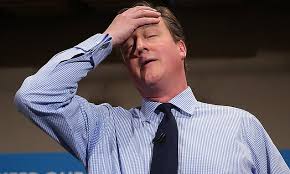
What a great story this is from the FT. It turns out that Lex Greensill, sleazebag Ozzie founder of recently collapsed Greensill Capital, former British Prime Minister ‘Brave’ Dave Cameron, and murderous Saudi tyrant-in-waiting Mohammed bin Salman went on a camping holiday together in the desert last year. It must have been tremendous fun.
More recently, Brave Dave, a highly-paid adviser (with a potential US$70 million of share options) of the delightful Lex Greensill, sent numerous text messages to the private number of British Chancellor Rishi Sunak urging him to extend special Covid loans to Greensill. Unfortunately, the phone reception in Oxfordshire is so poor that Dave has been unable to respond to journalists’ enquiries.
It is reassuring to see, in the wake of the Global Financial Crisis, that almost nothing has changed in the nexus between amoral financial services ‘professionals’ in the City of London and on Wall Street and Establishment politicians who fill their boots with the sector’s cash flows after leaving office. Greed is still good.
Also breaking since late last week is the story of Archegos Capital Management, founded by Bill Hwang, who was fined US$44m by US securities regulators in 2012 for trading on insider information about Chinese banks, but managed since then to borrow of the order of US$40 billion from global investment banks. Bill built an investment portfolio of around US$50 billion at its peak with as little as US$1 of equity for every US$8 of debt. He used derivative, total-return swap contracts as the basis for his portfolio, which meant no one could track the huge positions he was taking in the market (well done regulators — who are those mugs who said you’d learned your lesson?). Actual ownership of the stocks stayed with the prime brokerage units of the investment banks, which held them as collateral against the loans they extended to Bill.
What a great plan. The only, small oversight came with the recent sell-off of the kinds of growth stocks Bill liked to buy. When the investment banks asked Bill to put up more margin, it turned out he couldn’t or wouldn’t. Last Friday, the investment banks panicked and dumped an estimated US$20 billion of stock in a handful of firms into the market, with a predictable impact on prices. Credit Suisse (which was also a lead financier for Greensill and for the unfortunately named 2020 long-firm fraud Luckin Coffee) is headed for a hit of US$3-4bn, Nomura one of up to US$2bn.
Lex Greensill had penetrated the British establishment, forging close links with the country’s highest-ranking civil servants and ministers and lobbying for lucrative government contracts.
Now the Australian financier had a new sovereign client in mind, where wealth and power were more concentrated and the right relationships could transform his business: Saudi Arabia.
Before Greensill Capital collapsed this month, one of Lex Greensill’s favourite anecdotes was a camping trip he said he had taken with David Cameron and Saudi Crown Prince Mohammed bin Salman. Accompanied by the former UK prime minister, who was now his paid adviser, Greensill visited the desert with Prince Mohammed, the kingdom’s de facto leader, according to three people who heard his account of the journey.
One of the people placed the trip during January or February 2020, shortly before the spread of coronavirus largely halted international travel. Flight records for Greensill Capital’s four private planes show a series of trips to Saudi Arabia in the first three months of last year.
A second person who heard Greensill’s account of the trip said the Australian financier explained he bonded under the night sky with the Saudi royal, commonly known as MBS, over the fact the two men had both studied law at university.
Greensill Capital declined to comment. The Saudi embassy in London declined to comment. The Financial Times has attempted to ask Cameron about the account of the desert camping trip several times, but the former prime minister has ignored the inquiries.
His role in the company’s downfall has come under growing scrutiny, after the FT revealed he lobbied former colleagues for greater access to emergency government Covid loan schemes.
Cameron, who once stood to make tens of millions of pounds from Greensill share options before the company’s collapse rendered them worthless, visited Saudi Arabia publicly in October 2019, attending the so-called “Davos in the Desert” summit in Riyadh.
The trip — a year after the murder of journalist Jamal Khashoggi by Saudi agents — was criticised at the time by Amnesty International, which said the former prime minister’s attendance would be “interpreted as showing support for the Saudi regime” despite its “appalling human rights record”.
Cameron, who charges at least £120,000 per hour for speaking engagements, frequently used Greensill’s corporate jets to travel around the world, according to several people familiar with the matter.
The FT has also seen a photograph of him aboard one of these plushly furnished aeroplanes. Flight records for one of Greensill’s aircraft show numerous trips to and from Newquay airport, which is around half an hour’s drive from Cameron’s holiday home in Cornwall.
Greensill’s fleet of aircraft, an unusual luxury even for the largest multinational companies, came in useful during another visit to Saudi Arabia. In August 2019, SoftBank chief executive Masayoshi Son and his top lieutenant Rajeev Misra had been holding meetings in the commercial centre of Jeddah when they were invited to visit Yasir al-Rumayyan in the capital Riyadh.
Rumayyan was head of the country’s Public Investment Fund, which is in turn the largest investor in SoftBank’s $100bn Vision Fund, which has backed valuable start-ups from Uber to DoorDash.
As the men looked to change flight plans, Greensill spoke up to offer them a ride on his private jet. Some of those present were amazed the unassuming Australian had his own plane.
But Greensill, then 42, had recently cemented his status as a billionaire thanks to SoftBank’s investment in his eponymous finance company. He explained he had not one, but multiple aircraft. “We need it for clients,” one attendee recalls him explaining. “We need an air force.”
Greensill’s engagement with Saudi Arabia was multi-faceted. Last June, senior Greensill executive John Luu spoke at the “UK-Saudi Virtual Fintech Week”, an event hosted by the UK’s Department of International Trade and the British embassy in Riyadh.
The event’s marketing material touted the UK’s “progressive regulators” and Saudi Arabia’s “young and tech-savvy population”. “We are a firm that not many people have probably heard of,” Luu said at the event. “And yet, at the same time, our reach is pretty broad.”
He went on to explain that Greensill Capital was not only “part of the family” of Saudi’s PIF due to the company’s backing from SoftBank, but also that the finance firm had “just penned an agreement to become joint-venture partners” with the sovereign wealth fund. “As part of that, we’re establishing offices in Riyadh,” he added.
PIF did not respond to a request for comment. Luu, whose LinkedIn profile described his role as “spearheading Greensill’s expansion into Saudi Arabia”, also said at the event that his company had contracts with “some of the largest companies in the Kingdom”, but declined to name any of them.
The one company that seemed to be the target of a multiyear charm offensive in the country was state-controlled oil company Saudi Aramco. Greensill frequently touted that his company was in line to win a lucrative contract to offer so-called supply-chain finance to Aramco, according to people familiar with the matter.
Also known as reverse factoring, Greensill’s signature financing technique involves paying a company’s suppliers upfront at a discount and is known for its ability to flatter corporate balance sheets. The finance company never actually ended up providing any supply-chain finance to the oil company, however. Aramco, which also counts Rumayyan as its chair, declined to comment.
Greensill was also involved in some even more speculative financing proposals in Saudi Arabia. During the 2019 trip to Jeddah, SoftBank executives were examining how they could help the desert kingdom modernise the holy city of Mecca, which draws millions of visitors each year during the Islamic pilgrimage known as the hajj.
Different companies in the Vision Fund could play a role: US construction start-up Katerra to build new structures, Hong Kong artificial intelligence specialist SenseTime to offer facial recognition, while India’s Oyo could help set up hotels for visiting pilgrims. And Greensill would package all this up into investment products to finance the project.
Son at this time believed the Australian financier was capable of funding increasingly grand schemes, according to people who know the SoftBank founder. He even frequently introduced Lex Greensill by a pithy nickname: “the money guy”.
“He was part of the overall solution for a smart city for Mecca,” said a person involved in the talks. “That’s why Lex was down there. He was doing the financing.” The grand vision, again, never came to fruition.
Below is an excellent piece from The Atlantic about the recent US-China high-level meeting in Anchorage, which may come to be seen as the moment the US, and its allies, began to deal effectively with Xi Jinping’s regime.
Thursday night’s very public dustup between United States and Chinese officials in Anchorage, Alaska, during the Biden administration’s first official meeting with China, may have seemed like a debacle, but the exchange was actually a necessary step to a more stable relationship between the two countries.
In his brief opening remarks before the press, Secretary of State Antony Blinken said that he and National Security Adviser Jake Sullivan would discuss “our deep concerns with actions by China, including in Xinjiang, Hong Kong, Taiwan, cyber attacks on the United States, and economic coercion toward our allies. Each of these actions threaten the rules-based order that maintains global stability. That’s why they’re not merely internal matters and why we feel an obligation to raise these issues here today.”
Blinken’s comments seemed to catch the Chinese off guard. The last Strategic & Economic Dialogue of the Obama administration, in 2016, began with a conciliatory message from then–Secretary of State John Kerry and resulted in a declaration identifying 120 different areas of cooperation.
In response to Blinken, China’s top diplomat, Yang Jiechi, said that because Blinken had “delivered some quite different opening remarks, mine will be slightly different as well.” He spoke for 16 minutes, blowing through the two-minute limit agreed upon in torturous pre-meeting negotiations over protocol. “Many people within the United States,” he said, “actually have little confidence in the democracy of the United States.” He went on to say that “China has made steady progress in human rights, and the fact is that there are many problems within the United States regarding human rights.” He also took aim at U.S. foreign policy: “I think the problem is that the United States has exercised long-arm jurisdiction and suppression and overstretched the national security through the use of force or financial hegemony, and this has created obstacles for normal trade activities, and the United States has also been persuading some countries to launch attacks on China.”
As the press began to leave, assuming that the opening remarks were over and to make way for the private discussions, Blinken and Sullivan ushered them back in and challenged Yang, telling him that “it’s never a good bet to bet against America.” Determined to have the last word, Yang and China’s foreign minister, Wang Yi, responded again. Yang began by saying, sarcastically, “Well, it was my bad. When I entered this room, I should have reminded the U.S. side of paying attention to its tone in our respective opening remarks, but I didn’t.”
The opening exchange did not appear to materially affect the rest of the meeting. A senior administration official told me that the moment the cameras left, the Chinese side went back to business as usual, working through the list of issues on the agenda, including nonproliferation and Iran. The official told me that the U.S. delegation believed Yang’s opening gambit had been preplanned and was not an off-the-cuff response. The Chinese delegation had come, the official said, with the intention of delivering a public message, which they did in dramatic fashion. China believes that the balance of power has shifted in its favor over the past 10 years, especially during the pandemic, and wanted to play to the audience at home.
For an astonished press, witnessing the exchange was like being present at the dawn of a new cold war and seemed to sum up just how bad the U.S.-China relationship had become. Writing in The New York Times, Ian Johnson warned, “These harsh exchanges will only contribute to the dangerous decay in relations between the world’s two most powerful countries. Both sides seem to be trapped by a need to look and sound tough.”
But this view misunderstands what is needed in U.S.-China diplomacy right now. The meeting would have been a failure if it had resulted in general declarations to cooperate while minimizing competition, a common U.S. strategy when China’s intentions were not as clear. Organizing the relationship around cooperation is theoretically desirable as an end goal but will be unattainable for the foreseeable future, given the unfolding reality of an assertive, repressive China and a defiant America.
Last year, as it anticipated a win for Joe Biden in the U.S. election and then during the transition, China signaled that it wanted to effectively reset the relationship regarding cooperation on climate change and the pandemic. The Biden team saw these overtures for what they were: a trap to get the U.S. to pull back from competing with China in exchange for cooperation that would never really materialize. Biden officials told me that any reset would have been rhetorical only; China would have continued to push forward on all other fronts, including its quest for technological supremacy, its economic coercion of Australia, and its pressure on Taiwan.
Had the Biden administration embraced China’s offer, any agreement would have collapsed beneath the weight of Beijing’s actual behavior, as well as opposition in Washington. Biden would have been forced to adjust course and take a more competitive approach anyway, under less favorable conditions, including nervous allies and an emboldened China.
By skipping this step in favor of a strategy of competitive engagement—meeting with China but seeing it through the lens of competition—the Biden team not only saved time, but it flushed Beijing’s true intentions out into the open for the world to see. In his remarks, contrasting “Chinese-style democracy,” as he called it, with “U.S.-style democracy,” Yang implicitly acknowledged that the U.S.-China relationship is, and will continue to be, defined by a competition between different government systems: authoritarianism and liberal democracy.
The Biden administration understands that a more assertive U.S. approach is jarring to many in the American foreign-policy establishment, which is accustomed to decades of cautious and cooperative engagement in high-level meetings. But friction is necessary, given China’s play for dominance over the past several years. “It is increasingly difficult to argue that we don’t know what China wants,” said the senior administration official, who asked for anonymity so as to speak freely about the meeting. “They are playing for keeps.”
Biden’s priority rightly seems to be creating a greater common cause with allies against China, especially on technology and economics. Sullivan refers to this approach as building a situation of strength, echoing the famous formulation by Truman’s secretary of state Dean Acheson, who made clear that strengthening the Western alliance was a necessary precondition for any talks with the Soviet Union. The U.S. has had considerable success with the Quad, the informal strategic alliance among the United States, Japan, Australia, and India, although the U.S. needs to be far more imaginative and ambitious in getting European nations on board with its efforts to compete with China.
The question after Anchorage is what role should bilateral diplomacy with Beijing play in America’s overall strategy to deal with China. Now that the dramatic public exchange has set a more honest approach for a competitive era, the two sides can progress to a much harder next phase.
The rules-based international order is over. Beijing and Moscow concluded long ago that a world in which China and Russia generally acquiesced to U.S. leadership, as they did in the 1990s and 2000s, was untenable, a Western trap designed, in part, to undermine authoritarianism. They were not entirely wrong about that—many Americans saw globalization and multilateralism as having the desirable side effect of encouraging political liberalization around the world.
The truth is that the United States does pose a threat to the Chinese Communist Party’s interests (although not necessarily those of the Chinese people), while the CCP surely poses a threat to liberal democracy and U.S. interests. Ultimately, Washington and Beijing will have to acknowledge this to each other. That will be difficult for the Biden administration, which is accustomed to assuming that American interests are not a threat to any other government, but broadly benefit all major world powers. It will be even harder for Beijing, which goes to great lengths to conceal its revisionism behind a shield of insincere platitudes.
Such an acknowledgment will allow a truly frank strategic conversation to occur about how these two countries’ systems will relate to each other as they compete. These systems are incompatible in many respects, but they are also intertwined in a myriad of ways. The goals of U.S.-China diplomacy should initially be modest, to avoid unintentional provocations and to facilitate transactional cooperation on shared interests. Eventually, if China’s behavior and the geopolitical conditions are favorable, the two sides could explore broader cooperation and even the possibility of a détente—a general thawing of tensions—but that is a long way off.
Historically, the most volatile periods of rivalry between major powers is in the early stages; think of the late 1940s and the 1950s in the Cold War. The red lines become apparent only through interactions in crises. The greatest risk is for either side to miscalculate the resolve or intentions of the other. By getting real in Anchorage, both sides have taken the important first step toward a more stable relationship by acknowledging the true nature of their relationship.
This starts a series of notes from Africa, the world’s developmental frontier, about which I am writing a book. If you read Russian, these notes will be published in the Ukraine-based, Russian-language literary magazine Huxley.
Border disputes and territorial changes resulting from the war in Tigray. Source: Political Geography Now
Ethiopia is experiencing what may be the most significant political crisis on the African continent for a generation. Certainly, it is the most serious crisis to face Ethiopia, Africa’s most promising developmental state and its second most populous country, since the ruling coalition, the Ethiopian People’s Revolutionary Democratic Front (EPRDF), defeated the Stalinist Derg junta of Mengistu Haile Mariam in 1991.
The crisis stems from Prime Minister Abiy Ahmed’s decision in early November to take military action against the Tigrayan People’s Liberation Front (TPLF). From 1991 until Abiy (Ethiopians are traditionally referred to by their given names) became Prime Minister in April 2018, the TPLF dominated the ruling EPRDF coalition. Although the northern federal state of Tigray accounts for only six percent of the Ethiopian population, Tigrayans dominated cabinet, filled the majority of senior civil service positions, ran the federal army and held key offices in the intelligence services.
‘Power’, observed the British historian Lord Acton, ‘tends to corrupt, and absolute power corrupts absolutely.’ Although led until his passing in 2012 by perhaps the most erudite developmental leader the world has seen, Meles Zenawi, the TPLF enjoyed something close to absolute power. Tigrayans came to control much of the economy of the capital, Addis Ababa, and much of their money was not made honestly. The army engaged in widespread smuggling operations, using federal military transportation equipment. It bilked large sums through its control of Africa’s biggest energy project, the five-gigawatt Grand Ethiopian Renaissance Dam (GERD), on the Sudan border. The corruption was never Kenyan-, or Democratic Republic of Congo-style kleptocracy, but it delayed the critical dam project (see below) and dragged increasingly on an economy that has grown out of hunger and dire poverty at 10 percent a year.
So Abiy, from the largest, lowland ethnic group, the Oromo, which accounts for 35 percent of the Ethiopian population, decided to take the TPLF down. Whether it was necessary to do this militarily – as Abiy is trying – and whether a political solution was instead possible, is a subject of intense debate, both in Ethiopia and in international diplomatic circles. As with any counter-factual, we will never know the absolute truth. Equally, the question of which side kicked off the fighting between federal forces and the TPLF is a complex one. Abiy Ahmed’s government says that the TPLF attacked bases and the headquarters of federal Northern Command forces on 3-4 November, taking command of ethnic Tigrayan forces and looting vast amounts of military equipment. The TPLF says that troop movements on the Tigrayan and Eritrean borders prior to this attack made clear Abiy’s determination to pursue a military confrontation and that it was acting in self-defence. As with the origins of the First World War, analysts can argue in more than one direction.
Not your average empire
It is not possible to understand what is going on in Ethiopia without understanding the historical and ethnic inheritance of this country of 110 million persons. Like Germany, Russia or China, Ethiopia developed as a contiguous empire that expanded at its periphery. The dominant people in this empire building were highlanders, driven to expansion by population pressure and the desire for more-fertile land. The Tigrayans use the term abay, employed in a manner that is roughly equivalent to the German colonial-era word lebensraum (literally, ‘living space’), to express their expansionist instincts. But before the Tigrayans, it was their Amhara neighbours who led the quest for living space. In the last decade of the nineteenth century and first decade of the twentieth, Emperor Menelik grabbed large swathes of lowland territory south-west to what is now the Kenyan border, south-east into today’s Somalia, and west to the current borders of Sudan and South Sudan. He was also the only African leader to defeat an entire European army, an Italian one, at Adwa in Tigray in 1896.
Menelik’s successor was Emperor Haile Selassie, crowned in 1930 in the new imperial capital of Addis Ababa (the event is brilliantly recounted in Evelyn Waugh’s Remote People). Before his coronation, Haile Selassie was Ras Tafari, or Prince Tafari. Descendants of Jamaican slaves determined that this small man, an African who held the white man at bay, was in fact a living god, and built the principles of Rastafarianism around him. It was not all plain sailing, however. In 1935, Mussolini’s army returned to Ethiopia with chemical weapons, killing hundreds of thousands, and occupied the country for five years. The Italians had already occupied Eritrea since 1889. In 1941, however, the Italians lost their Horn of Africa possessions to the Allied East Africa campaign. Ras Tafari and Ethiopia were free again; the emperor annexed Eritrea in 1952.
Haile Selassie continued to rule for another 30 years. He stripped out manufacturing plants the Italians had installed in Eritrea and moved them to Addis Ababa, building up his capital at the country’s ethnic crossroads, following a logic similar to that of the Spanish when they created a capital bang in the middle of their fractious state. Thousands of Eritrean business people, artisans and technical workers migrated to Addis.
Haile Selassie was, in some respects, a reformer. But he was also an aristocrat, an emperor with an Addis casino and a lot of expensive French wine. He never confronted the most explosive issue in any developing state – land inequality. This cost him his life. In 1974, an army mutiny ushered in the Derg, a Maoist dictatorship that undertook land reform but then killed hundreds of thousands through forced collectivisation of agriculture, forced population relocations, and consequent famine.
The Derg junta boasted the biggest army in Africa, and Russian backing that included MiG fighter jets. And yet the Derg was taken down, after a long struggle, by an ethnic coalition of guerrilla warriors led by the Tigrayan Meles Zenawi. The Tigrayans have long spun this victory as theirs. In reality, Eritrean fighters were more numerous and often more important, particularly in the fall of the capital in 1991. Meles Zenawi’s military genius was to hold together a coalition that included a kaleidoscope of ethnic groups.
The key point to digest from this history is that Ethiopia is not, in one important respect, an empire like Germany, Russia or China. Unlike those empires, Ethiopia has been politically dominated by different ethnic groups. First, the Amhara of Menelik and Haile Selassie. From 1991, the Tigrayans of Meles Zenawi. And since 2018 there is Abiy, an Oromo, the most populous group. In the background are the coastal Eritreans, who overwhelmingly chose independence in a referendum in 1993, whose Ethiopia-based compatriots were expelled by Meles Zenawi, and who fought a devastating border war in 1998-2000 which left 100,000 dead. Nonetheless, the Eritreans have not forgotten that they were the leading force in Ethiopia’s economy under Haile Selassie or that they contributed as much as any group to the defeat of the Derg. Today, each of these four ethnic groups wants its day in the political sun. And many underemployed young men, and wily older men who manipulate them, are ready to shed blood to get it.
Abiy Ahmed’s secret and dangerous plan
The great mistake of Meles Zenawi, who passed away in 2012, was – in the context of a savage civil war – to promise a federal constitution under which every ethnic group bar the Tigrayans simmered with resentment that its narrow racial interests were not being given their due. The Ethiopian nation building of Menelik, Haile Selassie and even the Derg went on the back burner. Meles’ economic policies set the standard in Africa for development of smallholder agriculture, and now manufacturing, but after his death ethnic tensions in the 2010s became increasingly violent. It was in this context that Meles’ chosen successor, Hailemariam Desalegn, from a small lowland ethnic group called Wolayta, who was manipulated in office by the Tigrayans, decided to step down in February 2018 and make way for the Oromo former intelligence officer and cybersecurity chief Abiy.
No one but Abiy knows the mental process he went through in deciding how to confront the TPLF. Early in his administration, he conjured with Oromo nationalism. But the characters this brought to the fore were as ugly as anything seen in Amhara or Tigrayan nationalism. Abiy switched tracks. In June 2020, he locked up Oromo peddlers of ethnic hatred like the Oromo Federalist Congress’s (OFC) Jawar Mohammed. Recently, the detainees went on hunger strike but, perhaps unsurprisingly, they ended the strike before anyone died. As is so often the case, there is a bourgeois and profoundly self-seeking quality about the manipulators of racial populism in Ethiopia, including the Stanford-educated Jawar.
Abiy’s most practical problem in taking on the TPLF was that Tigrayans were in possession of most of the army’s weaponry; many estimates suggest they control four-fifths of federal small arms and artillery. Hence, Abiy’s ‘federal’ army faced a domestic enemy with more firepower. It appears he therefore determined to construct the largest possible coalition against the almost universally resented Tigrayans. In doing so, Abiy took risks that look to many observers to be reckless.
In July 2018, the new prime minister, only four months into his term, stunned the world by cutting a peace deal with Eritrea, two decades after the brutal Ethiopian-Eritrean border war. There is no full, public record of the deal made with the three-decade totalitarian leader of Eritrea, Isaias Afwerki, but it appears to include access for landlocked Ethiopia to Eritrean ports and the expulsion from Asmara of Oromo irredentists of the Oromo Liberation Front (OLF), who were long cosseted by Afwerki. In October 2019, Abiy was awarded the Nobel Peace Prize for the reconciliation with Isaias Afwerki – once a comrade of Meles Zenawi in the fight against the Derg.
It seems now, however, that peace was not the only thing on Abiy’s mind when engaging the deeply embittered Afwerki, a man who instituted open-ended military conscription in Eritrea since 2001, built a standing army of 200,000 in a nation of 3.5 million, and is rumoured to suffer from a hereditary and degenerative mental illness. In taking on the TPLF, Abiy wanted the use of Afwerki’s army, one raised on a diet of extremist, anti-Tigrayan indoctrination. In 1991, the TPLF had used Afwerki and a much larger Eritrean military force than their own to take Addis from the Derg. Abiy’s extraordinary gamble in November 2020 was to use Afwerki’s army to take down the TPLF. In Ethiopia, what goes around comes around.
The team that Abiy ended up with included perhaps half of Afwerki’s army – 100,000 Eritrean troops deployed inside Tigray. Then there are Amhara federal forces, special forces and a smorgasbord of violent young Amhara militia groups. The Amhara want what they regard as their lebensraum in mixed Amhara and Tigrayan western Tigray, some of which was demarcated as Tigrayan territory by the TPLF-dominated federal government after 1991 (see maps, above). Then there are federal troops from Ethiopia’s 90 other ethnic groups. And, finally, the Sudanese military government, which potentially offers the TPLF the only border across which it can resupply fuel, food and ammunition, and which both Abiy and Afwerki have pressured and cajoled to cut the Tigrayans off.
The upshot has been an utterly brutal conflict in which atrocities have been committed on all sides. The TPLF destroyed roads, bridges and other infrastructure to impede its enemies’ advance (and, coincidentally, humanitarian relief supplies), retreated to the caves and forests the TPLF knows intimately from the struggle against the Derg, and handed out large amounts of surplus firearms to civilians. The Eritreans poured across the border into eastern and central Tigray. Asked by UN Secretary General Antonio Guterres, Abiy ‘guaranteed’ there were no Eritrean troops in Tigray. In reality, they led the fighting, and the atrocities. In Aksum, Eritrean forces murdered hundreds of civilians. In Adrigrat, there were multiple credible reports of more civilian murder, widespread rape and looting of everything from private homes to hospitals. Mark Lowcock, the UN’s emergency relief coordinator, told the UN Security Council on March 4 that ‘multiple credible and widely corroborated reports from Tigray… speak of widespread atrocities, involving mass killings, rapes, and abductions of civilians’. He cited reports of ‘large-scale, organised, and systematic sexual violence’.
The butchery has continued for four months already, with satellite images showing that Eritrean troops have systematically burned fields and orchards, increasing the likelihood of famine. South-west of the Tigrayan capital Mekelle, around Gijet, analysis of satellite images taken on February 20 and February 22 revealed 508 burned-out buildings in that recent period alone. Abiy claimed that fighting stopped in late November; this is as much of a lie as his assertion that there are no Eritreans involved.
In western Tigray, regular Amhara forces and, particularly, militia behaved with similar brutality against ethnic Tigrayans. The same pattern of murder of civilians, endemic rape and burning of crops occurred. Amhara militia also entered the fertile, disputed al-Fashqa Triangle on the Sudanese side of the border where Tigray, Eritrea and Sudan meet and fought with Sudanese troops. Eritrean forces are likely also involved, raising the possibility of regional conflagration.
Superficially, what is happening in Tigray is ethnic conflict. In reality, it is a struggle for land and power among men who are defined by selfishness rather than ethnicity. Indeed, it is striking how the past and present actors in this ‘ethnic’ war are almost all mixed race, or at least of confused ethnic loyalties. Meles Zenawi, TPLF leader and architect of Tigrayan hegemony, had an Eritrean mother. Bereket Simon, Meles’ university friend turned right hand man, is a pure Eritrean raised in Gondar who supported the TPLF war against Eritrea; Abiy has put him in gaol. Tewodros Hagos, the super-nationalist head of the TPLF office in Tigray (now also in gaol) is half-Eritrean. Afwerki, the totalitarian leader of Eritrea, had a Tigrayan mother. His right-hand man, Yemane Gebreab, Head of Political Affairs and Presidential Adviser, is said to be part, or all, Amhara. Abiy Ahmed’s father, Ahmed Ali, is an Oromo Muslim, and his mother, Tezeta Wolde, is an Amhara Coptic Christian. Abiy himself is a Pentecostal evangelical. The notion that this conflict is about racial, or religious, purity is palpable farce.
Similarly, the notion that the TPLF is the defender of the interests of ordinary Tigrayans does not bear scrutiny. Under the premierships of Meles and Hailemariam Desalegn, almost the entire Tigrayan elite migrated to Addis Ababa, leaving Tigray and its capital Mekelle as a backwater. Even before November’s assault, Mekelle was a run-down town, without a functioning water system and with a large contingent of malnourished Tigrayan migrants from the countryside being fed by international aid groups. TPLF leaders didn’t much care. They preferred the five-star hotels of Addis.
Despite all this, Abiy Ahmed has created a situation where Tigrayan support for the TPLF is almost universal. As a former federal cabinet member who believes a negotiated settlement with the TPLF was possible (he is not himself Tigrayan) puts it: ‘The Tigrayan people support the TPLF 100 percent and that means they will get [food] supplies, one way or the other. And you know why the Tigrayan people support them 100 percent? Because of Eritrean involvement.’
On March 2, US Secretary of State Antony Blinken called Abiy to demand that Eritrean forces leave Tigray and that he pursue a negotiated settlement. This is what ought to happen, however it is unclear if the Biden administration and the rest of the international community will bring sufficient pressure to bear. Ethiopia remains the key US ally in the Horn of Africa, giving Abiy room to resist pressure for peace and continue military operations. Yet it is far from clear the TPLF can be defeated militarily. The Tigrayans are likely too well armed, too savvy in guerrilla tactics and too well supported by their civilian population. This is a war that needs to end soon, or it may be one that goes on for a very long time. The keys to ending the conflict are to get the Eritreans out, the Amhara militias out, to disarm all militia groups and civilians, and to seek political compromise with the more centrist, anti-independence elements of the TPLF. In addition, there needs to be a full and thorough investigation of war crimes that holds those responsible to account, and punishes them. The kind of ignore-and-forget approach to genocide that the international community sanctioned in, for instance, South Sudan, will only lead to festering vendettas and more violence in the future, as is happening in South Sudan. US leadership, and US money for reconstruction, will be critical if Ethiopia is to escape the Tigrayan hex on its enormous developmental potential, which could and should be a beacon for the rest of the African continent.
Images of burning of villages and fields in western Tigray:
https://twitter.com/i/status/1370761297000812549
Twitter thread with before and after satellite images of burning and destruction of buildings in western Tigray.
https://twitter.com/mapethiopia?lang=en
Better news
If the visitor wants to see what the Ethiopian developmental state is capable of, then a trip to the Grand Ethiopian Renaissance Dam (GERD), 15 kilometres from the Sudanese border on the Blue Nile in the Benishangul-Gumuz region, is a good place to start. At 5.125 gigawatts, the GERD will be the most potent hydropower project in Africa when fully operational, producing more electricity than the entire current installed generating capacity of Ethiopia (4.5 gigawatts). Like Nasser’s Aswan High Dam in Egypt, completed in 1970 with an output of 2.1 gigawatts, the GERD will have a revolutionary impact on Ethiopian economic potential. And where Nasser’s military successors, Anwar Sadat and Hosni Mubarak, undermined and undid most of Egypt’s developmental state capability, the same mistakes may not be made in Ethiopia.
If the visitor wants to see what the Ethiopian developmental state is capable of, then a trip to the Grand Ethiopian Renaissance Dam (GERD), 15 kilometres from the Sudanese border on the Blue Nile in the Benishangul-Gumuz region, is a good place to start. At 5.125 gigawatts, the GERD will be the most potent hydropower project in Africa when fully operational, producing more electricity than the entire current installed generating capacity of Ethiopia (4.5 gigawatts). Like Nasser’s Aswan High Dam in Egypt, completed in 1970 with an output of 2.1 gigawatts, the GERD will have a revolutionary impact on Ethiopian economic potential. And where Nasser’s military successors, Anwar Sadat and Hosni Mubarak, undermined or undid most of Egypt’s developmental state capability, the same mistakes may not be made in Ethiopia.If the visitor wants to see what the Ethiopian developmental state is capable of, then a trip to the Grand Ethiopian Renaissance Dam (GERD), 15 kilometres from the Sudanese border on the Blue Nile in the Benishangul-Gumuz region, is a good place to start. At 5.125 gigawatts, the GERD will be the most potent hydropower project in Africa when fully operational, producing more electricity than the entire current installed generating capacity of Ethiopia (4.5 gigawatts). Like Nasser’s Aswan High Dam in Egypt, completed in 1970 with an output of 2.1 gigawatts, the GERD will have a revolutionary impact on Ethiopian economic potential. And where Nasser’s military successors, Anwar Sadat and Hosni Mubarak, undermined or undid most of Egypt’s developmental state capability, the same mistakes may not be made in Ethiopia.
If the visitor wants to see what the Ethiopian developmental state is capable of, then a trip to the Grand Ethiopian Renaissance Dam (GERD), 15 kilometres from the Sudanese border on the Blue Nile in the Benishangul-Gumuz region, is a good place to start. At 5.125 gigawatts, the GERD will be the most potent hydropower projects in Africa when fully operational, producing more electricity than the entire current installed generating capacity of Ethiopia (4.5 gigawatts). Like Nasser’s Aswan High Dam in Egypt, completed in 1970 with an output of 2.1 gigawatts, the GERD will have a revolutionary impact on Ethiopian economic potential. And where Nasser’s military successors, Anwar Sadat and Hosni Mubarak, undermined and undid most of Egypt’s developmental state capability, the same mistakes may not be made in Ethiopia.
Identified as a potential dam site by American surveyors in 1966, the GERD is located in a natural gorge. This means that a dam cannot be built in the normal fashion — by creating a diversion, building the dam and then closing the diversion. In the rainy season, which normally begins in July, there is too much water in too narrow a gorge for diversion to be possible. So, the dam is being constructed in the long dry season, from October to June, and then flood water is allowed to flow over its lower, central section when the rains come. When the floods of 2019 occurred, the foundation and the sides of the GERD, and its first 25 vertical metres of central section, were in place. Through late 2019 until the rains of 2020, construction teams raced to add another 35 metres to the central section. This allow a first filling, or ‘impounding’, of 4.9bn cubic metres of water, creating a lake that at its peak stretched 100km, but is now in mid-dry season at more like 50km, before more water again came over the top of the lower central section. Since October 2020, more than 6,000 workers have again operated in two 12-hours shifts each day, attempting to raise the central section of the GERD to 107m of its ultimate 145m before this year’s rains. If the work is kept on schedule, the two largest turbines, which are undergoing final assembly, should start to produce power in September or October. At 775mw each, just two of the 13 (the others are 400mw) turbines will increase Ethiopia’s 2021 power output capacity by one-third.
The GERD should have been finished in 2017. But its construction was greatly delayed by Meles Zenawi having granted the key steel structures and electro-mechanical contracts to the TPLF-controlled military business Metals and Engineering Corporation (METEC). METEC was also given untendered contracts for a number of large, irrigated sugar plantations and mills, which also went disastrously wrong. It is impossible to define the precise mix of incompetence and corruption that caused these problems. At the GERD, METEC procured sub-standard steel and delivered brittle welding on turbine inlets and two ‘bottom outlets’ — tubes on the left side (looking down river) of the dam, which will release surplus floodwater when water ceases to flow over the top. In a structure subject to enormous pressures, it is critical to use the right steel and complete welds with a single action, since multiple welds make joints more brittle. After Abiy dismissed METEC from the project in 2018, it was discovered that many of the METEC welds had been repeated two or three times, creating fracture risk. Some of METEC’s work was stripped out and replaced, some was remediated.
Whether to be able to filch money, or because of raw arrogance (almost certainly a mix of the two), METEC’s military management refused to either work as a sub-contractor of a foreign technical director on the GERD or to enter a joint venture with a foreign firm. Ethiopian engineers with experience of hydropower projects (of which METEC had almost none) first recommended that the state military firm operate as a sub-contractor of the Italian civil works contractor Salini, reecently renamed WeBuild. METEC’s leadership refused, insisting that it handle the more complex, electro-mechanical aspects of the project. When engineers asserted this would require one or more joint ventures with foreign turbine manufacturers and structural consultants, METEC again declined. It was in this context that Kifle Horo, reappointed as Chief Engineer of the GERD project by Abiy in 2018, walked away from the dam in 2012. He reflects on his experience: ‘Most of the METEC people had never seen an HEP project. So what do you expect from these people?’
Since Kifle returned to the GERD, be brought in three Chinese contractors and the French unit of GE Hydro to oversee the electro-mechanical side of the project. And now the race to raise the dam is on. Each of the day’s two shifts is laying 3,000 cubic metres of Roller Compacted Concrete (RCC), delivered by conveyor belt from two plants on either side of the GERD. The first two turbines, on the right side of the dam when looking down stream, are undergoing final assembly, to be followed by testing. The site is a hive of activity — Ethiopians working together in the interests of national development, without conversations about ethnicity.
Kinfe Dagnew, the former CEO of METEC is in gaol. Simegnew Bekele, the Chief Engineer who remained on the project after Kifle Horo left, is dead, the victim of an apparent suicide in Addis Ababa in July 2018, although conspiracy theories abound. Kinfe and Simegnew’s overseer, Debretsion Gebremichael, remains one of the senior TPLF figures at large in Tigray. The cost of the GERD may hit Euro4bn versus a budget of Euro3.3bn — former METEC suppliers are suing for fulfilment of their contracts. However, Euro4bn for more than five gigawatts of generating capacity will still be a good deal for Ethiopia. The dam is a milestone in what may be the world’s first green accelerated economic development story. Ethiopia has no coal- or gas-fired power plants. The country’s power output is already dominated by hydro, with wind, geo-thermal and solar projects the only other ones either completed or in the national plan.
The economy, stupid
From the perspective of Ethiopia’s development prospects, the most concerning aspect of the Tigray war is that Abiy’s mind is not sufficiently focused on economic policy issues. The country is at the most challenging point in its developmental-state trajectory, mired in debt, bereft of foreign exchange and under great pressure from institutions like the World Bank and the International Monetary Fund (IMF) to do what foreigners have decided is right for Ethiopia. It is a time when Abiy needs to focus all his energy and intelligence on the economy, but when he seems unable to do so.
More than anything, Ethiopia needs jobs for its restless youth and expanded exports that generate foreign exchange and pay for the capital equipment imports that development requires. The framework for this is in place after the creation of a dozen investment zones around the country, much like the Chinese model. Hawassa, the first and biggest of the zones, is full already. But with civil war raging, the rest of the parks will not fill up quickly. Ethiopia has the same factory labour rate – around US$60 per month – that China had in 1992, the year of Deng Xiaoping’s Southern Tour, which kicked off the Chinese foreign direct investment (FDI) boom. Moreover, Ethiopia’s geographical location is better for European and east coast American logistics chains. But without what the Chinese euphemistically refer to as ‘stability’, the Ethiopian FDI story will not take off.
Equally concerning is the possibility that, under pressure from the multilateral institutions and bilateral aid partners, Abiy’s government may liberalise prematurely, handing to multinational corporations (MNCs) profit streams that should have remained in Ethiopian hands. This would be the opposite mistake to any that the state-ownership obsessed Tigrayan-dominated federal government would have made. A case in point is reform of the telecommunications sector. State monopoly Ethio Telecom carries a very large, unclarified debt. Early in Abiy’s administration, talk was of selling up to 40 percent of the firm to a foreign investor. Today, the plan under discussion is to sell more than 40 percent of Ethio Telecom and, additionally, to sell two new, wholly foreign-owned mobile licences to the likes of Vodafone and Orange.
Such a strategy makes no developmental sense. At a GDP per capita around US$900, Ethiopia is at the beginning of a cycle where mobile telephony will become a gold mine, much as it has in China and other fast-growing countries. What the current Ethiopian government is contemplating looks like childish desperation, wholly inconsistent with Meles Zenawi’s post-1991 development agenda. China did not sell out its utilities to foreigners at this stage of development. It introduced domestic competition, grew the businesses, and then sold Vodafone just five percent of the equity in China Mobile. That is more like what Ethiopia should be doing.
Unfortunately, Abiy’s administration appears to have lost the connection with reading and research that made the TPLF-dominated government an effective developmental state. Abiy flies around in a helicopter and does lots of meetings, but what does he actually know and believe? He appears to be micro-managing almost every aspect of national development policy, when what he should be doing is delegating to Ethiopia’s cadre of highly competent ministers and technocrats. What Abiy needs to recapture is a degree of Tigrayan cerebral seriousness. Meles Zenawi made Ethiopia the developmental-state leader in Africa by reading an awful lot of books and knowing, across agriculture, manufacturing, finance and international relations, what he was talking about. If Abiy and his advisers want to take Ethiopia forward at the pace the country is capable of achieving, they must to do the same. If not, the loss will not only be Ethiopia’s, but that of the entire African continent.
Well, here’s the straw that broke the camel’s back.
Tibet, Xinjiang, South China Sea, Taiwan, Hong Kong. And a ridiculous number of individual cases of persons taken hostage by a state.
In the words of the late, great Gill Scott Heron: ‘It follows a pattern, if you know what I mean…’
The straw is the case of an Irish businessman, recounted below in the Irish Independent.
I am less diplomatic than the thoroughly decent Winston Lord, who is quoted. What I say is: ‘Fuck Xi Jinping and his miserable, proto-fascist government.’
I should also say that I hope you will believe me that it is pure coincidence that it is the case of a white male that has brought me this point. He just happened to be that straw.
…..
In February 2019, Richard O’Halloran flew to Shanghai for a series of meetings and has been ‘held hostage’ by the authorities ever since. The Irish Government is facing growing calls to step up its response
Close knit: The O’Halloran family in happier times with Isabella, Tara, Ben, Scarlett, Richard and Amber all together Peter Goff February 06 2021 02:30 AM
As Dublin prepares to light up buildings red to celebrate Chinese New Year, an Irish businessman detained in Shanghai for “corporate ransom” has now missed two Christmases with his wife and four young children. Richard O’Halloran, a 45-year-old Dublin businessman, has been told he must pay $36m to the Chinese authorities before he can leave the country. His plight has put the potential hazards of doing business with China under the spotlight.
Critics say this is the latest example of Beijing’s lack of respect for the rule of law, international norms and human rights, while there have also been calls for the Irish Government to be more assertive. Winston Lord, a former US ambassador to China, says O’Halloran’s situation was “a very sad and frustrating and indeed cruel case”. “This is a slippery slope and unless countries push back firmly on this kind of unfair detention, it can lead to greater and greater outrages,” he says. The businessman’s wife, Tara O’Halloran, said last week on RTÉ radio that “we are crying out to the Government to step in and take control and demand he is released because he is innocent and he is not getting enough help”.
She said he had a serious lung condition, has suffered seizures in China, has had to be resuscitated twice, has regular panic attacks and that his mental health was at a low ebb. “We are pleading for him to come home on humanitarian grounds, his health is deteriorating, he is very ill,” she said. “It can’t go on much longer; he won’t survive much longer over there on his own.” President Michael D Higgins wrote to Chinese President Xi Jinping on December 23 and received a reply on January 29 suggesting the authorities on both sides “maintain communication and co-ordination to create conditions for an early and proper solution to the case”. Lord says he was encouraged by the correspondence, “but it never should have got to this point”. “I’m reluctant to criticise a friendly government, but I have to say in all candour that until this recent move by the Irish President, which I warmly welcome, the Irish Government’s performance in this has been disappointing, to put it is as diplomatically as I can,” he says.
“It has an interest, both in terms of protecting its own citizens but also just in pure humanitarian terms, and also for its reputation, to move aggressively to try to resolve this situation. And I think they’ve been very slow and tepid in their efforts until recently.”The Department of Foreign Affairs said that while it could not comment on the details of an individual case, it “continues to provide all possible consular support and assistance to Mr O’Halloran and attaches the utmost importance to his welfare”. It said the case has been raised regularly at “senior political and diplomatic level” with the Chinese authorities.
The statement added that Foreign Affairs Minister Simon Coveney “remains actively and personally engaged, and senior officials in Dublin, Beijing and Shanghai continue to do everything possible to ensure that Mr O’Halloran can return home”. ‘We can’t see any progress’ In response, Tara O’Halloran told RTÉ: “That is not enough. A couple of phone calls and a couple of emails to the authorities is not enough. They need to take a stance and stand up and say that he is being illegally detained; they have no basis for holding him. We can’t see any progress and I am literally begging for help. I’m begging them and begging them and begging them. For two years I’ve been begging them.”
Close knit: The O’Halloran family in happier times with Isabella, Tara, Ben, Scarlett, Richard and Amber all together Richard O’Halloran, a relative of the late Fine Gael taoiseach Garret FitzGerald, is a director of China International Aviation Leasing Service Co Limited (CALS Ireland). The complex case that he has found himself embroiled in centres on an Airbus A330 airplane that CALS has leased to Finnair, according to David Maughan, partner with law firm William Fry, which acts for CALS. The chairman of CALS, Min Jiedong, was arrested in China on charges of running an illegal crowdfunding scheme and was sentenced to 10 years in prison. There is no evidence that he used the money to buy the Airbus but the authorities are targeting it because it is a major asset connected to him. In February 2019, O’Halloran flew to China to hold meetings with colleagues after Min was arrested. When he attempted to board his return flight after a week of meetings, he was detained and told he would not be able to leave China. The charges against Min predate O’Halloran’s time with the company, and Min had agreed to buy the plane 10 months before he had joined CALS, Maughan says.
During the trial, both the prosecutor and Min told the court that O’Halloran had no involvement in Min’s crowdfunding in China and should be allowed to return to Ireland.“He is not guilty of any crime, nor has he been charged with any crime. He is being illegally detained… I would call this corporate ransom,” Maughan says.
O’Halloran testified as a witness four times in Min’s prosecution, and following Min’s sentencing he was subpoenaed to an enforcement court to give a financial account of CALS Ireland. On each of these five occasions, the Chinese authorities denied requests from the Irish Embassy to have representatives attend as observers. The court appointed an interpreter but O’Halloran was not allowed any legal representation in court, nor was he given any documentation relating to the appearances, Maughan says.
As part of a proposal to secure O’Halloran’s release, CALS sent the Chinese court $200,000 some weeks ago as a “good-faith payment”, Maughan says, but when the money arrived in China, police interrogated O’Halloran for six hours about the source of the funds. “During that interrogation the police said that the sum of $6m should be paid to resolve the case, and they also told him that his exit ban had been lifted,” he says. O’Halloran booked the next flight home, “but when he got to the airport, he was denied access to board the aircraft,” Maughan says, “and he was escorted out of the airport by seven police officers wearing bodycams”. At the latest hearing on February 2, in front of three judges, “they said that he was very healthy, despite all his many health issues, and is personally responsible to pay back the figure of $36m,” Maughan says. “We were flabbergasted. The Chinese side picked this number of $36m, which no one knows where it came from. We haven’t been party to any of the proceedings.”
Response: Simon Coveney “remains actively and personally engaged” in the Richard O’Halloran case, according to the Department of Foreign Affairs He says they had made several proposals to the Chinese ambassador in Dublin and to Coveney to try to resolve the issue, including resigning his position, handing over control of the bank accounts to the courts, or allowing the Chinese court to take over Min’s shares in related companies — including one in the Cayman Islands that owns the plane — so they could then control the assets. In 2019, CALS agreed with a third party after a public tender process to sell the aircraft. “But the Chinese courts turned down Richard’s request that the aircraft be sold. Unfortunately, due to the global pandemic, the aircraft is worth half of what CALS had agreed to sell the aircraft for,” Maughan says.
Another proposal involved O’Halloran returning to Dublin and continuing to work for CALS to manage the five remaining years of the lease on the plane to Finnair, at which point the plane could be sold or flown to China. None of the proposals were accepted, Maughan says. “If the Chinese side took the shares off Min, Richard O’Halloran would be home next week — if someone would take a big picture approach,” he adds. “There are plenty of solutions here if the Chinese wished to engage. I welcome Xi’s comments but it will take engagement. And I would not be optimistic, based on what the three judges said; that Richard and the board come up with $36m.” Barring visitors from leaving is a tactic used widely in China, and the Irish Department of Foreign Affairs now advises travellers to China that “Chinese authorities may place an exit ban on an individual to prevent them from leaving the country”. It adds that an exit ban “may be placed on an individual, their family or an employer; or in a criminal or civil matter, including a business dispute”.
The travel advisory says “such bans, which are distinct from detention or imprisonment, are part of the Chinese legal process and may endure for months, or longer”. The US State Department uses stronger language, saying China “arbitrarily enforces local laws, including by carrying out arbitrary and wrongful detentions and through the use of exit bans on US citizens and citizens of other countries without due process of law”. Charles Parton, a fellow of the Royal United Services Institute and a former British diplomat who spent more than two decades working in or on China, says that the taking of “hostages” was not unusual in commercial disputes in China.
“It’s quite a common tactic at a local level, provincial or below, where they’ve got contacts in the local government and in order to get their way in an argument with a foreign company, they deliberately take a hostage in this way,” he says. Tara O’Halloran said in the recent interview that for a long time she had not spoken out about her husband’s plight because she had been advised that quiet diplomacy would be the best approach. “We had faith in the Irish Government that they were going to help us, that they were going to intervene, help us, and we were advised not to go public because it might upset the Chinese, that they might retaliate, they might decide to keep him longer. But I can’t sit back and let him be there for another two years,” she said. Observers say that, in most cases, exit bans never come to light because the parties involved do not publicise them in the hopes of finding a quiet resolution.
Parton says while each situation was different, he felt that, in general, people should speak out about these bans. “I think this business of keeping a low profile is not always wise,” he says. “That plays along with their game. I think you should make as much noise about it as one can. This is an example of local rather than central abuse and it should be called out in my view.” Alexander Dukalskis, an associate professor at University College Dublin’s School of Politics and International Relations, says that, in general terms, the human rights situation has regressed “from an already low level” since Xi Jinping took the reins of the Communist Party of China (CCP) in 2012. “Human rights lawyers have been systematically repressed under Xi, which further compounds the problem because it eliminates a source of protection. The previous leadership of Hu Jintao was more liberal — by CCP standards — than the current party leadership. More criticism was tolerated in the political sphere and activists were able to operate within certain boundaries,” says Dukalskis, who is author of the forthcoming book Making the World Safe for Dictatorship. “Things have tightened under Xi, in some areas drastically so,” he adds. “China’s policies of repression in Xinjiang, for example, were already harsh before 2014, but since then they have become draconian, possibly even genocidal.” On the international stage, China has been accused recently of adopting an aggressive form of “Wolf Warrior diplomacy”, and generally taking a more combative approach to its multilateral relations. Lord, the former ambassador, says that things were getting worse “both domestically in terms of oppression and internationally in terms of adventurism, and in terms of interfering in other countries and pressuring other citizens”. As China plays an increasingly important role on the world stage, Parton says countries have to stand up against human rights abuses or the situation will only get worse. “Bullies are bullies whether they are at the international level or the playground level. And if you give way to bullies, what do you get? You just get more bullying,” says Parton, who worked with the EU delegation in Beijing for his final China posting.
More, later:
This guy is still going to Hong Kong. I guess the Hongkies need him, given what is going on there:
AN Oxford City councillor has announced he will be stepping down from his role with immediate effect as his work requires him to spend an increasing amount of time overseas.
Councillor Paul Harris will no longer represent the ward of St Margaret’s on Oxford City Council.
He was elected in 2018 and is a member of the Liberal Democrat Group on the council and has served as the opposition spokesperson for cleaner, greener Oxford, cycling, tourism and the city centre.
He has combined his work in Oxford with a career as a human rights barrister, often working in Hong Kong. Recent developments there, and restrictions on travel, have meant he has spent increasing amounts of time in Hong Kong and can no longer represent his ward as he would wish.
His seat will remain vacant until a by-election is held and St Margaret’s ward continues to be represented by Councillor Tom Landell Mills.
Councillor Landell Mills will cover the portfolio areas Mr Harris has held for the opposition in the run up to the elections.
Mr Harris said: “I have immensely enjoyed my almost three years as a councillor and will very much miss both colleagues and staff, as well as local residents in St Margaret’s Ward. I am pleased in particular I managed to get the towpath through St Margaret’s re-surfaced at last which was my main promise when I stood for election in 2018.
“The reason for my resignation is that I am relocating to Hong Kong with which I have work and family connections. I am a barrister specialising in human rights and I have been asked to be chairman of the Hong Kong Bar for the year 2021.”
It’s a funny paper. The wags at the firm called it, when ensconced in a tower in lower Mayfair, the Tower of Truth. That is the gaffe that I remember. Now it has moved.
What made me laugh the most was when they decided to try Economist tv. Ho Ho Ho. Suddenly, it was just a bunch of public school boys pontificating to a tv camera. The hijab was off. They canned that idea pretty fast. Day is not dumb.
But, I would say, The Economist has a soul.
And, if that soul were encapsulated by a single person. It would be a woman. Called Ann Wroe.
She is an earth mother. An extraordinary editor. And who knows what else. She just, somehow, understood, something.
This week, she did a digital interview. If you watch nothing else in your miserable life, watch Ann.