With respect to selling postcards of hangings (Perugia versus Bristol redux)

July 30, 2011

Chris Jefferies case: exquisite psychological investigation wrong again...

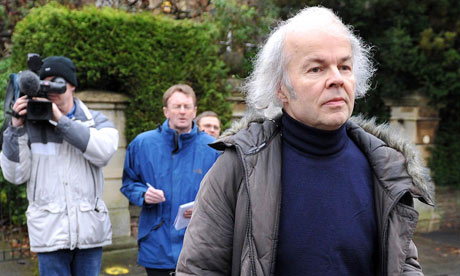
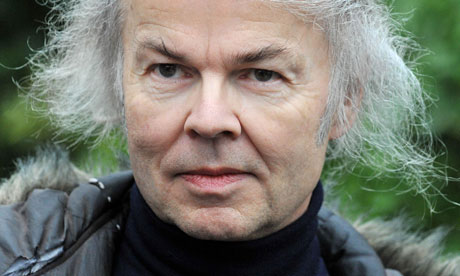
Chris Jefferies. Photograph: Tim Ireland/PA

Here is a salutary outcome from the Bristol murder case highlighted in my Perugia versus Bristol post of January 2011. Eight tabloid British newspapers have been swiftly and efficiently hit with substantial defamation damages after they attempted to convict Chris Jefferies on the basis he looks a bit odd. (And he wears an anorak. And he’s a teacher.) It is going to be very interesting to see how many Italian newspapers are hit with substantial damages for their reporting of the Sollecito-Knox satanic ritual murder trial after it turns out Sollecito and Knox aren’t satanists after all. Will Italians also realise that it is not necessary to have a criminal libel law in order to sort this kind of thing out, just a functioning judiciary?

The damages award as reported by Roy Greenslade in the Guardian on 29 July:

Eight national newspapers have made public apologies today to Christopher Jefferies for the libellous allegations made against him following the murder of Joanna Yeates,

The titles – The Sun, Daily Mirror, Sunday Mirror, Daily Record, Daily Mail, Daily Star, The Scotsman and Daily Express – have also agreed to pay him substantial libel damages, thought to total six figures.

The solicitor for Mr Jefferies, Louis Charalambous, told Mr Justice Tugendhat in the high court hearing that the newspapers had acknowledged the falsity of the allegations, which were published in more than 40 articles.

Ms Yeates, a Bristol architect, was killed in December last year. After her body was discovered, Mr Jefferies, who was her landlord, was arrested by police.

In subsequent days, into early January, the newspapers ran a series of articles about Mr Jefferies that were inaccurate and defamatory.

Charalambous, of Simons Muirhead and Burton, said after today’s hearing:

“Christopher Jefferies is the latest victim of the regular witch hunts and character assassination conducted by the worst elements of the British tabloid media.

Many of the stories published in these newspapers are designed to ‘monster’ the individual, in flagrant disregard for his reputation, privacy and rights to a fair trial.

These newspapers have now apologised to him and paid substantial damages.”

Bambos Tsiattalou, the solicitor who advised Mr Jefferies after he was taken into police custody, said that the media were given a fair warning to be careful about what they published.

He said: “We warned the media by letter, immediately following Mr Jefferies’ arrest, in the strongest possible terms to desist from publishing stories which were damaging or defamatory.

“We were dismayed that our warnings went unheeded and are pleased that the newspapers in settling Mr Jefferies’ claims have acknowledged the extent of the damage to his reputation.”

The papers’ publishers – News International, Trinity Mirror, Daily Mail & General Trust, Express Newspapers and Johnston Press – will now have to fork out substantial sums in damages and legal fees.

But Charalambous pointed out that once the rules over conditional fee (no win, no fee) agreements change next year, “the victims of tabloid witch hunts will no longer have the same access to justice.”

via Eight newspapers pay libel damages to Christopher Jefferies | Media | guardian.co.uk.

And there’s more:

Plus the two best-known UK tabloids have been found guilty of contempt of court (a charge that is filed against them too rarely). This is what italian papers should go down for, having leaked the Perugia investigation before it was complete, in brazen contravention of Italian law. Problem is that Italy doesn’t apply the law, most obviously because it is the police and the magistrates who do the leaking. Or did I misunderstand something?

Here is the Guardian again:

Joanna Yeates murder

Christopher Jefferies was intially declared a suspect and arrested in Joanna Yeates murder case, but was released later without charge. There was intense media speculation about his life. Photograph: Tim Ireland/PA Wire/Press Association Images
The Sun and the Daily Mirror were found guilty of contempt of court for publishing a series of “extreme” articles about a suspect who had been arrested by police investigating the murder of the landscape architect Joanna Yeates.

The Daily Mirror was fined £50,000 and the Sun £18,000 after the high court ruled that the papers posed a “substantial risk” to the course of justice in their reporting on the arrest of Christopher Jefferies, Yeates’s landlord, who was later released without charge and was entirely innocent of any involvement.

The Daily Mirror fine is the biggest against a British newspaper for contempt since 2004, when the Daily Star was fined £60,000 for revealing the identities of two Premiership footballers at the centre of high-profile gang rape allegations.

In a separate legal action eight national newspapers, including the Daily Mirror and Sun, collectively paid six-figure libel damages to Jefferies following allegations made about him in January, when the police hunt for Yeates’s killer was at its height.

In a written judgment on the contempt of court action handed down at the high court, the Lord Chief Justice, Lord Judge, Lord Justice Thomas and Mr Justice Owen described the Daily Mirror articles as “extreme” and “substantial risks to the course of justice”. The judges said the Sun’s coverage of Jefferies created a “very serious risk” that any future court defence would be damaged.

Lord Judge said: “The articles in the one issue of the Sun were written and laid out in such a way that they would have conveyed to the reader of the front page and the two inside pages over which the stories were spread that he was a stalker, with an obsession with death, who let himself into the flats of other occupants of the building where Miss Yeates lived, and that he had an unhealthy interest in blond young women.”

The court gave the Daily Mirror publisher Mirror Group Newspapers extended time in which to launch a petition for permission to appeal to the supreme court.

Vincent Tabak, a 33-year-old engineer, pleaded guilty to manslaughter but has denied murdering Yeates, who was found dead on a roadside verge in Failand, Somerset, on Christmas Day 2010. Tabak, who lived next door to Yeates, is due to go on trial accused of murder at Bristol crown court in October.

Tabloid media coverage at the time of Jefferies’s arrest was intense, with speculation about the suspect rife in newspapers and the internet. Dominic Grieve, the attorney general who brought the court action against the two papers, issued a rare warning to the press at the timeabout their reporting.

Two of the three articles found in contempt of court were published the day after Grieve’s warning, on New Year’s Day. The attorney general welcomed Friday’s judgment, saying: “[The Daily Mirror and Sun] breached the Contempt of Court Act and the court has found that there was a risk of serious prejudice to any future trial.”

Ken Clarke, the justice secretary, echoed the attorney general’s warnings in March when he said that media focus on suspects in recent criminal cases had been “startling” and “far removed” from what it was just a few years ago.

Contempt of court proceedings are infrequently issued against newspapers. It is more unusual still for the attorney general to take action in defence of an individual who has not been charged.

Eight national newspapers separately issued a public apology to Jefferies over libellous claims made about him in the aftermath of his December arrest. The Sun, Daily Mirror, Sunday Mirror, Daily Record, Daily Mail, Daily Star, the Scotsman and Daily Express agreed to pay the retired public-school teacher damages.

Lawyers acting for Jefferies said he had been the victim of “regular witch hunts” in more than 40 articles in the tabloid papers. Bambos Tsiattalou, the solicitor who advised Jefferies after he was taken into police custody, said that the newspapers had ignored warnings to be careful about what they published.

News from around the Third World

July 28, 2011

We start our report in the Third World’s richest nation, Italy.

I haven’t blogged about the Sollecito-Knox Satanic ritual murder case in my local provincial capital Salem*  for some time because the case has been unravelling as predicted. The star witness turned out to be a junkie-dealer who already testified for the police in two other murder trials (so much for drug addicts spending all day in bed). And the forensic procedures and DNA ‘evidence’ have been shredded by a long report from Rome’s Sapienza University.

We are now in the end game. The prosecutor Giuliano Mignini is firing off criminal defamation suits against people who point out he is unfit for office even in Italy at a rate unprecedented even for him. After the Rome academics introduced their report in court in Perugia this week, Mignini and his pals despatched two squad cars of police to Sapienza University in the capital in what appears to be a bizarre act of attempted intimidation. (The university sent them packing.) There is no real doubt that Sollecito and Knox are going to go free. The main point of interest for Italy-watchers is to ascertain that ABSOLUTELY NOBODY is held responsible for burning witches**. That includes the prosecutors; the half-witted magistrates; the gormless, overcharging lawyers; the thoroughly incompetent and corrupt police; the lazy and self-serving journalists who leaked the official side of the investigation at every turn in contravention of the law, and every other medievally-minded member of this shameful lynch-mob***.

When nobody is held responsible, it is important that you do not think of Sollecito and Knox. A couple of years inside will for them have been an interesting life experience. Think  instead of the family of Meredith Kercher, the murdered girl. They are the real victims of this pantomime performed by adults with uniforms and titles.

*Known in dialect as Perugia
** Should read: ‘sending innocent kids to prison for life’.

*** Should read: ‘professional mafia’.

A link to another part of the Third World that I cover is provided by poor old Google. The same US internet firm which last year decided to stand up to China by refusing orders to censor its service recently got a demand via Mr Mignini to shut down an Italian blog he does not like. The China decision has cost Google much of its market share in the Middle Kingdom as the Chinese government does almost everything it can to slow down and disrupt Google’s service (pushing many users to move to the Chinese Google rip-off provider, Baidu). In Italy, Google has already been intimidated under the country’s media laws in a case that saw some of its executives sentenced to prison (they won’t actually go, because that only happens to kids and poor people). So what did Google do when Mignini came knocking? The firm immediately pulled the site Mignini does not like (without contacting the blogger), even though there is no prima facie evidence it contains anything libelous under Italian law. The firm that took on the Dragon is caving in Italy. However, the blog in question has been moved to WordPress (which I use!), and which so far seems to have the necessary cojones for our Italian adventure.

The global battle against men who live with their mums, men with comb-over hair-cuts and men and women who call themselves ‘doctor’ but don’t actually have a doctorate, goes on.

We close today on the subject of the recent, horrific high-speed rail crash in China’s Zhejiang province and the official efforts to (literally) bury the truth of what happened (with corpses still inside). Rather than more news reports that you have probably already seen, here is a translation of Han Han, China’s most famous blogger. I wonder, is there anything in these lines that rings a bell for Italians with regard to the conduct of their own ‘professional’ classes:

“The Derailed Country”

You ask, why are they acting like a bunch of lunatics?

They think they’re the picture of restraint.

You ask, why can’t they tell black from white, fact from fiction?

They think they’re straight shooters, telling it like it is.

You ask, why are they running interference for murders?

They think they’ve thrown their friends under the bus. And they’re ashamed.

You ask, why all the cover-ups?

They think they’re letting it all hang out.

You ask, why are they so irretrievably corrupt?

They think they’re hardworking and plain-living.

You ask, why are they so infuriatingly arrogant?

They think they’re the picture of humility.

You feel like you’re the victim. So do they.

They think: “During the Qing Dynasty, no one had television. Now everyone has a television. Progress!”

They think: “We’re building you all this stuff, what do you care what happens in the process? Why should you care who it’s really for, so long as you get to use it? The train from Shanghai to Beijing used to take a whole day. Now you’re there in five hours (as long as there’s no lightning). Why aren’t you grateful? What’s with all the questions?

“Every now and then, there’s an accident. The top leaders all show how worried they are. We make someone available to answer journalists’ questions. First we say we’ll give the victims 170,000 kuai apiece. Then we say we’ll give them 500,000. We fire a buddy of ours. We’ve done all that, and you still want to nitpick? How could you all be so close-minded? You’re not thinking of the big picture! Why do you want us to apologize when we haven’t done anything wrong? It’s the price of development.

“Taking care of the bodies quickly is just the way we do things. The earlier we start signing things, the more we’ll have to pay out in the end. The later we sign, the smaller the damages. Our pals in the other departments—the ones who knock down all the houses—taught us that one. Burying the train car was a bonehead move, true, but the folks upstairs told us to do it. That’s how they think: if there’s something that could give you trouble, just bury it. Anyway, the real mistake was trying to dig such a huge hole in broad daylight. And not talking it over with the Propaganda Department beforehand. And not getting a handle on all the photographers at the site. We were busy, ok? If there’s anything we’ve learned from all this, it’s that when you need to bury something, make sure you think about how big it is, and make sure you keep the whole thing quiet. We underestimated all that.”

They think that, on the whole, it was a textbook rescue operation—well planned, promptly executed, and well managed. It’s a shame public opinion’s gotten a little out of hand, but they think, “That part’s not our responsibility. We don’t do public opinion.”

They’re thinking: “Look at the big picture: We had the Olympics, we canceled the agricultural tax, and you guys still won’t cut us a break. You’re always glomming on to these piddling little details. No can-do spirit. We could be more authoritarian than North Korea. We could make this place poorer than the Sudan. We could be more evil than the Khmer Rouge. Our army’s bigger than any of theirs, but we don’t do any of that. And not only are you not thankful, but you want us to apologize! As if we’ve done something wrong?”

Society has people of means, and those without. There’s people with power, and those that have none. And they all think they’re the victim. In a country where everyone’s the victim, where the classes have started to decouple from one another, where it’s every man for himself, in this huge country whose constituent parts slide forward on inertia alone—in this country, if there’s no further reform, even tiny decouplings make the derailings hard to put right.

The country’s not moving forward because a lot of them judge themselves as if Stalin and Mao were still alive. So they’ll always feel like the victim. They’ll always feel like they’re the enlightened ones, the impartial ones, the merciful ones, the humble ones, the put-upon ones. They think the technological drumbeat of historical progress is a dream of their own making.
The more you criticize him, the more he longs for autocracy. The more you gaomao him (piss him off), the more he misses Mao.

A friend in the state apparatus told me, “You’re all too greedy. Forty years ago, writers like you would’ve been shot. So you tell me, have things gotten better, or have they gotten worse?”

I said, “No, you’re all too greedy. Ninety years ago, that kind of thinking would have gotten you laughed out of the room. So you tell me: after all that, have things gotten better, or have they gotten worse?”

Worthwhile links:

No longer on Google’s Blogger, but now at WordPress (great courtroom detail):

http://perugiashock.com

Long reports can also be funny when they deal with Italian police conduct:

http://knoxdnareport.wordpress.com/

The highlights of this report (at least those that have thus far been translated into English) are here:

  • 5 big dos and 5 big don’’ts of crime scene investigation (Ooops. In Perugia the police and their ‘scientists’ did none of dos and all of the don’ts. Guess they had a bit of an off-day…)

http://knoxdnareport.wordpress.com/contents/conclusions-1/notes-on-inspection-and-collection-techniques/

  • Overall conclusions that police and their ‘scientists’ ignored standard international protocols, failed to perform some tests, misinterpreted results in others, claimed to have ‘scientific’ results where they did not:

http://knoxdnareport.wordpress.com/contents/conclusions-2/

Note the discovery at Sapienza of starch (err…food) on the knife between the blade and the handle. Prosecution claimed the knife had been thoroughly cleaned by the killers, but their great forensics still uncovered (internationally-unacceptably small trace of) Kercher blood on the blade. Presence of starch residue now shows satanic ritutal murder gang cunningly cleaned off blood but not food from the knife… just like they cleaned all their fingerprints, bloodprints, DNA, etc from the room where Kercher died while leaving Rudy Guede’s evidence all over the place. I say: Burn ‘em already…

Finally, here is that YouTube video of the chief investigator on the Sollecito-Knox case again, talking about his ‘exquisitely psychological’ investigation. There have been another 2,000 hits since I first posted it. It deserves 2 million. You will not find anything funnier on a comedy programme, so settle for Italian reality and send it to your friends.

http://www.youtube.com/watch?v=sWkZPWRS3N0
Homecoming

July 25, 2011

I.

On Saturday 16 July I was robbed for the second time since living in Italy on the same train, the one that runs from Fiumicino airport into Rome. On both occasions I was targeted because I was travelling with children and had a lot of luggage. The first time I was with my pregnant wife and one child, going to Malaysia to start work on my last book, Asian Godfathers. This time I was returning from a month in China with my 8 year old daughter where I finished my latest book, to be published this year. This time I lost not only passports, wallet, laptop, etc, but also 500 pages of interview notes. The robbery was very professionally done, involving at least two people, and perfectly timed as the train reached a station. The Italian passenger next to me was also fully taken in. Money and cigarettes were dropped on the floor, and my daughter’s case moved, by one person, my rucksack grabbed from behind my daughter’s back by another.

The theft problem on the Fiumicino trains is endemic and could not exist without either the studied incompetence or the collusion of Italy’s railway police (Polizia Ferroviaria or Polfer). In 2004 I was robbed beneath a mass of video surveillance cameras on platform 26 at Termini station; I noted the location of the nearest cameras and the exact minute the robbery occurred; the police blithely said the cameras do not work. This time the theft occurred as the train arrived at Tuscolana station. A young policeman who helped me check bins around the station in the vain hope of finding my documents said on the subject of police collusion that he himself found it strange when recently transferred in to this unit that he was not asked to start out in plain clothes making some arrests on the trains; that, he said, is the norm in other rail police units; here, he was sent out on day one in full uniform.

When I took my daughter back to the station where we were robbed (the train had carried on to the next stop), we found the decoy (the ‘palo’) in the robbery sitting on a bench there. I asked him in Italian: ‘You were the person who dropped the money and cigarettes on our train, weren’t you?’ In front of myself and my daughter he said: ‘Yes’. He wasn’t afraid, didn’t try to run. When the police showed up he said he was just a builder catching a train (He was smoking a cigarette from the red Italian brand packet he had dropped before my eyes and showed the police the charger unit for an electric tool he had in his pack — with no tool). They searched him, said he had no prior form, and let him go. I gave him my phone number on a piece of paper, begging him to ask his accomplice to return the documents. That, really, is where Italy is at. You beg the person who robs you for some sympathy, because nothing else works.

Then we went to do the ‘denuncia’ at the Tiburtina police station. After 17 hours flying, and two hours of being robbed and looking for my documents, I rang the bell and the policeman who came to the door told us to come back in half an hour. I asked if we could wait in the waiting room inside. I had one credit card in my pocket, but no money, because four bank machines I had tried were out of order (the phone lines were down). The policeman said we could not come into the station and should wait in the street. When we returned, a policeman holding an i-phone, sporting an expensive watch and wearing spotless Sunday casuals launched into the preemptive statement about what a terrible place Italy is, how foreigners are mad to live here and how under-resourced the railway police are. Who can say, but he did not look to me like he works night and day catching thieves on the trains. Instead, he patronised my daughter: ‘Ciao, bionda.’ She is only eight, but she is already old enough to spot a certain kind of Italian man.

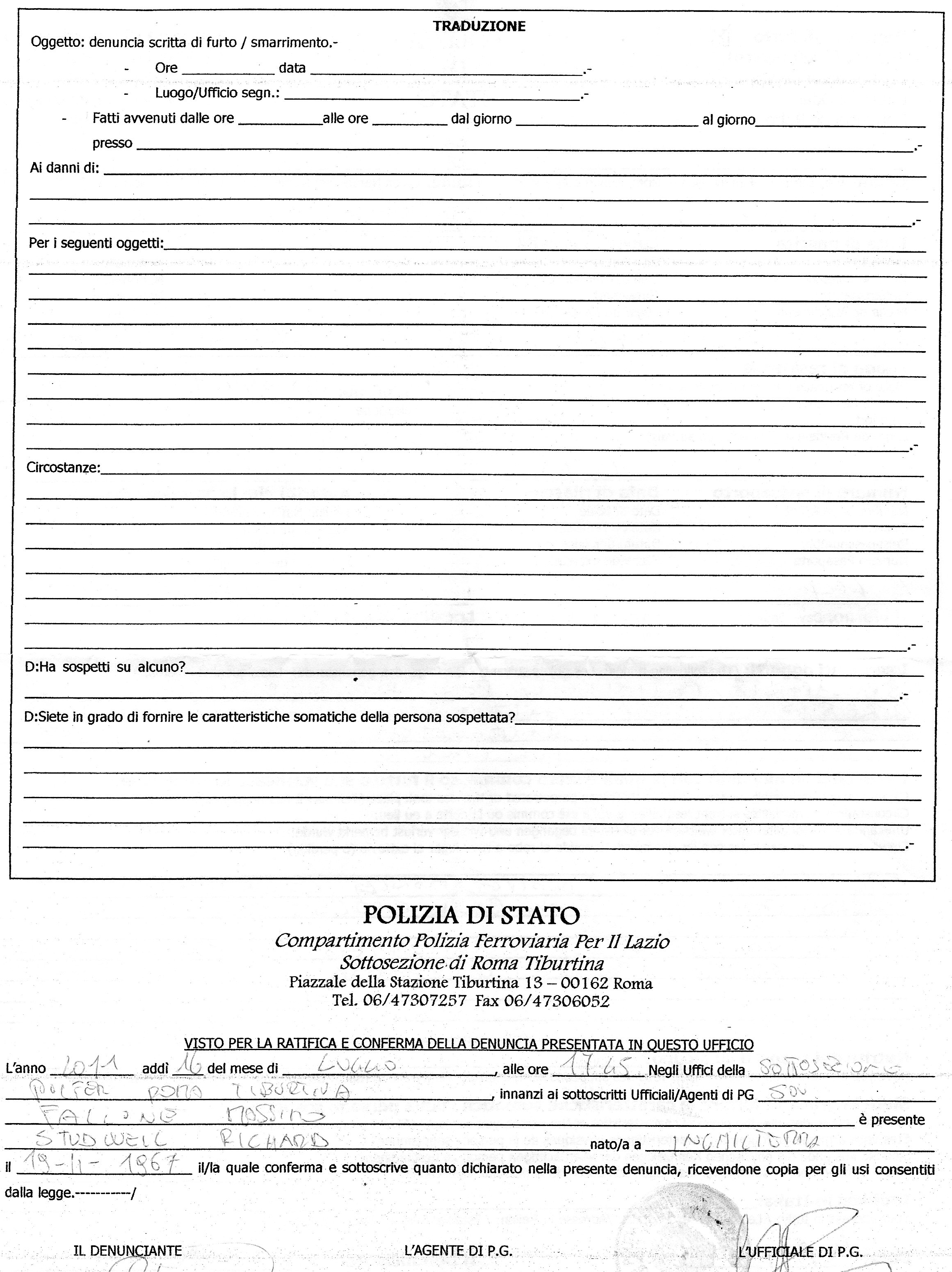
The policeman was insistent that I fill out a denuncia in English — instead of the standard Italian form — saying it ‘would be translated’, and despite my expectation and willingness to do this in Italian. As ever, you wonder why. Do the police really tell us how many people get robbed on that line? All we know for sure is that almost all the victims are foreigners.

Throughout this whole experience, my daughter and I were calm and accepting of our situation, including with the man who helped rob us. (My daughter cried very briefly at one point, for just about 30 seconds. She was trying to blame herself for the robbery because she asked to sit on the top deck of the train.) When I thought about this the next day, I realised that we have become the kind of people who accept suffering and unfairness as a part of normal life. In a sense, we have become Italian. The problem is — with the very greatest respect — I don’t want to be Italian.

II.

On 21 July I spent some time phoning around the railway police (Polfer) in search of published statistics about crime on the two Fiumicino train lines (to Termini and to Tiburtina). After some persistence I was put through to a woman who introduced herself as ‘Dottoressa Caccia’. Ms Caccia was the only person in my enquiry who was willing to give a name. (A web search suggests she is likely Barbara Caccia; like the vast majority of Italians who present themselves as ‘doctor’ she holds only an undergraduate degree.) Ms Caccia said that her office is responsible for Polfer statistics and, although my experience of being robbed twice on the airport lines was unfortunate, the statistical reality is that crime on the Fiumicino trains has fallen ‘at least 85 percent’ in the ‘last five years’. She was, however, unable to give me actual numbers, because she did not have them ‘sotto mano’.

After the robbery on 16 July, Gaia and I had to return from Tiburtina station to Tuscolana to see if my bag and papers had been abandoned (when we found the decoy sitting at the station) and then back to Polfer at Tiburtina station to do a denuncia. As we sat on our cases on these two trips, I watched at least two more pairs of impoverished eastern Europeans walking around the carriages in a manner wholly unnatural for actual passengers. Almost certainly they were looking for robbery victims. The policeman who took our denuncia said himself that we can have ‘no idea’ of the scale of theft on the line when he reflexively sought to defend the performance of Polfer. The helpful policeman who helped me look for my papers around Tuscolana station described the situation as running out of control, and said he understood that a member of parliament, whom he believed is from the Northern League, had been robbed on the train a few days previously.

There is no way that crime on these trains is down 85 percent. When I asked Ms. Caccia whether her numbers jived with reports received by foreign embassies about stolen passports, she pretended not to understand what I was saying and became defensive. ‘My memory is not perfect,’ she stated with respect to the data, telling me to write a request for figures on the state police ‘scrivici’ (write to us) web site. This site, I discovered, limits enquiries to 600 characters (about 100 words). None the less, I wrote a request, reassured by Ms Caccia’s guarantee that ‘If you write, we must respond.’

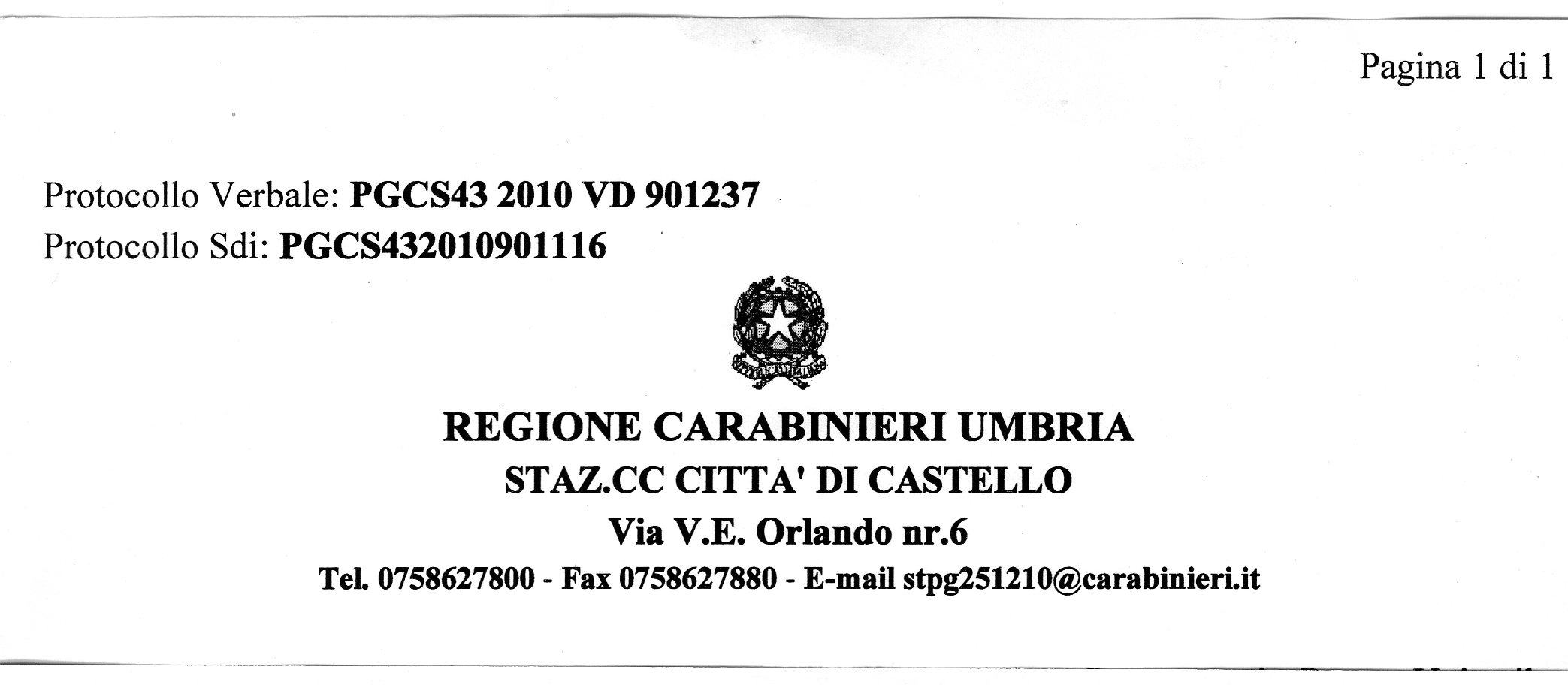
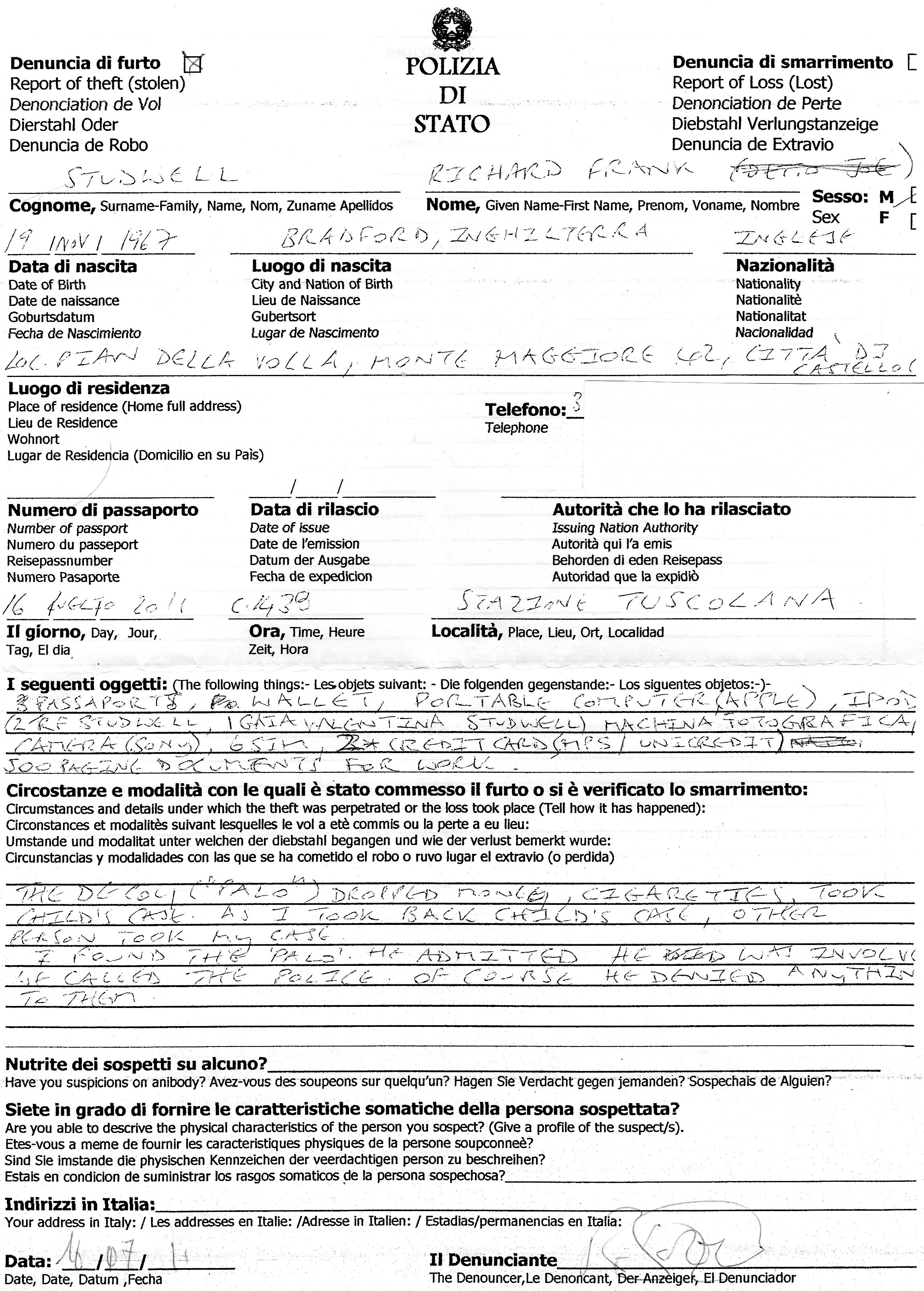
Thinking about Ms Caccia’s ’85 percent fall’, I looked again at the ‘foreigner’ denuncia that the officer at Tiburtina’s Polfer station had been so adamant I should fill out in preference to the standard Italian one. I realised what made me uncomfortable about the form: it contains no reference number of any kind. On Carabinieri denuncia forms I have looked at, there is always a ‘Numero protocollo Sdi’ and sometimes a ‘Numero protocollo Verbale’ as well. In other words the document is logged in ‘the system’. What I was made to fill out at Tiburtina station has no log in the system. It is simply a bit of floating paper, that could disappear without leaving any suggestion that it ever existed.

In addition, I note that at the top of the Polfer form are two small boxes to be ticked for either ‘stolen’ or ‘lost’. I missed these in filling out my form at the station. What then happened is that the Polfer officer photocopied my hand-written version, stamped a photocopy, and only ticked ‘theft’ on the copy he gave me. I very clearly watched him, through an internal office window, do the copying of the original and then bring a copy to me. I did not see him tick ‘stolen’ on the original or on any other copy, although he may have had me sign more than one copy. I cannot remember.

So. Is theft on the Fiumicino line down 85%? Or is reported theft down 85%?

III.

The problem with my mini-investigation is that checks with consular sections of embassies do not provide much useful evidence. The British embassy confirms it has had several thefts on the Fiumicino trains reported in recent weeks. But the US, Australian, New Zealand and Canadian embassies say that while they do have thefts reported on the trains, they see no particular trend. The Japanese say that the vast majority of thefts affecting their nationals at present are on Line A of the Rome Metropolitana (underground) on stops close to Termini station. While the Chinese say that most of their tourists come in groups and are rigorously warned by tour leaders about the risk of theft on Italian trains. (The Chinese embassy web site has descriptions of scams like the one that happened to us written up in great detail. There is also a description of an entire Chinese tour group recently being drugged and robbed on an Italian train. Of course all this is in Chinese… if stated in Italian, the content would likely lead to a minor diplomatic incident.)

What the consulates told me privately that they see does not add up to the industrial scale theft which I suspect goes on perennially on the airport trains. The reason may be that victims only turn to consulates if they lose their passports or all access to money, or both. And the vast majority of people are not as dumb as I am in keeping all their stuff in their back-pack. They have passports and credit cards closer to their person, in a wallet or pouch.

If I had not lost our passports on both occasions, it is unlikely I would have contacted the British embassy in Rome. After all, embassies are hardly places that invite extra business, and the British one in Rome  is about as bad as it gets — one is told the (out-of-country) emergency number is for cases of death or equivalent seriousness, while the switchboard is only manned from 0915 to 1200 each day.

My first letter to the US embassy last week was met with a written response that any information about thefts on trains affecting US citizens ‘is police information held by Italian law enforcement authorities. We therefore suggest you to refer to the Italian Police/Carabinieri to get the needed information.’

The modern embassy/consulate is a pretty shameful institution, and robbery victims are sensible to avoid it unless absolutely necessary. So the one potential source of reliable information about the scale of crime on trains in Italy — and the Fiumicino lines in particular — is Polfer. Which brings us back to those new ‘foreigner’ denuncia forms with no serial numbers. I will pass this post on to various foreign embassies in Rome and see if anyone is interested. Hold your breath!

Exhibits:

The header of a standard Carabinieri denuncia form, with ‘protocollo’ serial numbers, is here.

The front of the foreigner denuncia form I was told to fill out is here. There is no serial number of any kind. This is the photocopy of the original given to me by the Polfer policeman. He has crossed the ‘Report of theft’ box at the top left, but he did not do this in front of me for the original or for other copies. (I have blanked out my phone numbers on this scan.)

The back of the foreigner denuncia form is here. It is all ready for one of those Italian policemen who are fluent in foreign languages to bang out the translation and log the theft into the statistical record.

Do something useful

July 19, 2011

(Do something useful No.1)


Just back from China and from pretty much getting latest book finished. Except for a small hitch, about which I will blog later.

Meantime, I am adding a new Category button called Do Something Useful. I will use it to file interesting miscarriage of justice and political persecution cases about which readers of this blog might want to do something. Like onpass the cases to friends, sign petitions, even write letters. Imagine how good you will feel if someone you decide merits your support gets let out of prison…

Please only support cases that you have read. Do not assume that me posting stuff automatically means people are innocent of what they have been accused of.

Most of the cases will come from China and Italy since they are — in institutional terms — the Third World countries in which I spend most time. But let’s not pretend nothing ever goes wrong in the UK; there is just a lot less of it. At some point I will go through previous posts and link ones like Knox and Sollecito into this new category.

Our starter for ten today is a lady from China called Wang Lihong. Read on. The link to her case on the Global Voices campaign site is here.

China: Campaigning for the Release of Female Activist Wang Lihong

The Chinese government has been arresting human right activists and political dissidents since February 2011 under the pretext of the Jasmine crack down. Many of the detainees have been released, including the prominent artist activist Ai Weiwei. However, a female activist, Wang Lihong has been detained for 117 days, with the court finally deciding to prosecute her last week.

A number of prominent bloggers have decided to break the silence and campaign for the release of Wang Lihong even though the political climate is still tense. Independent documentary maker, Ai Xiaoming has written a biography [zh] for Wang Lihong in her blog:

Who is Wang Lihong?

Wang Lihong

????1955?10??????????????????????????1975?4?????????1978?10??1982?7????????????????????????????????1991???????????2008????????????????????????????

Wang Lihong was born in October 1955 in an army family in Qingtao and finished her elementary and secondary education in Beijing. She was sent to serve the rural society in Shaanxi in April 1975 and enrolled in the Chinese Department of Yanan University between October 1978 and July 1982. She returned back to Beijing upon graduation and worked there. She left her job in 1991 and became an entrepreneur. She retired in 2008 and started participating in social welfare activities online.

Wang was arrested on March 21, 2011, under the charge of “inciting social unrest”. Later in the official arrest document issued on April 22, 2011, the charge has been changed to “disturbing public transportation in a crowd”. Many believed that the police referred to the “surrounding gaze” flash mob action in Fujian, back in April 2010 (see below).

Below is an incomplete list of social activities that she has participated in since 2008.

  1. The police murder case of Yang Jia on July 1 2008. She visited Yang Jia’s mother and interviewed her and blogged about Yang Jia’s case.
  2. Together with another blogger, Temple Tiger, she helped the homeless people around Tienanmen square.
  3. The Deng Yujiao self defense murder case in May 2009. Wang Lihong travelled to Hubei to join the “surrounding gaze” flash mob in order to pressure the court for an open and fair ruling on Deng’s case.
  4. On May 2009, Wang campaigned for a visit to petitioner, Yao Jing, who was seriously injured by local government officials from Linyi who tried to intercept her petition in Beijing. Together with a group of bloggers, Wang raised donation for Yao Jing’s hospital and lawyer expenses.
  5. Campaigned for human rights lawyer Ni Yulan, who was prosecuted by Beijing authority soon after she was released from jail.
  6. Participated in the “surrounding gaze” flash mob action in support of the three Fujian netizens who was accused by local authorities for defamation in their citizen reports about a suspected rape case in March and April 2010.
  7. Celebrated the Nobel Prize award to Liu Xiaobo in October 2010. She was detained for two weeks and was under house arrest for several months.
  8. In March 2011, she visited two activists in a Henan detention center, Wang Yi who was sentenced to one year labour education for writing a tweet and Tian Xi, an AIDS activist.

Wang’s citizen practice

During her detention, the police have asked Wang to make three promises for a probation arrangement: 1. to never meet sensitive people again; 2. to never travel to sensitive regions again; 3. to never get involve in other people’s business again.

She refused to sign the document and made a statement instead (via @Wanyanhai [zh]):

????????????????????????????????????????????……????????????? ????????????????????????????????

I am a person with a conscience. I cannot guarantee that I can keep silence in front of others’ suffering. I can’t guarantee that when I stand in front of Qian Yunhui, Tang Fucheng, Li Shuling… I can pretend that I do not see their miseries. If I keep silence in front of all these suffering and evil deeds, the next person beaten down by evilness will be myself.

Prominent citizen reporter, Tufuwugan, has encountered with Wang in various public incident since 2009 and he has written a blog post on his impressions of Wang [zh]:

????????????????????????????????????????????????????????????????????????????????????????????????????????????????????…?????????????????????????????????????

We have completely different styles. She likes to argue for the truth and never compromises while I like to hang around with a [flash mob] group and joke around. That’s why I really like her righteousness and simple mindedness. She has everything written in her face and never lied about her feelings… She is a really engaging citizen and a thorn in the eyes of those mother f**kers.

What Tufu and Wang have been doing all these years has opened up a new political space in China. Ai Xiaoming wrote another blog post about the significance of Wang Lihong’s citizen action [zh]:

?????????????????????????????????????????????????????????????????????????????????????????????????????????????????????????????????????????????????????????????????????????????????????????????????????“??????”??????????2010?????????????????????????????????????????????????????????????????????????????????????????????????????????????????????????????????????????????????????

They get to know one and other through the Internet and collectively practice their citizen rights. We have so few experts and scholars who are willing to speak for the grassroots, but countless netizens participate [in grassroots movements] and create a new climate for the new politics. This is something beautiful that we have never had before: citizens are collected through the Internet and participate in public affair. Regardless of their background, they come together without knowing each others’ real identity. They are connected through common concern. They feel that they can do something to make change, little things such as yelling out for innocent netizens [who have been wrongly prosecuted]. “Surrounding gaze will change China” has become a belief spread across the Chinese Twittersphere. In 2010, outside the Fujian Mawei court, hundreds of netizens travelled across the country to present themselves on the spot and there have been more than 5,000 signatures collected for the campaign. He Yang’s documentary work has recorded the whole political scene. This is the first time since the 1989 incident [Tiananmen Square] that I have seen people marching in the street, calling out “Speech is not a crime, Long live freedom!”

Free Wang Lihong

A blog, Free Wang Lihong [zh], a Facebook event page [zh] and a Google Group [zh] have been set up to collect articles and news reports about Wang and campaign for her release.

Back in Twitter, @weiquanwang has created a signature petition page [zh] for the release of Wang Lihong. Children’s rights activist @zhaolianhai [zh] also helps collecting signatures via a Google Spread Sheet [zh].

Some netizens have claimed that they will surrender themselves to the police if the court sentences Wang to imprisonment. @tufuwugan [zh] is among one of them and there are more, he reports via Twitter:

???????????????????????????????????????????????????????????????????????????????????????????????????????????????????????????????

Just now I received a phone call from Chu Chengzhi saying if Wang is founded guilty, he would surrender himself. He asked me to get some legal advice first. He is right. I was also involved similar “crimes”. If she is guilty, we are all guilty, let us all be guilty. They just want to terrify people through prosecution. Let’s take the initiation to take your prosecution, to fulfill your animal thirst for prosecuting people.

Yin Longlong has written a poem, ‘Search for Wang Lihong‘ [zh] to pay his tribute to Wang. Below is the translation of the poem’s first verse:

???????????
??????????????????????????
?????
????????????????
????????????????????
??????????????
???
??????????

I look for my pride, a steel file
A string. The sea has submerged the skyscrapers, princesses and mermaids outside the Emperor’s hall
In the century before the last one
I look for Wang Lihong, only to tell her that the Dynasty is falling apart
Tell her that we have chosen silence because they are worthless to listen to
Tell her that there are still breathes under the earth of our dead sisters
Tell her
Animals and insects are inside the summer prison cell

Lawyers, by a mile

May 24, 2011

It is said that estate agents are worse, but at least the average estate agent has the moral (if not legal) defence that he or she is ignorant. Lawyers, by contrast, have all had the chance of a university education, and so will surely have more to answer for when they arrive in hell (presumably to be greeted at the door by a lawyer). The latest antics from Italy’s legal profession beggar belief, so utterly selfish are the lawyers in putting their personal interests ahead of society’s interest. This country really has become one whore-story after the next.

No other rich nation can hold a candle to Italy’s professional classes, but lest the British be accused in the Umbrian expression of beingmosche bianche (white flies), take note also of the British Director of Public Prosecutions’ performance this week. Keir Starmer should have decided to prosecute policeman Simon Harwood for manslaughter last July. He is now being forced to do so because of the outcome of a public inquest and makes the most pathetic attempt to construct an argument that the evidence produced in the inquest could not, or would not, have been brought out in a criminal trial. You know that a lawyer, like Starmer, is on the back foot when he starts using verbs like ‘adduced’. It is tantamount to saying: ‘Please take it for granted that I am very clever and doing the right thing, and not at all the stereotypical yes-man who is given this job.’

People like Louis Brandeis, Felix Frankfurter, or Gareth Peirce are the Halley’s comets of the legal profession. You are lucky to know one lawyer who cares about more than their new Audi and their holiday in the Maldives in a lifetime.

Lush places

March 31, 2011

The Star, The Express, The Times, and The Telegraph. Are there any other British newspapers that are now run for less than five quid a week? This, from The Telegraph, is a collector’s item. Evelyn Waugh could not have made it, or indeed the photo of the 13-year-old author, up. (Apologies that the typeface becomes WordPress standard.)


For pics you likely have to go to the Torygraph original, here. But the text is a feast of itself:

David Cameron out of stride with wife Samantha

Huffing and puffing, a red-faced and heavy-legged David Cameron plods along a pavement on his weekly jog, forcing one foot in front of the other on the unforgiving tarmac.

pastedGraphic.pdf

Both David and Samantha Cameron have enlisted the help of personal trainer Matt Roberts (Right) Photo: STEVE BACK

pastedGraphic_1.pdf

By Nick Collins 7:30AM BST 28 Mar 2011

Meanwhile his wife Samantha breezes through a leafy park accompanied by personal trainer Matt Roberts, looking confident, relaxed and brimming with energy.

Perhaps Mr Cameron was feeling drained or short of sleep, but a careful look at the recent photographs leads to a different conclusion – that while his wife would be well-equipped to tackle a marathon, the Prime Minister is simply not as adept at running as he is at running the country.

In fact, if Mr and Mrs Cameron decided to take exercise together or compete in a race, Samantha would be likely to comfortably outpace her husband, according to an expert analysis of their respective running styles.

While Mrs Cameron’s relaxed upper body enables her to make the most of her energy, the Prime Minister appears rigid, uncomfortable and exhausted – hardly a surprise given his primitive technique.

Despite having recently given birth, Mrs Cameron’s wider stride means she covers almost a third more ground each time she puts her foot down than her husband, and is at much lower risk of injury.

RELATED ARTICLES

  1. Sam Cam gets personal 10 Mar 2011
  2. David Cameron feels the chill on morning jog 24 Nov 2010

By taking too narrow a stride, lifting his toes too high and running in an upright position the Prime Minister is not only slowing himself down but risking shin splints, knee problems and arthritis, according to analysts.

Sam Murphy, a running coach and author of Running Well, said: “I would say Samantha needs a bit of tuition – but compared to her David has appalling technique.

“The first thing I noticed about the Prime Minister was the straightness of his leg on landing – he should bend his knees to dissipate the shock and aim to land with his foot below the knee rather than ahead of him to decrease the impact force.

“People tend to think running is like walking, and that if they want to go faster they should put their leg out further, but actually it is more like cycling. If you want to go faster you want to turn your leg over more quickly.”

To add to Mr Cameron’s embarrassment, he ought to be better at running than his wife because his masculine frame gives him an innate head-start, she added.

“Women biomechanically have more issues to overcome, for example their pelvis is wider, so their thighs are more likely to roll inwards which can put excess force on the knees. There isn’t any advantage that Samantha Cameron would have over David – quite the opposite in fact.”

Both David and Samantha Cameron have enlisted the help of personal trainer Matt Roberts – whose clients include supermodel Naomi Campbell – to help them stay in good shape.

But while Mrs Cameron appears to be benefiting from the fitness expert’s guidance as she jogs alongside him, Mr Cameron may not have taken quite so many lessons on board.

Bob Pritchard, an Olympic trainer with 40 years’ experience of analysing and improving athletes’ technique, said Mr Cameron’s stride width of 50 degrees, compared with his wife’s 65 degrees, is one of the lowest he has ever seen.

In a blog posted on the website of the California-based Somax Performance Institute, Mr Pritchard wrote: “David Cameron recently led some of his Afghan troops in a run and provided an excellent example of how not to run.

“David Cameron is covering 40 per cent less ground than the average, slow marathon runner. Good marathon runners have a stride angle over 100 degrees, which means that Cameron is covering 60 per cent less ground than they are.”

The difference in the couple’s stride angles may not sound like much, but even an extra degree of width can make an enormous difference to the amount of ground a runner is able to cover.

Mr Prichard said in an interview: “The Prime Minister’s wife has a bigger stride angle than he does, though not by much.

“But since you cover two per cent more ground with each stride for every degree you increase your stride angle, she covers 30 per cent more ground with each stride than her husband.

“As in governance, it is not how much you do but how efficient you are that counts.”

The key problem behind Mr Cameron’s awkward style, Mr Pritchard said, is tension – hardly surprising in a man with one of the most demanding jobs in the country.

“Basically, he is tense and stiff. You can see evidence of this tension in his toe lift, which is a phenomenal 27 degrees. Good runners don’t bother to lift their toes when running, as it is a waste of energy.

“Plus, when the toes are lifted like Cameron’s, it forces the runner to land on his heel, which slams the foot flat on the ground, violently stretching the very muscles that the runner is contracting to maintain toe lift.”

Mr Cameron could face worse than the humiliation of being overtaken by his wife if he fails to adapt his style because a short stride can lead to the softening of the cartilage around the knee, long-term knee problems and even arthritis in later years.

Forced stretching also tears fibres in the shin muscles, which can lead to problems as severe as shin splints and stress fractures, the British-born coach said.

However, Mr Cameron is unlikely to change his running style any time soon if he heeds the advice in the official London 2012 Olympics running guide, according to the expert who wrote it.

John Brewer, professor of sport at Bedfordshire University, said: “I have seen lots of top runners and many of them have styles which on the face of it look slightly ungainly, but these are elite runners and that in itself must suggest that they are doing something right.

“In my opinion, the more you try to change someone’s running style through analysis, the more likely it is that you will cause an injury. Naturally the body will need to adopt a running style that suits the individual.”

The danger of comparing the two pictures, he said, is that they only capture a moment in time – but even that is enough to draw some conclusions about the Camerons’ respective running styles.

Mr Brewer said: “Samantha looks fine. The key thing when anyone is running is to stay relaxed and she certainly looks as if she is doing that. The Prime Minister looks more tense, so I would recommend he stretches more before running to improve the flexibility of his hamstrings and calf muscles. That will help him push off more firmly, take a longer stride and make each stride seem that much easier.

“His head is looking more upwards and his neck and shoulders are tensed, so he certainly looks more rigid than Mrs Cameron. His hands are also clenched – that makes you tense and also prevents you losing a lot of heat from your palms, which is important when you are running.

“A lot depends on how tired he is – as people get tired they tend to tense up. But on the face of it Samantha Cameron is certainly the more aesthetic looking of the two.”

Answers on a postcard

March 29, 2011

It has been reported that the Italian government is trying to help out the international community by locating a pariah state with a good supply of sunglasses and a forgiving attitude to extra-marital sex where Muammar Gadaffi might be persuaded to seek exile. It is essential that the country should be one where a politician faces no risk of being brought to justice.

I am sure I can help on this. I have heard of such a place. And yet somehow the name eludes me… bah, my decaying brain…

Fratelli d’Italia

March 17, 2011

The school bus pulls up to reveal our three children waving self-made Italian flags. It can mean only one thing. The official celebration of Italy’s 150th birthday is upon us. This being a thoroughly divided nation, it has of course been dubbed the Festival of Unity.

For months the children have been returning from school singing what must be one of the most improbable choruses of any national anthem: ‘Stringiamoci a coorte / Siamo pronti alla morte / Italia chiamo’ or ‘Let’s all stand together / We are ready to die / Italy has summoned us.’ They do this with their right hands over their hearts and big grins on their faces.

‘It’s absurd,’ observes the eight-year-old. ‘But then so is the British one.’ She has a point. Nonetheless she has learned all the verses, including arcane references to Scipio, the blood of the Poles and so on, and needs little prompting to sing the whole thing over and over.

Italy’s popular president Giorgio Napolitano leads the celebratory tour of Rome, including a visit to the monument to Italy’s hot-headed revolutionary Giuseppe Garibaldi. Silvio Berlusconi is forced to accompany him and draws whistles and calls of ‘Resign’ and ‘Buffoon’.

This is tame compared with the last day of Carnival — the traditional party to consume all the stuff that cannot be consumed during Lent — in our nearby village of Cornetto. This year, instead of dressing up as cartoon characters, the men of the village regaled themselves as full-bosomed, heavily made-up prostitutes and arrived in a bunga-bunga car, groping anyone they could lay hands on. There then appeared a Berlusconi character, who set up a large table and proceeded to hand out Viagra to residents of the village before being violently and graphically humped by the bunga-bunga ladies.

All this went on, needless to say, while the children of the village were towed around, watching, in a toy train pulled by a tractor. Who says there is no hope for this country? ‘Siam’ pronti alla morte…

Meanwhile:

More leaked phone taps suggest that Silvio’s advice to Ruby was to pretend to be insane. While Silvio would pretend to have believed that she (Moroccan) was Mubarak’s granddaughter. The great thing is that in Italy you can actually say this kind of stuff in court. There is also more detail from Ruby’s first police interview in which the Silvio link came up.

Come the revolution

March 7, 2011

The Liberal Democrats keep sending me emails complaining that opponents of voting reform in the UK are running outrageous and unethical advertisements. Perhaps it is just my naive faith in the average person, but it really doesn’t worry me if some inbred Tory eejit or some equally self-serving Nooo Labour eejit is  suggesting that babies will die because of the alternative voting system (referred to ‘instant run-off’ in the US and ‘preferential voting’ in some other countries). Much more likely, the ads will have the same effect Winston Churchill engendered in the 1945 election when he said that a Labour victory would mean communism in Britain. People looked at Clem Attlee and thought: ‘I’m not so sure, Winnie.’ And they voted Labour.

The truth is that people get dangerous idiots in charge of them not because they are conned, but because they choose self-evidently dangerous idiots to be in charge of them.  This explains why they vote for dangerous idiots again and again, the only mitigation being that the stupidity is much easier to spot than the danger. Tony Blair and Silvio Berlusconi are classic examples. What is interesting about them is not some supposed con, but why people repeatedly vote for a Tone or a Sil despite the mounting evidence that they are absolute plonkers, incapable of running their own lives, let alone anyone else’s. Anger, frustration, the hopelessness of the opposition, the different voter pattern of female electors (who always, I am sad to mention, vote disproportionately for reactionaries) — this is the stuff of psephological analysis, not some tripe about how clever advertising convinced us all to tick the wrong box.

So the political message is: state your case with maximum clarity to the maximum number of people. And what better opportunity to put this into practice than the AV referendum, which is surely an idea whose time has come. It is an almost-no-risk improvement to the voting system in a country where 35 percent of votes now go to  parties other than the biggest two, compared with less than five percent after the Second World War. AV doesn’t favour small and silly parties. It keeps MPs answerable to geographic constituencies. Above all, it makes politics more competitive, which is why indolent and self serving people do not like the idea one bit. Martin Wolf in the FT (subscription needed) likes it, and though he is called Wolf, he is not exactly Wolfie out of Citizen Smith. Here’s the nub of what Wolf has written:

‘Why, then, might the switch to the alternative vote be justified? The answer is that over time the present system has become increasingly unrepresentative, to the point of threatening its legitimacy. We have, above all, seen a huge decline in the share of votes going to the two leading parties, from 97 per cent in 1951 to 65 per cent in 2010, a record postwar low. Under the current system, parties with less than 40 per cent of the votes are potentially able to win large majorities in the House of Commons. Thus, the House risks becoming so unrepresentative of the preferences of electors as to lose its legitimacy. Ultimately, that threatens the effectiveness of government, as well. Under the alternative vote, however, candidates would need to obtain the support of a majority of constituents. That is highly likely to increase the representation of currently under-represented voters.’

The case is so compelling that I write to the Liberal Democrats in Cambridge asking for 100 pro-AV badges and some pens to boot. Their web site says this stuff can be had for free, though I told them I was quite willing to pay for it. I have to be in the UK to attend a exclusive actors’ party on the roof of the National Theatre and there seems no better place to undertake some effective propaganda work. I will pin an AV badge on the lapel of Maureen Lipman, or someone even more famous…

Unfortunately, there is just one hitch. It being the Liberal party that backs the AV, they don’t get it together to send me the badges. You just know that if you had phoned Tory HQ and asked some random Sloane for 500 Shoot the Badgers stickers, they would have been sent round the same day. If the revolution goes pear shaped on 5 May, my liberal comrades, do not blame me.

More:

This wikipedia entry on the Alternative Vote system is helpful, and tells you all the places where the system is already employed.

(Almost) nowhere to run to

February 22, 2011


Tunisia, Egypt, Libya… the list of north African countries to which Italian politicians may no longer be able to flee in exile gets longer every day. Bettino Craxi, the politician who ‘made’ Sivio Berlusconi, fled of course to Tunisia (here he is, all remorseful, on the beach). Italian spooks assisted the coup which brought the lately chased out Mr. Ben Ali to power.

Silvio himself might have been expected to skip off to his friend Muammar Gaddafi in Libya if things had gotten really nasty at home. But the way it is looking in Tripoli just now (here is some text from the first US tv crew in), there may be no north African option left. One feels for Silvio after all the effort expended smoothing the path of Gaddafi’s third son Saadi into Italian Serie A football, where he ‘played’ for four seasons and managed a cumulative half an hour on a first-team pitch. It is a wonder that Perugia, Udine and Sampdoria dared to leave him on the bench after his bodyguards in Libya had in 1996 killed eight opposing fans and wounded 39 for mocking this (please note) much underrated footballing prodigy.

Berlusconi has made multiple trips to Libya, including to Benghazi (search ‘Cooperation with Italy’) where the current rebellion started, but he likely won’t be going back soon. Gaddafi came to see Silvio in Italy several times, including just last August when he paid a modelling agency to supply him 200 nubile young women he could give a lecture to on the merits of (his version of) Islam. Muammar and Silvio were such a great team, but the former’s (liberal, London-educated) second son Saif going on telly and promising to keep shooting until the last bullet has put the relationship in a rather poor light.

I guess that in a worst case scenario Silvio can always go to Russia and see his best mate Vlad. But how would he keep his suntan up in Moscow? He could call in some of those unpaid holiday letting favours from Tony and Cherie (‘Flowers for me, Silvio?’) Blair, but he won’t get any more bronzed in north London. Surely there must be somewhere hot and dodgy left in the world where a man on the run can put his feet up? I know. Singapore!

Meanwhile: Stanley Ho, if you are watching, check this out. Perhaps you and Muammar should swap family management tips. Well, you both like ballroom dancing…