Rich and miserable, by graphs

November 15, 2011

Krugman highlighted a great site on his blog this week. And it is a great site, so here’s the link if you haven’t seen it.

The World Top Incomes Database has income distribution data for 22 countries, with more being added, over long periods of time. Go to the graphics page and you can call up series for different shares of the population for your favourite countries.

I went for the top 5 percent of tax payers in the UK, US and Denmark since 1900. The top 5 percent of earners in the US and UK have gobbled 25-30 percent of national personal incomes in recent years. In Denmark — the country which consistently tops out the rankings in European ‘happiness’ surveys — the percentage is consistently under 15 percent. (UK and US shares were of course lower until the well-known inflection point in the 1970s).

Unfortunately I can’t reproduce the graph here. But you can make your own.

Oooh la la…

November 14, 2011

Should have posted this rather nice graphic from the NYT a few days ago, showing debt relationships in Europe.

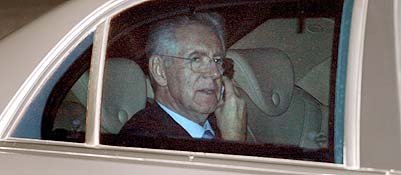
It reminds us, as Mario Monti goes to work, that the Italian debt buck stops in France.

For it is the French banking system that has a net exposure to Italy of something over US$350 billion.

When the history of recent world banking is written, US and  British bankers will take the prize for unadulterated, venal greed and selfishness.

But French bankers must surely lift the trophy in the combined greed-with-stupidity category.

The French liability in Italy is about 15 percent of French GDP. Which particular risk model were the French banks running when they decided that was a good idea?

The gentle breeze of British hypocrisy

November 12, 2011

The Economist has published its sixth, and presumably final, cover story on Silvio Berlusconi. The headline – ‘That’s all folks’ – is supposed to evoke the cartoon quality of his premiership. But coupled with a backdrop of Sil set in a painting of end-of-Empire Roman lassitude, it is too busy. Far more visually effective was the June 2011 cover with a simple photo of Sil and the line ‘The man who screwed an entire country’.

I haven’t been the biggest fan of The Economist’s coverage of Italy because it has focused so overwhelmingly on Sil — rather than on a the malaise of an entire professional class which he symbolises. What sets Italy apart is that, relative to its level of economic development, it has the most backward, self-serving professional class and professional institutions of any state in the world. This includes, but is far from limited to, its political and legal and fiscal institutions.

There is also a very English undercurrent of hypocrisy in the manner in which the British elite discusses the Italian crisis with a told-you-so attitude. The Economist is particularly guilty of this, putting the boot in to the German response to the crisis on a weekly basis.

What is forgotten is how the Germans are left to do the political heavy lifting in Europe almost single-handedly. They have a French ‘assistant’, but he is barely worthy of the name.

If Britain had joined the Euro, things would have been different. There would be two big political grown-ups in the Euro-zone instead of one, and that would have made the job of dealing with Italy so much easier.

You cannot argue with Britain’s decision to stay out of the Euro from a selfish, pragmatic perspective, but anyone who supported that decision should limit themselves when yelling from the sidelines about what to do now. How would you like to be Merkel, put in a team with Sarko, and expected to sort out Greece and Italy?

If Britons are honest, they must concede that post-war Germany has done the bulk of the work in creating a stable, prosperous and progressive Europe while the British — famed as people of action — stood around bitching. And when Britain realised it desperately needed to be inside the Common Market in the early 1970s, it needed German support — against French opposition — to get in.

Germany, not Britain, is the moral leader of Europe in the past half century.
Trust

November 10, 2011

Nouriel Roubini, who lived for 20 years in Italy, has the day’s best post on the evolving Italian crisis. The concluding paragraph is a reasonable summary of what is required by Italy’s Euro partners to keep it in the currency bloc at this point:

‘Only if the ECB became an unlimited lender of last resort and cut policy rates to zero, combined with a fall in the value of the euro to parity with the dollar, plus a fiscal stimulus in Germany and the eurozone core while the periphery implements austerity, could we perhaps stop the upcoming disaster.’

What Roubini does not spell out is why this is unlikely to happen. When all the talking is done, it is a simple matter of trust.

Northern Europe does not trust Italy to push through the reforms that would make the effort and expense worthwhile.

The Matilda problem that I highlighted back in August is coming home to roost.

My own thought for the day is Article 54 of the Italian Constitution:

Those citizens to whom public functions are entrusted have the duty to fulfil such functions with discipline and honour.

It seems the last Euro-era chance to interpret that line in a more mundane and literal fashion may fall to Mario Monti.

Studying the classics

November 9, 2011

They say you can learn from the classics. So here are my bullet points on the heroic struggles of Europe’s ancients.


How Greece did it:

1. Get money from EU in return for reforms.

2. Tell EU/IMF you need to hold referendum in order to get population on board.

3. Abandon referendum when rest of Europe says this is devious and should have been discussed up front.

4. Bicker and look ridiculous.

5. Leave Euro and return to Third World.

(6. Feel really bad when Turkey joins EU and takes commitments seriously.)


How Italy could do better.

1. Tell EU you need to hold referendum in order to get population on board.

2. Form government of national unity. Agree comprehensive package of labour market, justice system and fiscal reforms with EU/IMF to be overseen by IMF.

3. Don’t bicker. Hold referendum in January.

4. Implement reforms under IMF oversight.

5. Remain in Euro and begin to be respected member of First World instead of being resident joke member.

(6. Not have to feel bad when Turkey joins EU and takes commitments seriously.)


But which option to go for?

Rodin's epic representation of the Italian politician

The song of a lost nation

November 9, 2011

Here’s a new song to sing to keep up spirits as we wait for Italy to fall into the abyss:

IMF, IMF, IMF

IMF, IMF, IM-E-EFF

IMF, IMF, IMF

AYE EMM FFFF


Because even though the country is among the richest in the world, it can’t look after itself.

And take a look at the bio of David Lipton, who the IMF had already scheduled to go to Rome next week (before Italian bond yields hit 7.5% this evening). This guy appears to have the cv from hell. He worked at disaster bank Citi in the run-up to the global financial crisis. He (presumably) filled his boots at hedge fund Moore prior to that. He was part of the Clinton financial deregulation road to hell  team in the 90s. Which came just after he had worked with Jeff ‘did I say that?’ Sachs to provide restructuring ‘advice’ to developmental superstate Russia in the 1989-1991 period. Maybe there really is a God. And he really has lost patience with Italy.

Seven

November 9, 2011

Time for Giuliano Mignini to investigate. The yield on Italian debt has hit seven percent. Which is the same as the number of deadly sins committed by the Italian prime minister. Every week, which in turn has seven days. And today is only just more than seven days after Halloween, the diabolical festival when Raffaele Sollecito and Amanda Knox, give or take a day, hatched their Satanic ritual murder plot. In Perugia. Whose name has seven letters.

It is soooooooo obvious that everything in the whole world is a conspiracy. How can anyone be expected to take action when confronted by forces beyond our control?

Frankly, they can’t. Which is why Italy’s professional class is doing nothing as the country goes down the tubes.

Let Rome burn!

The images will at least form a good backdrop for a Dolce and Gabbana advertising campaign. Sicilian peasant chic — combining glamour, stoicism and passion — is surely the perfect day-wear for the modern cataclysmic financial crisis. Not to mention a great metaphor for a society living on bullshit.

Prime Minister Nero putting in a bunga-bunga order last night.

Worth a read:

Nouriel Roubini reposts what he said about Italy at Davos in 2006. Roubini’s analysis led to a bizarre racial outburst from finance minister Giulio Tremonti, the former professor of ethics who was recently busted renting a Rome apartment for cash.

Oh mamma, can this really be the end? (Nth reprise)

November 8, 2011

Only in Italy do markets bounce, the currency strengthen, and gold weaken when the leader of political ‘right’ says he will step down (in order, as the traditional Italian formulation has it, to spend more time with his bunga-bunga girls).

Of course Sil hasn’t said when he will go.

As if to remind us that whatever the Greeks can do badly, the Italians can do at least as badly, this limp political comedy will continue.

Meanwhile, the IMF has been invited to Rome, which will give staffers a pre-change-of-government chance to reflect on what actually needs doing to keep Italy in the Euro. Most economists quoted in the press focus on the need to deflate. But this is impractical — Italians couldn’t take the deflation any more than Greeks could. No society can watch its real incomes shrink by a quarter or a third in order to make economists’ graphs look the way they ought to.

The only real way forward for Italy is very serious structural reforms which unlock fairly quick productivity gains and hence growth.

There is no theoretical reason why this cannot happen.

However, the job that will confront the IMF if it is called in to run a programme — which I continue to believe it will be — would exceed anything it has undertaken before.

Not only the labour market and outsize public sector need to be overhauled, but the entire justice system has to be reworked.

Can a foreign agency do such things outside the settlement terms of a catastrophic war? I suspect not. Which leaves two choices. Either give Italy German money and accept the country will not change and will remain a fiscal burden on the centre. Or kick Italy out of the Euro and refocus the group on a more northerly European caucus of states that can actually deliver political, social and fiscal integration.

In the end, it is all politics.

We like dull

November 8, 2011

Three recent articles make me think how dull and conservative good industrial policy in developing countries needs to be. And how China is proving the point.

The first piece reveals that only 106 plug-in electric cars were bought in the UK in the third quarter of the year. The second indicates that after biding its time, General Electric is making a move into the solar industry (FT sub needed) — but not into the poly-silicon technology that has dominated thus far, instead into the thin film approach that grew out of the US semiconductor business. The third article concerns GE’s third quarter results (FT sub needed), which were none too bad but which were not helped by falling wind turbine prices, a business where GE is already very active.

China has designs on all these green energy businesses. It also has large domestic firms in each sector which are screaming for subsidies. The government could have thrown its money at the most exciting technology — electric vehicles — or at the one where Chinese scientists lead the world — poly-silicon solar. But instead it chose to place its big bets on wind turbines, where the technological path is most established and the cost of green energy lowest, throwing billions of dollars at the construction of Chinese wind farms. It was the boring choice, but it looks like having been the right one — hands down.

As recent press shows, the market for electric vehicles remains tiny. If China had gotten too far ahead of the demand curve, the country could have wasted vast sums on e-vehicle technologies that fizzle. In the solar business, where private Chinese companies dominate global production of poly-silicon cells, there is a real risk that poly-silicon is not going to be the winning long-run technology.

The shape of the evolving wind turbine market, by contrast, is easier to see. It is largely a matter of making the same turbines bigger. In this context, China has created some of the world’s largest wind turbine producers in the space of a few years and there is little chance going forward that they will be ‘technologically disrupted’. They are competing first on price — hence the pressure mentioned by GE in its third quarter results — capturing market share, over-running the entire production value chain so as to ‘own’ the technology, and they will then start to compete on quality and service later.

Sensible industrial policy in a developing country involves plucking low hanging technological fruit. Then you bring cheap capital — human and financial —  to bear.

Liberal parenting II: blending seamlessly into Cambridge

October 31, 2011

I have gotten into the habit of taking the kids on a very beautiful walk in Cambridge. We cycle five minutes down to the west gate of Kings, lock up the bikes, and enter the college via its back door. We walk down to the college’s internal bridge over the river Cam, survey passing punts and geese, take a loop around the gardens, and exit the front gate to a tiny cake shop down an alley opposite. This is the pay-off for the children. Caked-up, the three of them gambol merrily around the corner to Clare College — to me the most beautiful — via whose courtyards, bridge and fellows’ garden we return to the other side of the river and our bikes.

It is hard not to feel pleased with yourself in such august surroundings with three attractive children behaving with reasonable decorum. I am normally too nervous of them to enter any of the college buildings. But today, seeing there is a service in Clare chapel I accept the request of the eldest to take a look. Arriving early, we mill around with devout, serious-looking old people in the narthex. After a couple of minutes, I am summoned animatedly by the eldest child, eight, to view a large book displayed in the middle of the room in which people are writing names.

‘What is this?’

[I ponder.] ‘It is an ‘In Memoriam’ — in memory — book where people are invited to write the names of those who have died in the last year so that they can be remembered in prayers.’

‘Grandpa died three years ago. Who can we write in the book?’

[Pause.] ‘I don’t know anyone who died in the past year.’

‘I do — Gaddafi.’

‘You are not writing Gaddafi’s name in that book.’

‘Why not? He died this year and someone should remember him.’

‘Because, because…’

‘He died a few days ago… How do you write his name?’

Luckily, at this point the eight-year-old’s younger male sibling butts in with a very loud ‘I don’t like churches’. Before the four-year-old — who originated this refrain and caused a major scene in St Peter’s in Rome last year — can join in, I herd them out.