Archive for the ‘Asia’ Category

Official: I will no longer travel to China

February 7, 2021

Well, here’s the straw that broke the camel’s back.

Tibet, Xinjiang, South China Sea, Taiwan, Hong Kong. And a ridiculous number of individual cases of persons taken hostage by a state.

In the words of the late, great Gill Scott Heron: ‘It follows a pattern, if you know what I mean…’

The straw is the case of an Irish businessman, recounted below in the Irish Independent.

I am less diplomatic than the thoroughly decent Winston Lord, who is quoted. What I say is: ‘Fuck Xi Jinping and his miserable, proto-fascist government.’

I should also say that I hope you will believe me that it is pure coincidence that it is the case of a white male that has brought me this point. He just happened to be that straw.


…..

In February 2019, Richard O’Halloran flew to Shanghai for a series of meetings and has been ‘held hostage’ by the authorities ever since. The Irish Government is facing growing calls to step up its response 

Close knit: The O’Halloran family in happier times with Isabella, Tara, Ben, Scarlett, Richard and Amber all together

Close knit: The O’Halloran family in happier times with Isabella, Tara, Ben, Scarlett, Richard and Amber all together
Peter Goff
February 06 2021 02:30 AM


As Dublin prepares to light up buildings red to celebrate Chinese New Year, an Irish businessman detained in Shanghai for “corporate ransom” has now missed two Christmases with his wife and four young children.
Richard O’Halloran, a 45-year-old Dublin businessman, has been told he must pay $36m to the Chinese authorities before he can leave the country. His plight has put the potential hazards of doing business with China under the spotlight.


Critics say this is the latest example of Beijing’s lack of respect for the rule of law, international norms and human rights, while there have also been calls for the Irish Government to be more assertive.
Winston Lord, a former US ambassador to China, says O’Halloran’s situation was “a very sad and frustrating and indeed cruel case”. “This is a slippery slope and unless countries push back firmly on this kind of unfair detention, it can lead to greater and greater outrages,” he says.
The businessman’s wife, Tara O’Halloran, said last week on RTÉ radio that “we are crying out to the Government to step in and take control and demand he is released because he is innocent and he is not getting enough help”.


She said he had a serious lung condition, has suffered seizures in China, has had to be resuscitated twice, has regular panic attacks and that his mental health was at a low ebb.
“We are pleading for him to come home on humanitarian grounds, his health is deteriorating, he is very ill,” she said. “It can’t go on much longer; he won’t survive much longer over there on his own.”
President Michael D Higgins wrote to Chinese President Xi Jinping on December 23 and received a reply on January 29 suggesting the authorities on both sides “maintain communication and co-ordination to create conditions for an early and proper solution to the case”.
Lord says he was encouraged by the correspondence, “but it never should have got to this point”.
“I’m reluctant to criticise a friendly government, but I have to say in all candour that until this recent move by the Irish President, which I warmly welcome, the Irish Government’s performance in this has been disappointing, to put it is as diplomatically as I can,” he says.

“It has an interest, both in terms of protecting its own citizens but also just in pure humanitarian terms, and also for its reputation, to move aggressively to try to resolve this situation. And I think they’ve been very slow and tepid in their efforts until recently.”The Department of Foreign Affairs said that while it could not comment on the details of an individual case, it “continues to provide all possible consular support and assistance to Mr O’Halloran and attaches the utmost importance to his welfare”. It said the case has been raised regularly at “senior political and diplomatic level” with the Chinese authorities.

The statement added that Foreign Affairs Minister Simon Coveney “remains actively and personally engaged, and senior officials in Dublin, Beijing and Shanghai continue to do everything possible to ensure that Mr O’Halloran can return home”.
‘We can’t see any progress’
In response, Tara O’Halloran told RTÉ: “That is not enough. A couple of phone calls and a couple of emails to the authorities is not enough. They need to take a stance and stand up and say that he is being illegally detained; they have no basis for holding him. We can’t see any progress and I am literally begging for help. I’m begging them and begging them and begging them. For two years I’ve been begging them.”

Close knit: The O’Halloran family in happier times with Isabella, Tara, Ben, Scarlett, Richard and Amber all together

Close knit: The O’Halloran family in happier times with Isabella, Tara, Ben, Scarlett, Richard and Amber all together
Richard O’Halloran, a relative of the late Fine Gael taoiseach Garret FitzGerald, is a director of China International Aviation Leasing Service Co Limited (CALS Ireland). The complex case that he has found himself embroiled in centres on an Airbus A330 airplane that CALS has leased to Finnair, according to David Maughan, partner with law firm William Fry, which acts for CALS.
The chairman of CALS, Min Jiedong, was arrested in China on charges of running an illegal crowdfunding scheme and was sentenced to 10 years in prison. There is no evidence that he used the money to buy the Airbus but the authorities are targeting it because it is a major asset connected to him. In February 2019, O’Halloran flew to China to hold meetings with colleagues after Min was arrested. When he attempted to board his return flight after a week of meetings, he was detained and told he would not be able to leave China. The charges against Min predate O’Halloran’s time with the company, and Min had agreed to buy the plane 10 months before he had joined CALS, Maughan says.

During the trial, both the prosecutor and Min told the court that O’Halloran had no involvement in Min’s crowdfunding in China and should be allowed to return to Ireland.“He is not guilty of any crime, nor has he been charged with any crime. He is being illegally detained… I would call this corporate ransom,” Maughan says.

O’Halloran testified as a witness four times in Min’s prosecution, and following Min’s sentencing he was subpoenaed to an enforcement court to give a financial account of CALS Ireland. On each of these five occasions, the Chinese authorities denied requests from the Irish Embassy to have representatives attend as observers. The court appointed an interpreter but O’Halloran was not allowed any legal representation in court, nor was he given any documentation relating to the appearances, Maughan says.

As part of a proposal to secure O’Halloran’s release, CALS sent the Chinese court $200,000 some weeks ago as a “good-faith payment”, Maughan says, but when the money arrived in China, police interrogated O’Halloran for six hours about the source of the funds. “During that interrogation the police said that the sum of $6m should be paid to resolve the case, and they also told him that his exit ban had been lifted,” he says.
O’Halloran booked the next flight home, “but when he got to the airport, he was denied access to board the aircraft,” Maughan says, “and he was escorted out of the airport by seven police officers wearing bodycams”.
At the latest hearing on February 2, in front of three judges, “they said that he was very healthy, despite all his many health issues, and is personally responsible to pay back the figure of $36m,” Maughan says.
“We were flabbergasted. The Chinese side picked this number of $36m, which no one knows where it came from. We haven’t been party to any of the proceedings.”

Response: Simon Coveney “remains actively and personally engaged" in the Richard O'Halloran case, according to the Department of Foreign Affairs

Response: Simon Coveney “remains actively and personally engaged” in the Richard O’Halloran case, according to the Department of Foreign Affairs
He says they had made several proposals to the Chinese ambassador in Dublin and to Coveney to try to resolve the issue, including resigning his position, handing over control of the bank accounts to the courts, or allowing the Chinese court to take over Min’s shares in related companies — including one in the Cayman Islands that owns the plane — so they could then control the assets.
In 2019, CALS agreed with a third party after a public tender process to sell the aircraft. “But the Chinese courts turned down Richard’s request that the aircraft be sold. Unfortunately, due to the global pandemic, the aircraft is worth half of what CALS had agreed to sell the aircraft for,” Maughan says.

Another proposal involved O’Halloran returning to Dublin and continuing to work for CALS to manage the five remaining years of the lease on the plane to Finnair, at which point the plane could be sold or flown to China. None of the proposals were accepted, Maughan says.
“If the Chinese side took the shares off Min, Richard O’Halloran would be home next week — if someone would take a big picture approach,” he adds. “There are plenty of solutions here if the Chinese wished to engage. I welcome Xi’s comments but it will take engagement. And I would not be optimistic, based on what the three judges said; that Richard and the board come up with $36m.”
Barring visitors from leaving is a tactic used widely in China, and the Irish Department of Foreign Affairs now advises travellers to China that “Chinese authorities may place an exit ban on an individual to prevent them from leaving the country”. It adds that an exit ban “may be placed on an individual, their family or an employer; or in a criminal or civil matter, including a business dispute”.

The travel advisory says “such bans, which are distinct from detention or imprisonment, are part of the Chinese legal process and may endure for months, or longer”.
The US State Department uses stronger language, saying China “arbitrarily enforces local laws, including by carrying out arbitrary and wrongful detentions and through the use of exit bans on US citizens and citizens of other countries without due process of law”.
Charles Parton, a fellow of the Royal United Services Institute and a former British diplomat who spent more than two decades working in or on China, says that the taking of “hostages” was not unusual in commercial disputes in China.

“It’s quite a common tactic at a local level, provincial or below, where they’ve got contacts in the local government and in order to get their way in an argument with a foreign company, they deliberately take a hostage in this way,” he says.
Tara O’Halloran said in the recent interview that for a long time she had not spoken out about her husband’s plight because she had been advised that quiet diplomacy would be the best approach.
“We had faith in the Irish Government that they were going to help us, that they were going to intervene, help us, and we were advised not to go public because it might upset the Chinese, that they might retaliate, they might decide to keep him longer. But I can’t sit back and let him be there for another two years,” she said.
Observers say that, in most cases, exit bans never come to light because the parties involved do not publicise them in the hopes of finding a quiet resolution.

Parton says while each situation was different, he felt that, in general, people should speak out about these bans. “I think this business of keeping a low profile is not always wise,” he says. “That plays along with their game. I think you should make as much noise about it as one can. This is an example of local rather than central abuse and it should be called out in my view.”
Alexander Dukalskis, an associate professor at University College Dublin’s School of Politics and International Relations, says that, in general terms, the human rights situation has regressed “from an already low level” since Xi Jinping took the reins of the Communist Party of China (CCP) in 2012.
“Human rights lawyers have been systematically repressed under Xi, which further compounds the problem because it eliminates a source of protection. The previous leadership of Hu Jintao was more liberal — by CCP standards — than the current party leadership. More criticism was tolerated in the political sphere and activists were able to operate within certain boundaries,” says Dukalskis, who is author of the forthcoming book Making the World Safe for Dictatorship.
“Things have tightened under Xi, in some areas drastically so,” he adds. “China’s policies of repression in Xinjiang, for example, were already harsh before 2014, but since then they have become draconian, possibly even genocidal.”
On the international stage, China has been accused recently of adopting an aggressive form of “Wolf Warrior diplomacy”, and generally taking a more combative approach to its multilateral relations.
Lord, the former ambassador, says that things were getting worse “both domestically in terms of oppression and internationally in terms of adventurism, and in terms of interfering in other countries and pressuring other citizens”.
As China plays an increasingly important role on the world stage, Parton says countries have to stand up against human rights abuses or the situation will only get worse.
“Bullies are bullies whether they are at the international level or the playground level. And if you give way to bullies, what do you get? You just get more bullying,” says Parton, who worked with the EU delegation in Beijing for his final China posting.

More, later:

This guy is still going to Hong Kong. I guess the Hongkies need him, given what is going on there:

AN Oxford City councillor has announced he will be stepping down from his role with immediate effect as his work requires him to spend an increasing amount of time overseas.

Councillor Paul Harris will no longer represent the ward of St Margaret’s on Oxford City Council.

He was elected in 2018 and is a member of the Liberal Democrat Group on the council and has served as the opposition spokesperson for cleaner, greener Oxford, cycling, tourism and the city centre.

ALSO READ: ‘Lockdown only needed due to PM’s failure’, says Layla Moran

He has combined his work in Oxford with a career as a human rights barrister, often working in Hong Kong. Recent developments there, and restrictions on travel, have meant he has spent increasing amounts of time in Hong Kong and can no longer represent his ward as he would wish.

His seat will remain vacant until a by-election is held and St Margaret’s ward continues to be represented by Councillor Tom Landell Mills.

Councillor Landell Mills will cover the portfolio areas Mr Harris has held for the opposition in the run up to the elections.

Mr Harris said: “I have immensely enjoyed my almost three years as a councillor and will very much miss both colleagues and staff, as well as local residents in St Margaret’s Ward. I am pleased in particular I managed to get the towpath through St Margaret’s re-surfaced at last which was my main promise when I stood for election in 2018.

“The reason for my resignation is that I am relocating to Hong Kong with which I have work and family connections. I am a barrister specialising in human rights and I have been asked to be chairman of the Hong Kong Bar for the year 2021.”

It’s failed-states’ Wednesday

February 3, 2021

The article below by Max Fisher in the New York Times is very interesting on the disaster that is Myanmar. Far better than anything in the British press.

What Fisher writes chimes with what I saw in Myanmar and why I declined offers to go back there in the time of Ms Aung (she’s really called Ms Suu).

Meanwhile, breaking news in a failed state closer to home is that Mario Draghi is trying to form an Italian government. Ho, ho, ho.

Having gone to Frankfurt to run the European Central Bank and stave off the bankruptcy of his miserable but attractive country, Mario is now going to try to actually change Italy.

Good luck with that!

I guess we’ll soon find out if he really is Super Mario.

More, later:

Could I just mention, while we are on the subject of Italy, that the bung-taking architect of Putin’s insane Black Sea palace, described in Navalny’s wonderful documentary, is none other than Lanfranco Cirillo, who is, of course, Italian. They certainly invented fascism. Did they also invent corruption?

Cirillo is from Brescia, about 50 kilometres east of Milan (remember Berlusconi, or Bettino Craxi, or Poalo Pilliteri, who I interviewed when young?) All from the same neck of the woods. Northern Italians like to blame the south for the country’s problems. But my observation has long been that this is a crock of shit. It is the north of Italy that is the spawn-pool of selfishness and corruption. The south, after all, gave us Gramsci, possibly the last principled Italian. He died in 1937.

And here come the Myanmar generals…

February 1, 2021

You could not make it up.

Xi Jinping. Vladimir Putin. Myanmar generals.

Covid is now providing cover for every villain on the planet to do his worst (they do all seem to be men).

The generals in Myanmar, having been crushed in a free election, and then saying they wouldn’t do a coup, have done one.

What a mess. The key observations in the linked article come from the venerable Thant Myint-U:

<The author and historian Thant Myint-U wrote on on Twitter: “The doors just opened to a very different future. I have a sinking feeling that no one will really be able to control what comes next. And remember Myanmar’s a country awash in weapons, with deep divisions across ethnic & religious lines, where millions can barely feed themselves.”>

I should say that I am not a big fan of Aung San Suu Kyi. She seems to me to be a hippy and hippies don’t make good leaders if you want economic development and an end to poverty (remember Ghandi?).

About three years ago I was asked by a foundation that works on land reform to go to Myanmar and I met some of Ms Aung’s advisers and ministers. I was appalled by the non-quality and intellectual laziness of much of what I saw. (It was like I imagine having dinner with George Osborne or Boris Johnson would be.)

Still, none of this justifies putting the lunatics back in charge of the asylum.

I should also say that, although I have twice been in the same room as her, I have never actually spoken to the little lady, so there is some room for doubt about my opinion of her.

I also wonder if the Communist Party of China is meddling in this coup. It wouldn’t be a big surprise.

The sun also sets: Hong Kong version

January 31, 2021

I’m not going to start writing about the illegal misery that the Communist Party of China is raining down on Hong Kong. My only thought is that Xi Jinping may one day have to go into exile and I wonder where would take him? DPRK, I guess, if he brings enough cash. Or Saudi Arabia. Or DRC. It’s not a good choice-set.

If you are interested in Hong Kong and don’t know it, I would highly recommend in this period a lunatic friend’s Big Lychee blog. I suppose I’ll go and visit him when they lock him up. Take him a baguette.


California versus Beijing: inside the spook war

December 22, 2020

You cannot beat a great tale of spooks fighting a covert war and Foreign Policy has one. Kudos to the reporter. This is as good as anything about Sino-US relations that I have read in recent times. Here is the original piece, with graphics — as good an invitation to subscribe to the venerable FP as you will get. Parts 2 and 3 are pending in the next couple of days.

CHINA USED STOLEN DATA TO EXPOSE CIA OPERATIVES IN AFRICA AND EUROPE

The discovery of U.S. spy networks in China fueled a decadelong global war over data between Beijing and Washington.

BY ZACH DORFMANDECEMBER 21, 2020, 6:00 AM

Around 2013, U.S. intelligence began noticing an alarming pattern: Undercover CIA personnel, flying into countries in Africa and Europe for sensitive work, were being rapidly and successfully identified by Chinese intelligence, according to three former U.S. officials. The surveillance by Chinese operatives began in some cases as soon as the CIA officers had cleared passport control. Sometimes, the surveillance was so overt that U.S. intelligence officials speculated that the Chinese wanted the U.S. side to know they had identified the CIA operatives, disrupting their missions; other times, however, it was much more subtle and only detected through U.S. spy agencies’ own sophisticated technical countersurveillance capabilities.

The CIA had been taking advantage of China’s own growing presence overseas to meet or recruit sources, according to one of these former officials. “We can’t get to them in Beijing, but can in Djibouti. Heat map Belt and Road”—China’s trillion-dollar infrastructure and influence initiative—“and you’d see our activity happening. It’s where the targets are.” The CIA recruits “Russians and Chinese hard in Africa,” said a former agency official. “And they know that.” China’s new aggressive moves to track U.S. operatives were likely a response to these U.S. efforts.

This series, based on interviews with over three dozen current and former U.S. intelligence and national security officials, tells the story of China’s assault on U.S. personal data over the last decade—and its consequences.

Part 2: Beijing Ransacked Data as U.S. Sources Went Dark in China
Coming Tuesday, Dec. 22

Part 3: As Trump’s Trade War Raged, Chinese Spy Agencies Enlisted Private Firms 
Coming Wednesday, Dec. 23

At the CIA, these anomalies “alarmed chiefs of station and division leadership,” said the first former intelligence official. The Chinese “never should have known” who or where these undercover CIA personnel were. U.S. officials, lacking a smoking gun, puzzled over how China had managed to expose their spies. In a previous age, they might have begun a mole hunt, looking for a single traitor in a position to share this critical information with the other side, or perhaps scoured their records for a breach in a secret communications platform.

But instead, CIA officials believed the answer was likely data-driven—and related to a Chinese cyberespionage campaign devoted to stealing vast troves of sensitive personal private information, like travel and health data, as well as U.S. government personnel records. U.S. officials believed Chinese intelligence operatives had likely combed through and synthesized information from these massive, stolen caches to identify the undercover U.S. intelligence officials. It was very likely a “suave and professional utilization” of these datasets, said the same former intelligence official. This “was not random or generic,” this source said. “It’s a big-data problem.”

The battle over data—who controls it, who secures it, who can steal it, and how it can be used for economic and security objectives—is defining the global conflict between Washington and Beijing. Data has already critically shaped the course of Chinese politics, and it is altering the course of U.S. foreign policy and intelligence gathering around the globe. Just as China has sought to wield data as a sword and shield against the United States, America’s spy agencies have tried to penetrate Chinese data streams and to use their own big-data capabilities to try to pinpoint exactly what China knows about U.S. personnel and operations.

This series, based on extensive interviews with over three dozen current and former U.S. intelligence and national security officials, tells the story of that battle between the United States and China—a conflict in which many believe China possesses critical advantages, because of Beijing’s panopticon-like digital penetration of its own citizens and Chinese companies’ networks; its world-spanning cyberspying, which has included the successful theft of multiple huge U.S. datasets; and China’s ability to rapidly synthesize—and potentially weaponize—all this vast information from diverse sources.

China is “one of the leading collectors of bulk personal data around the globe, using both illegal and legal means,” William Evanina, the United States’ top counterintelligence official, told Foreign Policy. “Just through its cyberattacks alone, the PRC has vacuumed up the personal data of much of the American population, including data on our health, finances, travel and other sensitive information.”

This war over data has taken on particularly critical importance for the United States’—and China’s—spy agencies. In the intelligence world, “information is king, and the more information, the better,” said Steve Ryan, who served until 2016 as deputy director of the National Security Agency’s Threat Operations Center and is now the CEO of the cybersecurity service Trinity Cyber. In the U.S.-Soviet Cold War, intelligence largely came in piecemeal and partial form: an electronic intercept here, a report from a secret human source there. Today, the data-driven nature of everyday life creates vast clusters of information that can be snatched in a single move—and then potentially used by Beijing to fuel everything from targeting individual American intelligence officers to bolstering Chinese state-backed businesses.

Fundamentally, current and former U.S. officials say, China believes data provides security: It ensures regime stability in the face of internal and external threats to the Chinese Communist Party (CCP). It was a combination of those threats that created the impetus for China’s most aggressive counterintelligence campaign against the United States yet.

The CIA declined to comment for this story. The Chinese Embassy in Washington, D.C., did not respond to multiple requests for comment.

In 2010, a new decade was dawning, and Chinese officials were furious. The CIA, they had discovered, had systematically penetrated their government over the course of years, with U.S. assets embedded in the military, the CCP, the intelligence apparatus, and elsewhere. The anger radiated upward to “the highest levels of the Chinese government,” recalled a former senior counterintelligence executive.

Exploiting a flaw in the online system CIA operatives used to secretly communicate with their agents—a flaw first identified in Iran, which Tehran likely shared with Beijing—from 2010 to roughly 2012, Chinese intelligence officials ruthlessly uprooted the CIA’s human source network in China, imprisoning and killing dozens of people.

Within the CIA, China’s seething, retaliatory response wasn’t entirely surprising, said a former senior agency official. “We often had [a] conversation internally, on how U.S. policymakers would react to the degree of penetration CIA had of China”—that is, how angry U.S. officials would have been if they discovered, as the Chinese did, that a global adversary had so thoroughly infiltrated their ranks.

The anger in Beijing wasn’t just because of the penetration by the CIA but because of what it exposed about the degree of corruption in China. When the CIA recruits an asset, the further this asset rises within a county’s power structure, the better. During the Cold War it had been hard to guarantee the rise of the CIA’s Soviet agents; the very factors that made them vulnerable to recruitment—greed, ideology, blackmailable habits, and ego—often impeded their career prospects. And there was only so much that money could buy in the Soviet Union, especially with no sign of where it had come from.

But in the newly rich China of the 2000s, dirty money was flowing freely. The average income remained under 2,000 yuan a month (approximately $240 at contemporary exchange rates), but officials’ informal earnings vastly exceeded their formal salaries. An official who wasn’t participating in corruption was deemed a fool or a risk by his colleagues. Cash could buy anything, including careers, and the CIA had plenty of it.

At the time, CIA assets were often handsomely compensated. “In the 2000s, if you were a chief of station”—that is, the top spy in a foreign diplomatic facility—“for certain hard target services, you could make a million a year for working for us,” said a former agency official. (“Hard target services” generally refers to Chinese, Russia, Iranian, and North Korean intelligence agencies.)

Over the course of their investigation into the CIA’s China-based agent network, Chinese officials learned that the agency was secretly paying the “promotion fees” —in other words, the bribes—regularly required to rise up within the Chinese bureaucracy, according to four current and former officials. It was how the CIA got “disaffected people up in the ranks. But this was not done once, and wasn’t done just in the [Chinese military],” recalled a current Capitol Hill staffer. “Paying their bribes was an example of long-term thinking that was extraordinary for us,” said a former senior counterintelligence official. “Recruiting foreign military officers is nearly impossible. It was a way to exploit the corruption to our advantage.” At the time, “promotion fees” sometimes ran into the millions of dollars, according to a former senior CIA official: “It was quite amazing the level of corruption that was going on.” The compensation sometimes included paying tuition and board for children studying at expensive foreign universities, according to another CIA officer.

Chinese officials took notice. “They were forced to see their problems, and our mistakes helped them see what their problems were,” recalled a former CIA executive. “We helped bring to fruition what they theoretically were scared of,” said the Capitol Hill staffer. “We scared the shit out of them.” Corruption was increasingly seen as the chief threat to the regime at home; as then-Party Secretary Hu Jintao told the Party Congress in 2012, “If we fail to handle this issue well, it could … even cause the collapse of the party and the fall of the state,” he said. Even in China’s heavily controlled media environment, corruption scandals were breaking daily, tainting the image of the CCP among the Chinese people. Party corruption was becoming a public problem, acknowledged by the CCP leadership itself.

But privately, U.S. officials believe, Chinese leaders also feared the degree to which corruption had allowed the CIA to penetrate its inner circles. The CIA’s incredible recruiting successes “showed the institutional rot of the party,” said the former senior CIA official. “They ought to [have been] upset.” The leadership realized that unchecked corruption wasn’t just an existential threat for the party at home; it was also a major counterintelligence threat, providing a window for enemy intelligence services like the CIA to crawl through.

This was a global problem for the CCP. Corrupt officials, even if they hadn’t been recruited by the CIA while in office, also often sought refuge overseas—where they could then be tapped for information by enterprising spy services. In late 2012, party head Xi Jinping announced a new anti-corruption campaign that would lead to the prosecution of hundreds of thousands of Chinese officials. Thousands were subject to extreme coercive pressure, bordering on kidnapping, to return from living abroad. “The anti-corruption drive was about consolidating power—but also about how Americans could take advantage of [the corruption]. And that had to do with the bribe and promotion process,” said the former senior counterintelligence official.

The 2013 leaks from Edward Snowden, which revealed the NSA’s deep penetration of the telecommunications company Huawei’s China-based servers, also jarred Chinese officials, according to a former senior intelligence analyst. “Chinese officials were just beginning to learn how the internet and technology has been so thoroughly used against them, in ways they didn’t conceptualize until then,” the former analyst said. “At the intelligence level, it was driven by this fundamental [revelation] that, ‘This is what we’ve been missing: This internet system we didn’t create is being weaponized against us.’”

There were other ripple effects. By the late 2000s, U.S. intelligence officials had observed a notable professionalizing of the Ministry of State Security, China’s main civilian intelligence agency. Before Xi’s purges, petty corruption within the agency was ubiquitous, former U.S. intelligence officials say, with China’s spies sometimes funneling money from operations into their own “nest eggs”; Chinese government-affiliated hackers operating under the protection of the Ministry of State Security would also sometimes moonlight as cybercriminals, passing a cut of their work to their bosses at the intelligence agency.

Under Xi’s crackdown, these activities became increasingly untenable. But the discovery of the CIA networks in China helped supercharge this process, said current and former officials—and caused China to place a greater focus on external counterespionage work. “As they learned these things,” the Chinese realized they “needed to start defending themselves,” said the former CIA executive.

By about 2010, two former CIA officials recalled, the Chinese security services had instituted a sophisticated travel intelligence program, developing databases that tracked flights and passenger lists for espionage purposes. “We looked at it very carefully,” said the former senior CIA official. China’s spies “were actively using that for counterintelligence and offensive intelligence. The capability was there and was being utilized.” China had also stepped up its hacking efforts targeting biometric and passenger data from transit hubs, former intelligence officials say—including a successful hack by Chinese intelligence of biometric data from Bangkok’s international airport.

To be sure, China had stolen plenty of data before discovering how deeply infiltrated it was by U.S. intelligence agencies. However, the shake-up between 2010 and 2012 gave Beijing an impetus not only to go after bigger, riskier targets, but also to put together the infrastructure needed to process the purloined information. It was around this time, said a former senior NSA official, that Chinese intelligence agencies transitioned from merely being able to steal large datasets en masse to actually rapidly sifting through information from within them for use. U.S. officials also began to observe that intelligence facilities within China were being physically co-located near language and data processing centers, said this person.

For U.S. intelligence personnel, these new capabilities made China’s successful hack of the U.S. Office of Personnel Management (OPM) that much more chilling. During the OPM breach, Chinese hackers stole detailed, often highly sensitive personnel data from 21.5 million current and former U.S. officials, their spouses, and job applicants, including health, residency, employment, fingerprint, and financial data. In some cases, details from background investigations tied to the granting of security clearances—investigations that can delve deeply into individuals’ mental health records, their sexual histories and proclivities, and whether a person’s relatives abroad may be subject to government blackmail—were stolen as well. Though the United States did not disclose the breach until 2015, U.S. intelligence officials became aware of the initial OPM hack in 2012, said the former counterintelligence executive. (It’s not clear precisely when the compromise actually happened.)

When paired with travel details and other purloined data, information from the OPM breach likely provided Chinese intelligence potent clues about unusual behavior patterns, biographical information, or career milestones that marked individuals as likely U.S. spies, officials say. Now, these officials feared, China could search for when suspected U.S. spies were in certain locations—and potentially also meeting secretly with their Chinese sources. China “collects bulk personal data to help it track dissidents or other perceived enemies of China around the world,” Evanina, the top U.S. counterintelligence official, said.

Many felt the ground give way immediately. For some at the CIA, recalled Gail Helt, a former CIA China analyst, the reaction to the OPM breach was, “Oh my God, what is this going to mean for everybody who had ever traveled to China? But also what is it going to mean for people who we had formally recruited, people who might be suspected of talking to us, people who had family members there? And what will this mean for agency efforts to recruit people in the future? It was terrifying. Absolutely terrifying.” Many feared the aftershocks would be widespread. “The concern just wasn’t that [the OPM hack] would curtail info inside China,” said a former senior national security official. “The U.S. and China bump up against each other around the world. It opened up a global Pandora’s box of problems.”

Others were more resigned, if no less disturbed. “You operate under the assumption that good tradecraft”—and not the secrecy provided, in theory, by cover—“will protect your assets and operations,” said Duyane Norman, a former senior CIA official. “So OPM wasn’t some kind of eye-opener. It was confirmation of new threats we already knew existed.”

There were other bad omens. During this same period, U.S. officials concluded that Russian intelligence officials, likely exploiting a difference in payroll payments between real State Department employees and undercover CIA officers, had identified some of the CIA personnel working at the U.S. Embassy in Moscow. Officials thought that this insight may have come from data derived from the OPM hack, provided by the Chinese to their Russian counterparts. U.S. officials also wondered whether the OPM hack could be related to an uptick in attempted recruitments by Chinese intelligence of Chinese American translators working for U.S. intelligence agencies when they visited family in China. “We also thought they were trying to get Mandarin speakers to apply for jobs as translators” within the U.S. intelligence community, recalled the former senior counterintelligence official. U.S. officials believed that Chinese intelligence was giving their agents “instructions on how to pass a polygraph.”

But after the OPM breach, anomalies began to multiply. In 2012, senior U.S. spy hunters began to puzzle over some “head-scratchers”: In a few cases, spouses of U.S. officials whose sensitive work should have been difficult to discern were being approached by Chinese and Russian intelligence operatives abroad, according to the former counterintelligence executive. In one case, Chinese operatives tried to harass and entrap a U.S. official’s wife while she accompanied her children on a school field trip to China. “The MO is that, usually at the end of the trip, the lightbulb goes on [and the foreign intelligence service identifies potential persons of interest]. But these were from day one, from the airport onward,” the former official said.

Worries about what the Chinese now knew precipitated an intelligence community-wide damage assessment surrounding the OPM and other hacks, recalled Douglas Wise, a former senior CIA official who served deputy director of the Defense Intelligence Agency from 2014 to 2016. Some worried that China might have purposefully secretly altered data in individuals’ OPM files to later use as leverage in recruitment attempts. Officials also believed that the Chinese might sift through the OPM data to try and craft the most ideal profiles for Chinese intelligence assets seeking to infiltrate the U.S. government—since they now had granular knowledge of what the U.S. government looked for, and what it didn’t, while considering applicants for sensitive positions. U.S. intelligence agencies altered their screening procedures to anticipate new, more finely tuned Chinese attempts at human spying, Wise said.

The Chinese now had unprecedented insight into the workings of the U.S. system. The United States, meanwhile, was flying with one eye closed when dealing with China. With the CIA’s carefully built network of Chinese agents utterly destroyed, the debate over how to handle China would become increasingly contentious—even as China’s ambitions grew.

Editor’s Note: This is the first in a three-part series. The second part, to be published Dec. 22, covers how U.S. intelligence under Barack Obama struggled as Xi Jinping consolidated his power. The third part, to be published on Dec. 23, covers the Donald Trump era and the growing cooperation between Chinese intelligence and tech giants. Zach Dorfman is a senior staff writer on national security and cybersecurity for Aspen Digital, a program of the Aspen Institute, and a senior fellow at Carnegie Council for Ethics in International Affairs. Twitter: @zachsdorfman

Fat Pang’s Man of the Year

December 21, 2020

I have mixed emotions about Fat Pang, or Chris Patten, the last governor of Hong Kong. I guess I am just suspicious of British Tory politicians holding forth about matters of political principle in former British colonies. When Fat Pang was recently arrived as governor, I asked to interview him about his understanding of British colonial history (he read history as an undergraduate). His press manager asked what books I had read on the subject, and for a rough idea of questions. When I provided the requested information, the interview failed to materialise.

Nonetheless, Fat Pang’s Man of the Year article from Project Syndicate (original version and subscription details here), is worth a read. It is, of course, about the estimable Jimmy Lai.

Dec 17, 2020 Chris Patten

By jailing fearless Hong Kong pro-democracy campaigner Jimmy Lai on charges of breaking its new national security law, the Communist Party of China intends to reinforce the new limits to the rule of law, dissent, and autonomy in the city. But imprisonment often ennobles fighters for democracy and bolsters support for their cause.

LONDON – On December 12, Jimmy Lai, a successful businessman and brave campaigner for freedom and democracy, was led into court in Hong Kong in handcuffs and chains, accused of breaking the national security law recently imposed by the Communist Party of China (CPC). The Chinese authorities’ goal in charging Lai was to reinforce the new limits to the rule of law, dissent, and autonomy in the city.

The judge was handpicked by Hong Kong’s pliant chief executive, Carrie Lam, whose primary responsibility is to execute the CPC’s malevolent instructions regarding the city. Supporters of the 72-year-old Lai, including Catholic Cardinal Joseph Zen, were in the courtroom to witness him being denied bail until a trial scheduled for April 2021.

The Chinese government hates Lai, because he embodies a passionate belief in freedom, and we must hope that any time Lai spends in prison will be in Hong Kong rather than the mainland. His handcuffs and chains are a tragic symbol of what has happened to Hong Kong’s once-free society in 2020.

The CPC has of course victimized us all this year. The party initially covered up the COVID-19 outbreak in China and silenced brave doctors when they tried to warn the world about what we would soon face.

Some national leaders have added to the gloom. US President Donald Trump’s refusal to accept the result of an election that he lost by seven million votes has undermined America’s democratic system. His appalling behavior – abetted by Republican leaders and the GOP’s media allies – demeans him and his party and weakens the case for liberal democracy everywhere.

Meanwhile, Russian President Vladimir Putin continues to connive in the security services’ murders of his opponents and to undermine democratic states wherever he can. Other authoritarian leaders, from Turkish President Recep Tayyip Erdo?an to Hungarian Prime Minister Viktor Orbán, have consolidated illiberal regimes by changing their countries’ constitutions and electoral systems.

But it is Chinese President Xi Jinping who has represented the most serious threat to liberal democratic values this year. Exploiting the world’s preoccupation with the pandemic, Chinese forces have killed Indian soldiers in the Himalayas, sunk and threatened other countries’ fishing vessels in international waters, and menaced Taiwan. Xi’s regime has also continued to pursue genocidal policies toward Muslim Uighurs in Xinjiang, in addition to targeting Hong Kong’s freedoms.

When Hong Kong returned from British to Chinese sovereignty in 1997, China’s leaders promised in an international treaty lodged at the United Nations that the city would continue to enjoy its way of life and high level of autonomy for 50 years. That promise, like so many of the CPC’s undertakings, has now been junked.

China was clearly horrified that elections and demonstrations increasingly showed that the majority of people in Hong Kong refused (like the Taiwanese) to accept that to love China, they had to love the CPC. But at least two-thirds of Hong Kong citizens were themselves refugees or relatives of refugees from the horrors of China’s communist history.

These people wanted to retain the system that had helped them prosper and made Hong Kong an international economic hub. The city’s governance, like that of other free societies, was based on the separation of executive, legislative, and judicial powers, freedom of expression, and a market economy.

These aspects of an open society terrify Xi’s regime. The CPC’s control depends on party bosses at the center maintaining an iron grip on everything. Universities and schools must be “engineers of the soul,” to use Stalin’s phrase. Courts should do what the CPC tells them. The free flow of information is too dangerous, and any notion of democratic accountability must be stifled.

Countries from Australia to Canada that criticize some of the CPC’s behavior are singled out for commercial bullying, or worse. China has taken two Canadian citizens hostage because of Canada’s 2018 decision to detain a senior executive of Chinese telecommunications firm Huawei; the men are about to spend a third Christmas in solitary confinement.

This year, it was Hong Kong’s turn. The comprehensive stifling of the city’s freedom has proceeded remorselessly, encompassing schools and universities, the legislature, courts, civil service, and the media. All dissent is to be crushed, with democracy campaigners thrown into prison.

Lai is the latest and most prominent victim of the CPC’s idea of law, which the American China scholar Perry Link once described as like “an anaconda in the chandelier.” Lai was born in China but escaped to Hong Kong as a 12-year-old stowaway without a penny to his name. He worked in a garment factory, earned enough to start his own business, and founded the international retail fashion chain Giordano.

Lai never forgot that it was freedom and the rule of law that allowed him and others to prosper, and he denounced communism’s contempt for both. After the 1989 massacre of demonstrators in Tiananmen Square and elsewhere in China, he criticized then-Chinese premier Li Peng directly. As a result, his home and businesses were attacked and bombed by United Front communist activists and their fellow travelers in Hong Kong’s criminal triads.

Forced to close his garment business, Lai established a hugely popular magazine and newspaper group. He strongly supported democracy and never toned down his criticisms of Chinese communism. A devout Catholic, Lai regarded Hong Kong as his home, and was determined to stay and fight for the city he loved.

For the apparent crimes of principle and courage, and his refusal to surrender his beliefs, Lai has been targeted by a vengeful CPC with the collaboration of a few Hong Kong lickspittles whose reputations will forever be tarred by shame and infamy. But imprisonment often ennobles fighters for democracy and bolsters support for their cause: think of Martin Luther King, Jr., Nelson Mandela, or Václav Havel. And now think of Jimmy Lai, my man of the year.

Vogel passes, leaving lessons for us all

December 21, 2020

Ezra Vogel, a remarkable East Asia scholar, author of the best biography of Deng Xiaoping, and all round generous, decent man, has passed away. Below is an obituary posted by his son. If you work on developing countries, the takeaway for me is the breadth of intellectual tools that Ezra Vogel applied during his life to produce outstanding scholarship. This was no one-trick pony.

Ezra F. Vogel, 90, one of the country’s leading experts on East Asia through a career that spanned six decades, passed away in Cambridge, MA, December 20 due to complications from surgery.

Vogel studied an extraordinary range of substantive topics in multiple countries from the perspectives of various academic disciplines, retooling himself as a scholar many times over in his academic career.  He was originally trained as a sociologist studying the family in the United States.  He devoted two years to language study and field research in Japan in 1958-60, emerging as a specialist on Japanese society.  He then embarked on Chinese-language study in the 1960s, before it was possible to travel to mainland China, and became an accomplished scholar of Chinese society as well.  His scholarship spanned from family issues, to social welfare, industrial policy, international relations, and history.  He served as the National Intelligence Officer for East Asia with the National Intelligence Council from 1993 to 1995, and maintained a strong interest in U.S. foreign and security policy in Asia from that time.  He turned to history in his later years, producing magisterial works on Deng Xiaoping and Sino-Japanese relations. 

Vogel’s scholarship was not restricted to any single methodology, but rather reflected his drive to get the story right through whatever means necessary.  For his research on the Japanese family, he engaged in intensive ethnographic research with his first wife, Suzanne Hall Vogel, interviewing six families about once a week for a year.  He kept up with some of the families over the years, and the family friendships now span three generations.  For his first book on China, he relied primarily on interviews in Hong Kong with refugees who had escaped from the Guangzhou region.  He was a passionate life-long student of language, and he mastered both Japanese and Chinese.  He took pride in his ability to conduct research and give public lectures in both languages.

Vogel will be most remembered for his boundless good cheer and boyish enthusiasm.  He grew up in the small town of Delaware, Ohio, the son of Jewish immigrants, Joe and Edith Vogel.  His father ran a men’s and boys’ clothing store in the center of town, the People’s Store, and he often helped out.  He managed to transfer the effusive friendliness of a small-town shoe salesman to the unlikely corridors of Harvard University and Washington D.C.  He had an irrepressible ability to see the good in every person and every nation, while recognizing nonetheless that many of us fall short of our ideals.  He sustained a network of Japanese graduate students and young scholars at Harvard, the “juku” (study group), which met regularly at his home in Cambridge until the Coronovirus pandemic intervened.  He hosted smaller groups of students working on China as well.  He participated in a reunion of former students, colleagues, and “juku” members almost every summer in Tokyo.

Vogel was a devoted husband and father, who hosted a celebration for his extended family at his home every holiday season for the past 25 years.  The 2020 reunion was to be via Zoom on the day he passed away.  He loved keeping up with friends, family and colleagues.  Undeterred by COVID-19, he raved about his ability to talk to family and colleagues in Japan, China, and other parts of the world with Zoom.  He and his wife Charlotte were supportive companions.  Among other activities, they enjoyed running daily for twenty years.  When his knees began to falter, they turned to biking for the last twenty years.  He even biked four miles one day shortly before he died.  He maintained long-term friendships, regularly going back for high school and college reunions in his hometown.  He made a major gift to his hometown alma mater, Ohio Wesleyan, of the entire royalties from the mainland Chinese edition of his biography of Deng Xiaoping.

Vogel was the Henry Ford II Professor of the Social Sciences Emeritus at Harvard.  After graduating from Ohio Wesleyan in 1950 and serving two years in the U.S. Army, he studied sociology in the Department of Social Relations at Harvard, receiving his Ph.D. in 1958.  In 1960-1961 he was assistant professor at Yale University and from 1961-1964 a post-doctoral fellow at Harvard, studying Chinese language and history.  He remained at Harvard, becoming a lecturer in 1964 and a professor in 1967.  He retired from teaching in 2000.

Vogel was also an institution builder at Harvard.  He succeeded John Fairbank to become the second Director (1972-1977) of Harvard’s East Asian Research Center and Chairman of the Council for East Asian Studies (1977-1980).  He co-founded the Program on U.S.-Japan Relations at the Center for International Affairs and served as its first Director (1980-1987) and as Honorary Director ever since.  He was Chairman of the undergraduate concentration in East Asian Studies from its inception in 1972 until 1991.  He was Director of the Fairbank Center (1995-1999) and the first Director of the Asia Center (1997-1999).  He was Chairman of the Harvard Committee to Welcome President Jiang Zemin (1998).  He also served as Co-Director of the Asia Foundation Task Force on East Asian Policy Recommendations for the New Administration (2001).

Drawing on his original field work in Japan, he wrote Japan’s New Middle Class (1963).  A book based on several years of interviewing and reading materials from China, Canton Under Communism (1969), won the Harvard University Press faculty book of the year award.  The Japanese edition of his book Japan as Number One: Lessons for America (1979) was a breakaway best-seller in Japan.  In Comeback (1988), he suggested things America might do to respond to the Japanese challenge.  He spent eight months in 1987, at the invitation of the Guangdong Provincial Government, studying the economic and social progress of the province since it took the lead in pioneering economic reform in 1978.  The results are reported in One Step Ahead in China: Guangdong Under Reform (1989).  His Reischauer Lectures were published as The Four Little Dragons: The Spread of Industrialization in East Asia (1991).  He visited East Asia every year after 1958 and spent a total of over six years in the region.  He returned from his most recent trip to China in January, just as word was first coming out about the COVID-19 pandemic.

At the age of 81, Vogel published the definitive biography of Deng Xiaoping, Deng Xiaoping and the Transformation of China (2011).  The book won: the 2012 Lionel Gelber Prize, Lionel Gelber Foundation, Munk School of Global Affairs at the University of Toronto; Honorable Mention 2012 for the Bernard Schwartz Book Award, Asia Society; Finalist 2011 for the National Book Critics Circle Award for Biography; a Bloomberg News Favorite Book of 2014; and Esquire China Book of the Year 2012; a Gates Notes Top Read of 2012; an Economist Best Book of 2011; a Financial Times Best Book of 2011; a New York Times Book Review Editor’s Choice 2011; a Wall Street Journal Book of the Year 2011, and a Washington Post Best Book of 2011.  The book became a bestseller in China.

At the age of 89, he published China and Japan: Facing History (2019), which reviews the history of political and cultural ties between the two nations over 1500 years.  Vogel hoped that the book would offer an accurate portrayal of how the two countries learned from each other over the centuries, but also serve to encourage the Chinese and Japanese leaders to forge a more constructive relationship going forward.  Vogel was also concerned about the state of U.S.-China relations

Vogel received honorary degrees from Kwansei Gakuin (Japan), the Monterrey Institute, the Universities of Maryland, Massachusetts (Lowell), Wittenberg, Bowling Green, Albion, Ohio Wesleyan, Chinese University (Hong Kong) and Yamaguchi University (Japan).  He received the Japan Foundation Prize in 1996 and the Japan Society Prize in 1998.

Vogel is survived by his wife of 41 years, Charlotte Ikels; son David Vogel of Cambridge, MA; son Steven Vogel of Berkeley, CA; daughter Eve Vogel of Amherst, MA; sister Fay Bussgang of Dedham, MA; and five grandchildren. 

Resource links

Scholar profile here.

Harvard Fairbank Center profile here.

Wikipedia page here.

Amazon book page here.

YouTube videos here.

New York Times interviews here.

Oz and China go head to head

September 22, 2020

China’s relationships with all sorts of countries are, to say the least, fraying. Much of the coverage in this respect focuses on Sino-US relations. But more interesting from a fight-lover’s perspective is a confrontation such as Australia versus China. A nation of 25 million, heavily dependent on trade with the Middle Kingdom, squares up against a nation of 1.3 billion.

Without going into the background of why the Aussies are ready to deck Beijing, this article about personal experience highlights how ugly the fight is getting. A journalist describes a threat to put his 14-year-old daughter in prison and his family’s flight from China.

To my understanding, although the minimum age of legal responsibility in China is 14, it would not be easy under Chinese law to put a 14-year-old in prison for a non-violent crime (probably easier to lock up the parents and put the child in an orphanage — a favourite tactic in Tibet and spectacularly unpleasant). But the fact that Foreign Ministry and police employees threatened prison in this case tells you something about what is going on.

It is also a reminder of how un-Chinese the Chinese Communist Party is becoming. Respect for kids is one of the more reliable and charming aspects of Chinese culture. Just not in this case.

Busting Baidu

August 31, 2020

BuzzFeed, which I must confess I have not previously paid attention to, has produced a couple of fantastic reports on Chinese repression in Xinjiang. The two reports are here and here.

What is even more interesting than these reports if you are concerned about research methodologies is the nuts and bolts of how BuzzFeed used the efforts of China’s leading search engine, Baidu, to hide what is going on to instead expose what is going on.

That fascinating story is here. It is to do with how the airbrushing of satellite maps by Baidu actually led researchers to the location of hundreds of new internment and forced labour camps.

Baidu is often described as the Google of China. This is a near-literal comparison because most of what Baidu does it ripped off straight from Google, even down to ‘moonshot’ investments like self-driving cars. Baidu has never, to my knowledge, produced meaningful innovation, unlike firms such as Tencent and Bytedance, the Tik Tok creator.

If you own Baidu stock (BIDU), I would get rid of it. The rising Economic Social and Governance (ESG) movement that seeks to promote more ethical investing is presented with a very juicy target here. Plus, Baidu doesn’t seem to be able to innovate anyway, so you won’t even get rich from supporting the concealment of genocide.

Another day in Hong Kong

August 27, 2020

Further confirmation — if indeed it is needed — that press freedom is a thing of the past in Hong Kong. The city’s lickspittle government has denied a visa to the incoming editor of the excellent Hong Kong Free Press. This type of behaviour is standard practice in autocracies like China when governments want to censor without being seen to explicitly do so. However, it is a relatively new phenomenon in Hong Kong.

The piece pasted below explains the context. If you can spare any money, I would encourage you to donate to HKFP to support their free-to-reader coverage while raising a middle finger to the Hong Kong government. The donation process is very quick.

After Jimmy Lai was arrested and his Chinese-language tabloid Apple Daily‘s offices raided, Hong Kong people variously bought the company’s stock and purchased record volumes of the newspaper as a means to support Mr Lai and his paper and to show the government what they thought. The English-language HKFP doesn’t have the same audience-reach in Hong Kong and relies on donations from around the world.

The Hong Kong government will doubtless thank you for supporting quality journalism because it says the media are absolutely hopeless at their job. Only yesterday government and police spokespeople were pointing out that journalists completely misinterpreted photographs and video footage of police officers hanging out with suspected triad members.

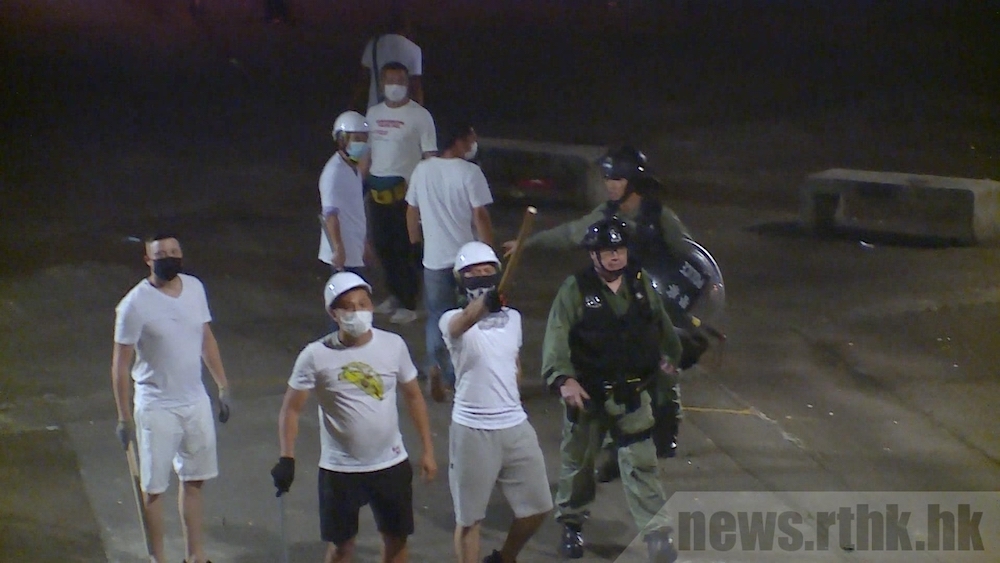
The police were not consorting with triad members in attacks on pro-democracy protesters and random members of the public. Instead they were forcing the naughty triad types to go home. Anyone who cannot see the police actively pushing those ‘white shirts’ away hasn’t watched the video footage closely enough. The police didn’t take their names — despite the men being armed — because… err, well, that bit we haven’t come up with a cunning answer to yet. The main thing is that everyone agrees that there should not be an independent enquiry because we all trust the Hong Kong police and Carrie Lam.

Here is some ridiculous mis-reporting of the issue by more of those terrible journalists, in this instance ones who work for the Hong Kong equivalent of the BBC.

Visas ‘weaponised’: Gov’t denies Hong Kong Free Press editor a work visa, without explanation, after 6-month wait


Hong Kong Free Press has been denied a work visa for an established journalist following an almost 6-month wait. The Immigration Department’s rejection for HKFP’s incoming editor Aaron Mc Nicholas was handed down without any official reason on Tuesday, raising further concerns for the business community and the city’s press freedom in light of the new security law.

The news comes weeks after New York Times journalist Chris Buckley was forced to leave the city after being denied a visa without reason amid a tit-for-tat dispute between Washington and Beijing. The US newspaper subsequently shifted a third of their local workforce to South Korea.

Editor-in-chief Tom Grundy said that many other news outlets remain in limbo amid unprecedented visa delays, and a pattern had now emerged: “We are a local news outlet and our prospective editor was a journalist originally from Ireland, so this is not another tit-for-tat measure under the US-China trade dispute. It appears we have been targeted under the climate of the new security law and because of our impartial, fact-based coverage.”

He said that neither the applicant, nor HKFP, had been denied a visa before: “Other sectors can expect to be subjected to a similar bureaucratic rigmarole in light of the security law. Companies are already leaving or avoiding the city for this very reason,” Grundy said. “Businesses can be assured that visa issues are now a feature, not a bug. They may decide that Hong Kong is no longer a suitable place to set up a regional headquarters or base.”

He added that HKFP would press the government to offer reasons for the denial and will consider an appeal and legal challenge. 

Work visas ‘weaponised’

A senior lawyer – who has represented a number of media organisations and journalists but did not wish to be named – said the denial of visas for two respected journalists in such a short time was “unprecedented and deeply concerning.”

“This strongly indicates that the Hong Kong authorities, like those in the PRC [People’s Republic of China], have now weaponised work visas as a tool to control the reporting of Hong Kong affairs by international and local media, as well as silence free speech for all those needing a visa,” he said.

“Press freedom in Hong Kong has been under attack since the Victor Mallet case in late 2018. These actual and de-facto denial of visas for journalists since the national security law indicates how far and how fast the authorities are prepared to degrade press freedom in Hong Kong,” he added, referring to visa delays.

In an emailed response to HKFP on Tuesday, a spokesperson for Immigration did not state why the visa was denied: “Hong Kong has always adopted a pragmatic and open policy on the employment of professionals in Hong Kong, allowing those possessing special skills, knowledge or experience of value to and not readily available in Hong Kong to apply to come to work, including journalistic work,” they said. They added that each case was processed in accordance with the law.

‘Against press freedom’

The Committee to Protect Journalists’ Asia Programme Coordinator Steven Butler told HKFP that the incident undermined the city’s free status: “Denial of a work visa to a thriving local news operation bashes the most basic promise of press freedom given repeatedly by the Hong Kong government. It also severely undermines Hong Kong’s status as an international city and financial centre, which cannot flourish unless journalists are free to do their work.”

Meanwhile, in a statement, Reporters Without Borders’ East Asia chief Cédric Alviani told HKFP that months-long delays were highly unusual: “The Hong Kong government must revert this decision that clearly goes against press freedom, a principle enshrined in the Basic Law.”

The Hong Kong government must revert this decision that clearly goes against press freedom, a principle enshrined in the Basic Law”, Alviani said adding the the rejection is another sign of the decline in press freedom following the implementation of the security law whereby “the Beijing regime allows themselves to directly intervene on the territory.” He also cited the arrest of pro-democracy media tycoon Jimmy Lai this month, and the raid on the Apple Daily offices.

6-month delay

News outlets such as the Wall Street Journal, New York Times and South China Morning Post have also reportedly suffered months-long delays in a process that normally takes a few weeks. Despite the Covid-19 pandemic, HKFP knows of visas for professionals in other industries that have been processed within reasonable time-frames.

Local media reported earlier this month that visas for journalists are now being vetting by a new national security unit within the Immigration Department. When asked about the unit last week, Immigration did not answer directly or deny its existence, but a spokesperson said that visas were processed by the Visa and Policies Branch.

Earlier this month, the Foreign Correspondents’ Club said that highly unusual processing delays have “affected journalists of multiple nationalities and in some cases have prevented journalists from working.” It has yet to receive a response to its latest letter demanding an explanation.

Jodi Schneider, president of the press club, told HKFP on Wednesday that they were closely following the issue: “This is obviously a key concern for the media working in Hong Kong. It is a press freedom issue.”

More:

I just ordered a new board game about Hong Kong police corruption via Kickstarter. It was inspired by the legendary Hong Kong police corruption of the 1960s and early 1970s. But maybe the game is relevant today? Let’s hope it arrives! Billionaire Seargeant is sold here.